The Wedge: How Discord Got Its First Customers
Discord got its first users by taking free voice-and-text chat directly into online gaming communities: Jason Citron and Stan Vishnevskiy's studio Hammer & Chisel had built low-latency voice technology for its own mobile game, Fates Forever, and when the game failed to find an audience, they relaunched in 2015 around the chat itself — seeding it through Reddit gaming threads where the team joined early servers' voice channels to talk with users directly.
The wedge was aimed at a pain every online gaming group already knew by name: TeamSpeak and Mumble required renting and configuring a server, Skype was heavy and call-shaped rather than community-shaped, and nothing existing combined persistent text channels with reliable low-latency voice in a link anyone could click.
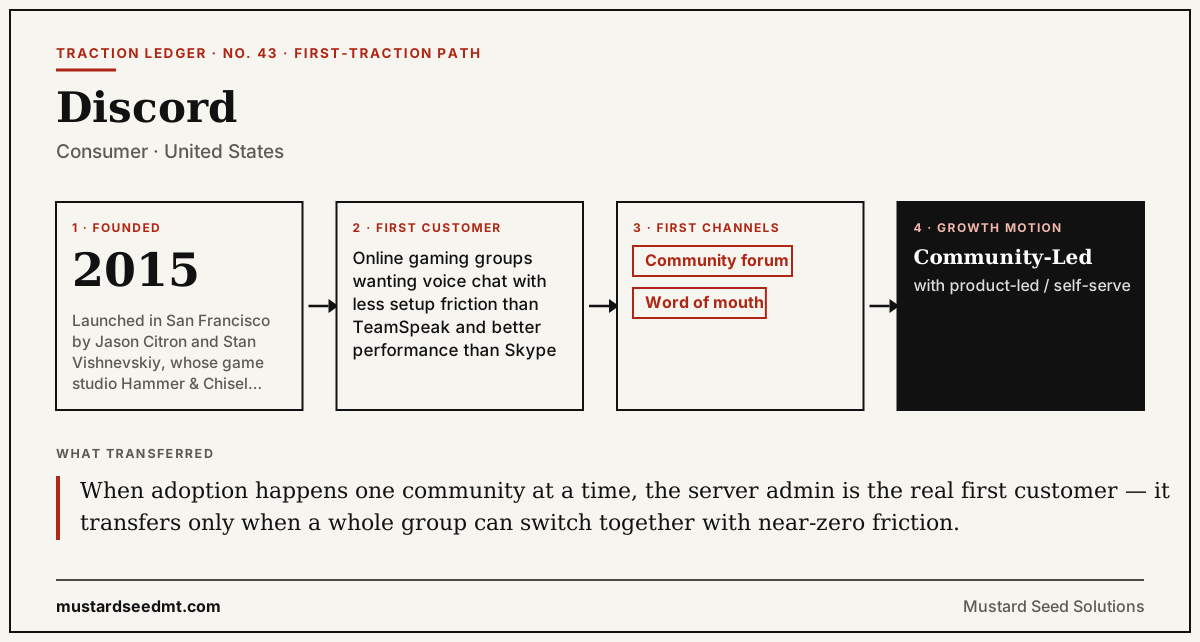
Launched in San Francisco by Jason Citron and Stan Vishnevskiy, whose game studio Hammer & Chisel pivoted after its game Fates Forever failed to find an audience (2015).
Discord's First Channel
The first channel was existing gaming communities on Reddit and in team chat groups, approached where they already gathered rather than through any owned channel — the widely retold launch story has early traction arriving after a Discord invite link was posted into a subreddit gaming thread and the developers hung around in voice chat answering questions from whoever joined.
The channel worked because Discord's unit of adoption was a group, not an individual. A server admin who adopted Discord moved an entire community's conversation with them, so each successful conversion delivered dozens or hundreds of users at once — and because joining required only clicking an invite link, even in a browser with no install, the switching cost for the invited members rounded to zero.
The Motion: Community-Led
The core motion was community-led adoption compounded by a free product with no monetization at launch at all: growth was the entire early agenda, and the absence of ads or paywalls was itself part of the pitch to communities burned by the alternatives' economics.
Within each adopted community, the product's mechanics did the retention work — persistent channels meant the community's history and social graph accumulated inside Discord, making each server stickier the longer it ran. Between communities, gamers who belonged to several groups carried the product from one to the next, the same lateral spread pattern that moved Slack between companies, operating here between guilds and clans.
Monetization arrived deliberately late and deliberately cosmetic: the Nitro subscription sold perks and personalization rather than gating the core product, protecting the free, frictionless adoption loop the whole motion depended on.
The Turn
The company's existence was already a turn — game studio to communications product, with the failed game's infrastructure becoming the actual asset. The go-to-market turn came later: by 2020 Discord formally broadened its positioning from a gamers' tool to "your place to talk," a home for communities of every kind — study groups, hobbyists, creators — ratifying a widening that its users had begun on their own years earlier.
Era: 2015+
Where It Ended Up: Private; still independent
What Transferred
"When adoption happens one community at a time, the server admin is the real first customer — it transfers only when a whole group can switch together with near-zero friction."
Sources
Related Entries
GitLab
A self-hosted, open-source alternative to GitHub, built by a distributed team from day one.
Open-source repoHashiCorp
Open-source infrastructure tools that developers adopted years before HashiCorp sold anything.
Open-source repoMongoDB
A flexible-schema database open-sourced for web developers frustrated with rigid relational databases.
Open-source repo