
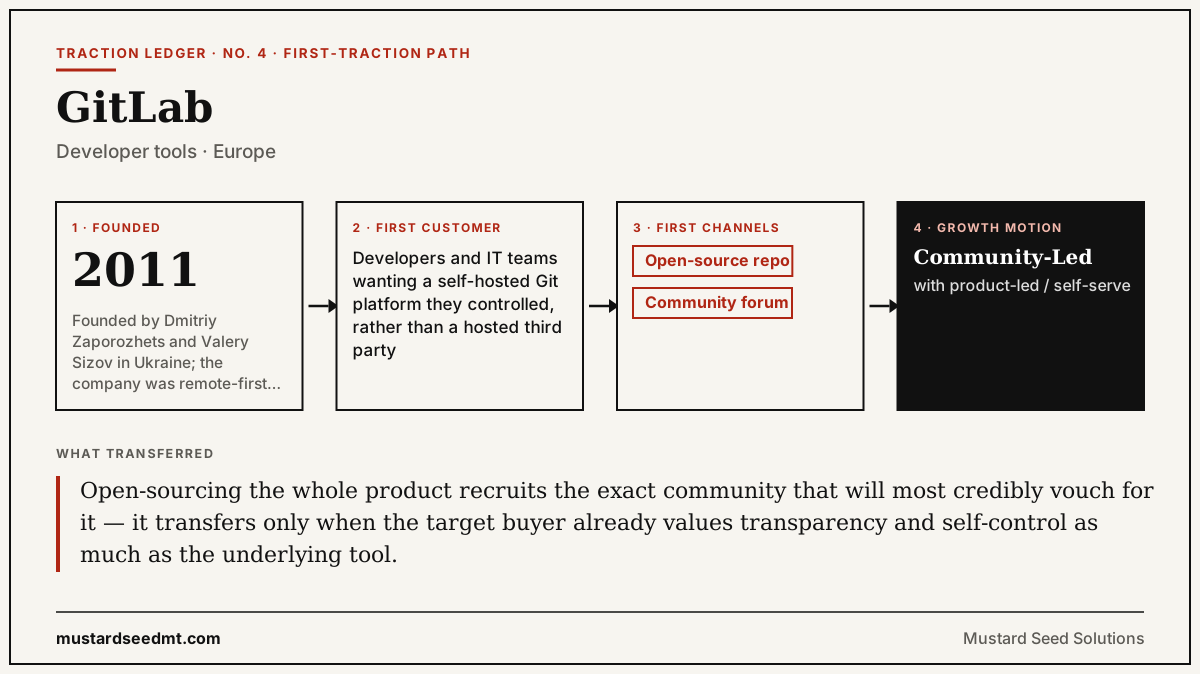
The Wedge: How GitLab Got Its First Customers
GitLab got its first users by publishing its own source code and letting developers who wanted control over their Git infrastructure — rather than depending on a third-party host — adopt, self-host, and contribute to it directly. Dmitriy Zaporozhets built the original project to solve his own team's need for a self-managed alternative to hosted Git services.
The earliest adopters were exactly the population who cared enough about hosting their own code, on their own servers, to accept the extra operational work that entailed — often regulated industries, security-conscious teams, and open-source-native developers uncomfortable depending on a single hosted provider.
Founded by Dmitriy Zaporozhets and Valery Sizov in Ukraine; the company was remote-first from its earliest days (2011).
GitLab's First Channel
The channel was the open-source project itself, distributed through its own public repository and the broader open-source community's forums and mailing lists, where developers evaluating self-hosted alternatives to GitHub would find and try it directly.
Because GitLab's own team and processes were fully public and remote-first from the start, the company's transparent way of working became its own credibility signal inside the developer community it was recruiting from — the product and the company's public operating style reinforced each other.
The Motion: Community-Led
The free, open-source Community Edition was the acquisition mechanism: any team could download, self-host, and use it without ever speaking to a salesperson, which matched exactly how its target ICP wanted to evaluate infrastructure software.
The paid Enterprise Edition layered on top of the same codebase, adding features aimed at larger organizations (advanced permissions, compliance, support) — so the free tier proved the product and the paid tier monetized the organizations that outgrew self-support.
As adoption grew, GitLab broadened the product surface from source control alone into continuous integration, security scanning, and project management inside one application, positioning the whole suite as a single DevOps platform rather than a collection of point tools.
The Turn
The turn was the shift from "self-hosted GitHub alternative" to "the DevOps platform" — a repositioning that widened the addressable market considerably beyond developers who specifically wanted to avoid a hosted Git provider, into any organization wanting to consolidate its software delivery toolchain.
Era: 2005-2014
Where It Ended Up: Public (Nasdaq: GTLB) since 2021
What Transferred
"Open-sourcing the whole product recruits the exact community that will most credibly vouch for it — it transfers only when the target buyer already values transparency and self-control as much as the underlying tool."
Sources
Related Entries
Twilio
SMS and voice as an API — pay per call, no sales conversation required.
Hacker NewsGitHub
Git hosting that made open-source collaboration social, starting with the Ruby community.
Open-source repoHashiCorp
Open-source infrastructure tools that developers adopted years before HashiCorp sold anything.
Open-source repo