
The Wedge: How HashiCorp Got Its First Customers
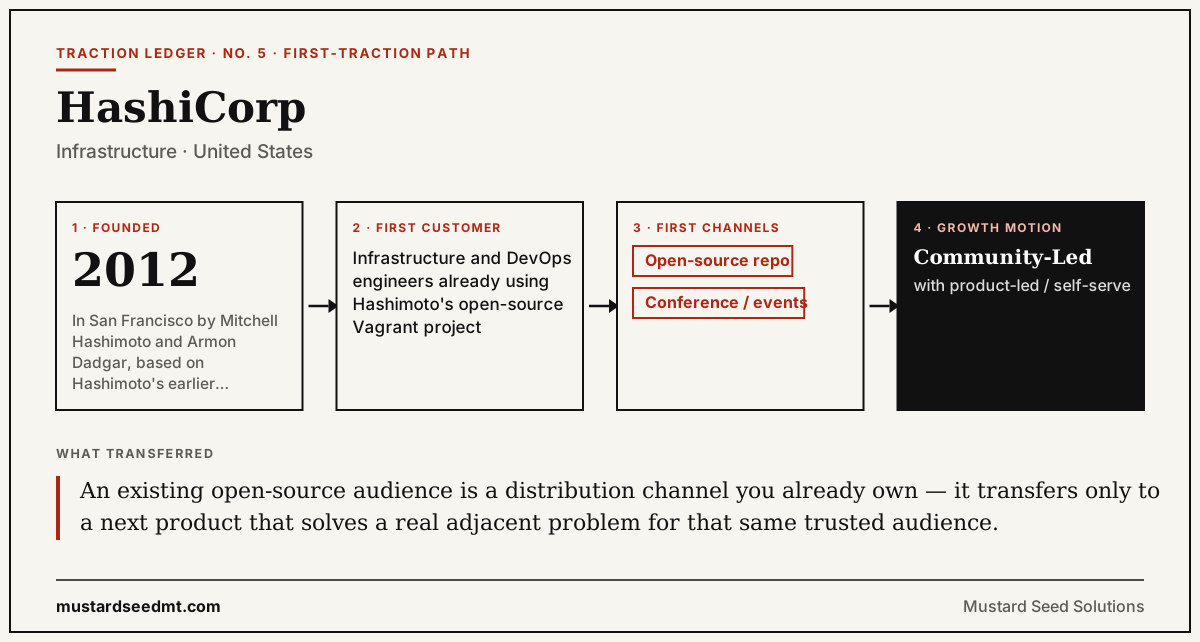
HashiCorp got its first commercial customers from a population that already existed before the company did: the large open-source user base of Vagrant, a developer-environment tool Mitchell Hashimoto built and released years before HashiCorp was founded as a company. The wedge wasn't a sales pitch — it was the credibility and reach that came from already being useful, for free, to thousands of engineers.
The first paying relationships came from that same population once HashiCorp released Terraform and other infrastructure tools that solved adjacent, more consequential problems (provisioning cloud infrastructure, managing secrets) for teams who already trusted the founders' earlier open-source work.
Founded in San Francisco by Mitchell Hashimoto and Armon Dadgar, based on Hashimoto's earlier open-source project Vagrant (2012).
HashiCorp's First Channel
The channel was entirely the open-source ecosystem: releasing tools publicly, presenting at infrastructure and DevOps conferences, and letting adoption spread through the same developer community that had already adopted Vagrant.
This worked because infrastructure engineers evaluate new tools primarily through trust in the people and track record behind them, and Hashimoto's public open-source history did that credibility-building work before any commercial conversation began.
The Motion: Community-Led
The commercial model followed an "open core" pattern: each tool (Terraform, Vault, Consul, Nomad) shipped a fully functional free, open-source version, with paid enterprise editions adding features aimed at large organizations — governance, high availability, dedicated support.
This let engineers adopt tools individually and bottom-up, without needing budget approval, while the paid tier monetized the same tools once an organization depended on them widely enough to need enterprise-grade guarantees.
As the tool suite grew, HashiCorp increasingly sold the combination — provisioning, secrets, networking, and orchestration together — as a single infrastructure platform story to larger buyers, layering a more traditional enterprise sales motion on top of the original bottom-up adoption.
The Turn
The turn was moving from a single open-source tool (Vagrant) to a multi-product infrastructure suite, each new product re-using the same open-source-first adoption pattern that had worked the first time, until the combined suite was pitched to enterprises as a unified infrastructure platform.
Era: 2005-2014
Where It Ended Up: Public (Nasdaq: HCP) since 2023; acquisition by IBM announced in 2024
What Transferred
"An existing open-source audience is a distribution channel you already own — it transfers only to a next product that solves a real adjacent problem for that same trusted audience."
Sources
Related Entries
GitLab
A self-hosted, open-source alternative to GitHub, built by a distributed team from day one.
Open-source repoDocker
A container tool that went from conference lightning talk to industry standard in under two years.
Open-source repoMongoDB
A flexible-schema database open-sourced for web developers frustrated with rigid relational databases.
Open-source repo