
The Wedge: How MongoDB Got Its First Customers
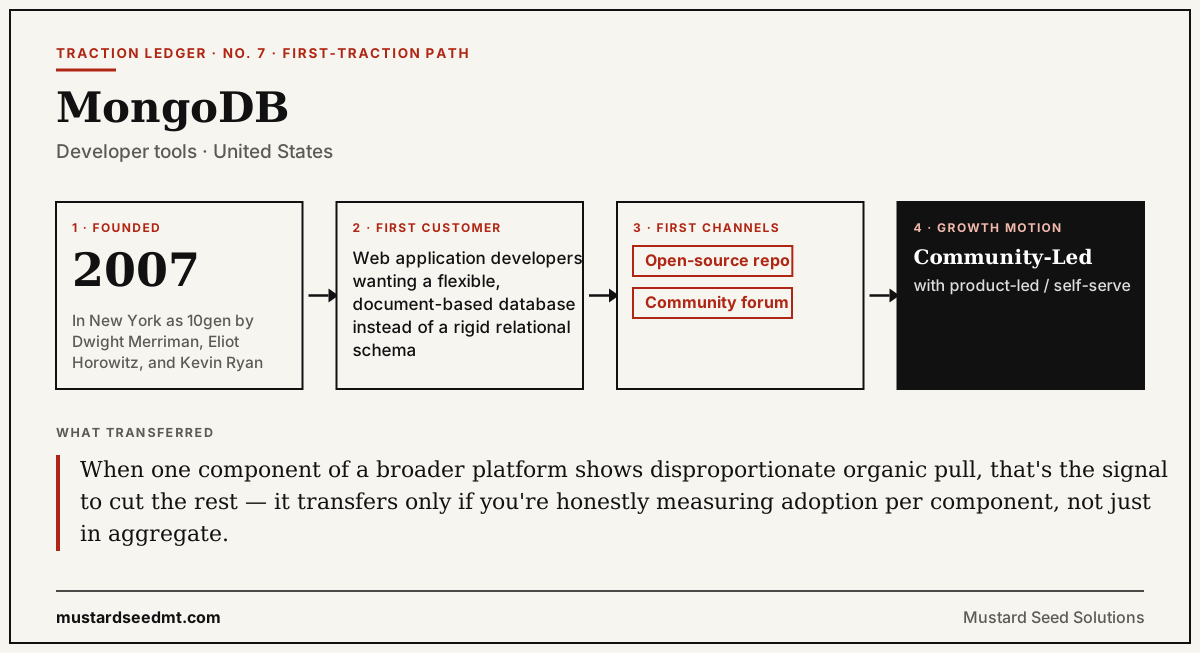
MongoDB got its first users by being downloadable, free, and immediately useful to a web developer who found relational databases too rigid for fast-changing application data. Dwight Merriman and Eliot Horowitz built the original database as one component of a broader application platform their company, 10gen, was developing.
It became clear quickly that the database component itself was generating far more organic interest and adoption than the rest of the platform — developers were downloading and using MongoDB specifically, on its own, independent of the other tools 10gen had built around it.
Founded in New York as 10gen by Dwight Merriman, Eliot Horowitz, and Kevin Ryan (2007).
MongoDB's First Channel
The channel was the open-source project's own distribution: a developer could download MongoDB directly, run it locally, and start building without any commercial conversation, discovering it primarily through developer forums, conference talks, and word of mouth inside the web development community.
Because the database solved a specific, widely felt frustration (rigid schemas slowing down fast iteration), developers self-selected into trying it based on that pain point alone, without needing a case made to them by a salesperson.
The Motion: Community-Led
The company open-sourced the database core and monetized around it — first through paid enterprise support and features, and later through a fully managed cloud database service, MongoDB Atlas, which converted the same self-serve adoption motion into a recurring, usage-based subscription.
This let individual developers and small teams adopt MongoDB with zero procurement friction, while Atlas gave the company a scalable, high-margin business built on top of an already-adopted open-source core rather than requiring a new sales motion to introduce the database itself.
As the customer base matured from individual developers to large organizations, direct enterprise sales layered on top for support contracts and Atlas commitments, but the entry point — a free download solving a specific developer pain point — never changed.
The Turn
The turn was organizational focus: 10gen dropped its broader application-platform ambitions once it was clear the database itself was the real product-market fit, eventually renaming the company MongoDB Inc. to match the product that was actually driving adoption.
Era: 2005-2014
Where It Ended Up: Public (Nasdaq: MDB) since 2017
What Transferred
"When one component of a broader platform shows disproportionate organic pull, that's the signal to cut the rest — it transfers only if you're honestly measuring adoption per component, not just in aggregate."
Sources
Related Entries
Twilio
SMS and voice as an API — pay per call, no sales conversation required.
Hacker NewsGitHub
Git hosting that made open-source collaboration social, starting with the Ruby community.
Open-source repoGitLab
A self-hosted, open-source alternative to GitHub, built by a distributed team from day one.
Open-source repo