
The Wedge: How Duolingo Got Its First Customers
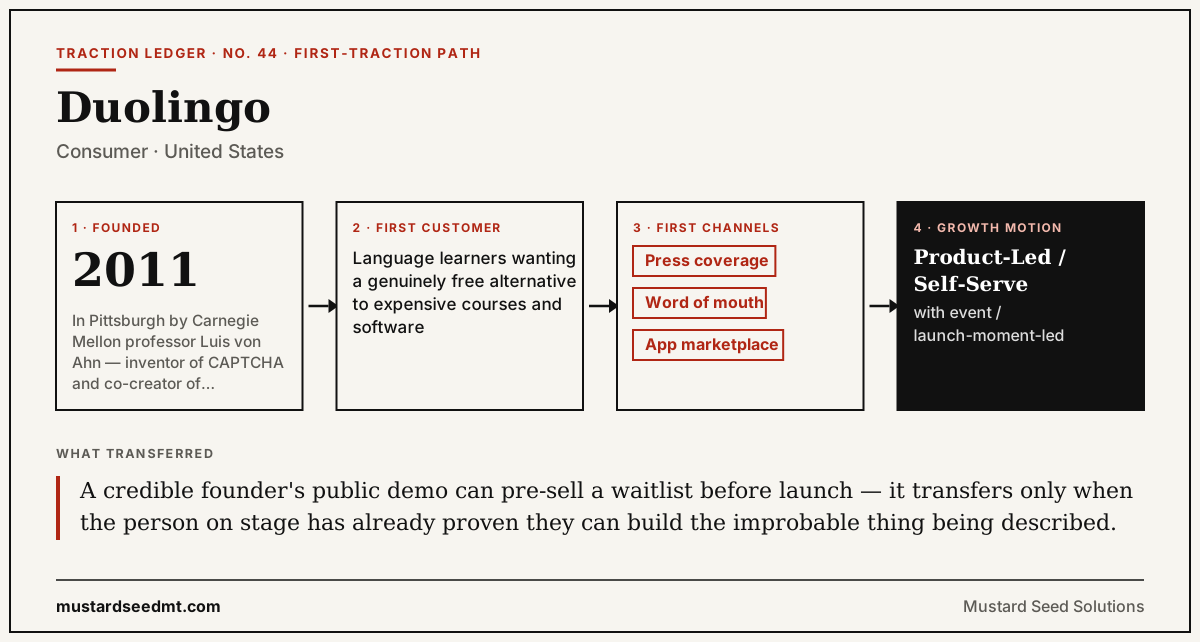
Duolingo got its first users from a waiting list generated by a talk: founder Luis von Ahn — the Carnegie Mellon professor behind CAPTCHA and reCAPTCHA — described the idea of learning a language while translating the web in a 2011 TED talk, and roughly three hundred thousand people signed up to try the private beta before the product publicly launched in 2012.
The credential did real work in that mechanism. Von Ahn had already proven, with reCAPTCHA, that millions of people's small efforts could be aggregated into commercially valuable work as a by-product of something they were doing anyway — reCAPTCHA had been acquired by Google — so when he and his PhD student Severin Hacker proposed the same logic for language learning, the audience had reason to believe the improbable-sounding pitch. The consumer-facing promise was simpler and sharper: real language education, genuinely free, in a market anchored by expensive incumbents.
Founded in Pittsburgh by Carnegie Mellon professor Luis von Ahn — inventor of CAPTCHA and co-creator of reCAPTCHA — and his PhD student Severin Hacker (2011).
Duolingo's First Channel
The first channel was earned attention around a single moment — the TED talk and the press coverage that followed it — converted into a waitlist rather than left as applause. The waitlist mattered: it banked the spike into an owned asset the company could draw down deliberately at launch, rather than needing the attention and the product to peak on the same day.
After launch, distribution shifted to the app stores, where Duolingo's polish and its free-with-no-catch model made it a natural editorial pick — Apple named it iPhone App of the Year in 2013 — and to word of mouth, which a free product with visible streaks and shareable progress is unusually well built to generate.
The Motion: Product-Led / Self-Serve
The scaled motion was product-led in the consumer register: a free, aggressively gamified app — streaks, hearts, leaderboards, a persistent owl — engineered around daily habit formation, where retention itself was the growth engine because a retained learner both compounds usage and recruits others.
The founding economics inverted the category's norm. Instead of charging learners, the plan was to fund free education by selling the translations learners produced as practice, with media companies as the paying side — an ingenious structure that made "free forever" credible from day one, whatever its eventual fate as a business line.
App-store featuring compounded the loop: each round of editorial recognition delivered installs at zero marginal cost, the gamification retained them, and the growing daily-active base made the next feature placement more likely.
The Turn
The turn was the business model, not the audience: the crowdsourced-translation revenue line was wound down in the mid-2010s when it proved unable to carry the company, and monetization moved to advertising and an optional premium subscription layered over the same free product. The learner-facing promise — free language education — survived the turn intact, which is precisely why the audience did too.
Era: 2005-2014
Where It Ended Up: Public (Nasdaq: DUOL) since 2021
What Transferred
"A credible founder's public demo can pre-sell a waitlist before launch — it transfers only when the person on stage has already proven they can build the improbable thing being described."
Sources
Related Entries
Twilio
SMS and voice as an API — pay per call, no sales conversation required.
Hacker NewsGitHub
Git hosting that made open-source collaboration social, starting with the Ruby community.
Open-source repoDatadog
Unified monitoring for DevOps teams juggling too many separate dashboards.
Webinars