
The Wedge: How Gumroad Got Its First Customers
Gumroad got its first users from a single Hacker News post. Sahil Lavingia, then nineteen and working as an early designer at Pinterest, wanted to sell one pencil icon for a dollar and found that setting up somewhere to sell it would take longer than drawing it had. He built the smallest possible fix over a weekend and posted it the following Monday morning; by reported accounts more than fifty thousand people looked at it in the first day.
The wedge was a single link. Every existing option asked a creator to build a store — a catalogue, a checkout, a shipping model, an account somebody had to configure — and Gumroad replaced all of it with a URL that took money and delivered a file. The product was defined by what it refused to do, which is why it could be explained in one sentence on a forum and understood without a demonstration.
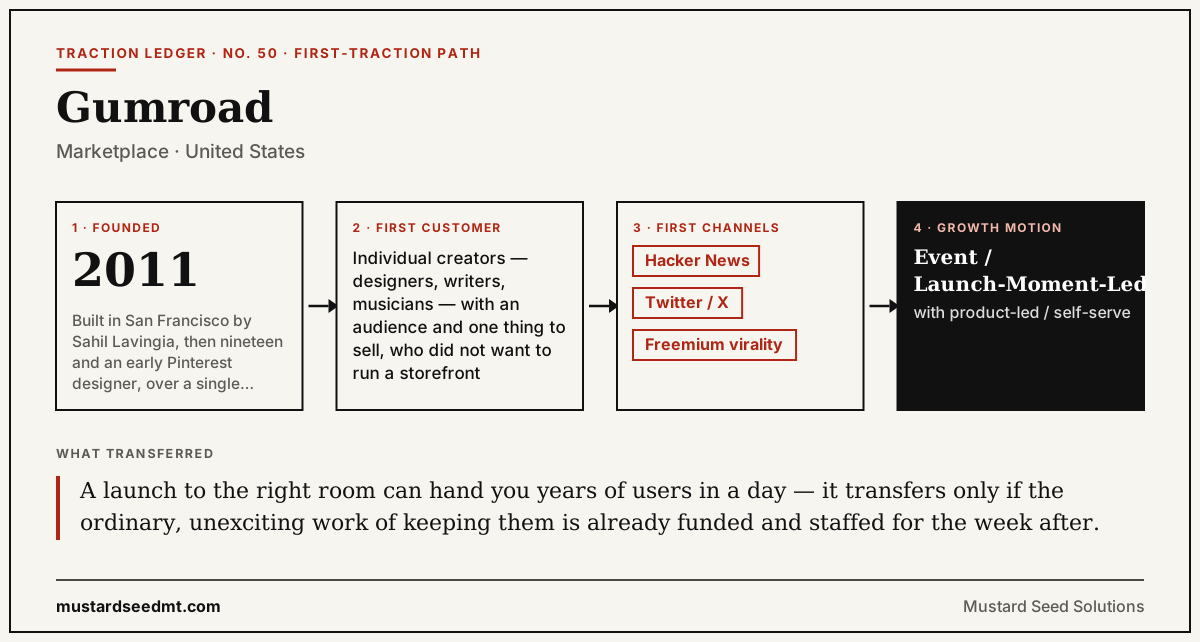
Built in San Francisco by Sahil Lavingia, then nineteen and an early Pinterest designer, over a single weekend as a side project (2011).
Gumroad's First Channel
The first channel was a launch moment aimed at a specific room. Hacker News in 2011 was full of designers and developers who both understood the problem instantly and had finished files sitting on their hard drives they had never bothered to sell — an audience that could act the same afternoon, which is the property separating a useful launch from a merely popular one.
The channel underneath was the checkout page. Because a Gumroad link is sent by the creator to their own audience, every sale put the product in front of buyers who had not chosen it and needed to be persuaded of nothing — and some fraction of any creator's audience is also a creator. Gumroad's growth was carried by other people's marketing, which is the structural advantage of being the invisible layer under someone else's transaction, and equally its ceiling: the company grows only as fast as its creators do.
The Motion: Event / Launch-Moment-Led
The spike was not the motion, and this entry is instructive because the company said so afterwards. Fifty thousand visitors in a day produced a large number of signups and a much smaller number of people who ever sold anything, and the ordinary work that followed — payouts, reliability, fraud handling, file delivery — is what converted the attention into a business over the following years.
The commercial model made adoption nearly costless: no monthly fee, no setup, a share of each sale. A creator with nothing to sell yet lost nothing by having an account, which is why the free-to-start base accumulated far ahead of revenue, and why the revenue, when it came, concentrated in a small number of creators doing real volume.
The buying audience was always someone else's. Gumroad never had to acquire buyers, only sellers — a one-sided acquisition problem inside a two-sided transaction — so its marketing targeted people who already had readers, listeners, or followers and simply had no way to charge them.
The Turn
The turn was downward, and it was published. Gumroad raised venture money, hired a team, grew quickly, and then in 2015 failed to raise its next round; it laid off nearly everyone and Lavingia continued running the product with a handful of contractors. In 2019 he wrote a detailed public account of that failure — unusually specific primary-source material for a record like this one — and the company carried on as a small profitable business, later raising from its own users in a 2021 community round. The go-to-market motion never really changed; what changed was the size of company that motion was asked to support.
Era: 2005-2014
Where It Ended Up: Private; independent, run as a small profitable company after a 2015 downsizing, with a community investor round in 2021
What Transferred
"A launch to the right room can hand you years of users in a day — it transfers only if the ordinary, unexciting work of keeping them is already funded and staffed for the week after."
Sources
Related Entries
Docker
A container tool that went from conference lightning talk to industry standard in under two years.
Open-source repoSuperhuman
An email client so exclusive it kept new users on a waitlist and onboarded them personally, one call at a time.
Word of mouthShopify
An online snowboard shop whose founders built their own ecommerce software because nothing else was good enough — then sold the software instead.
SEO / content