
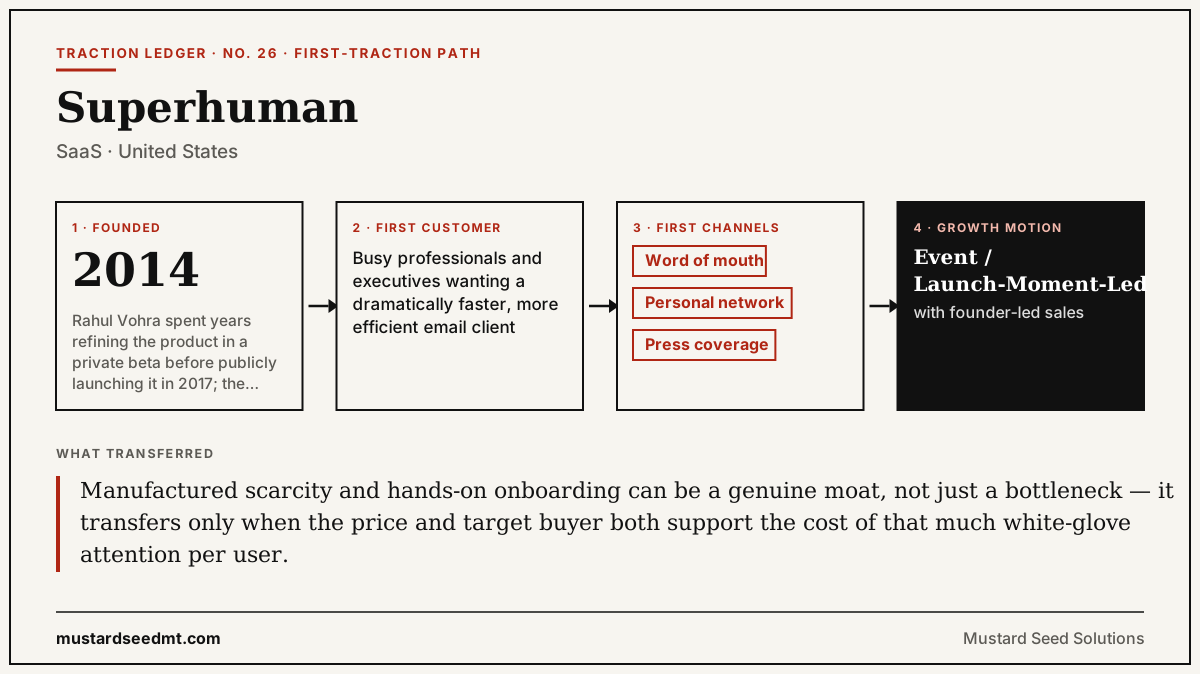
The Wedge: How Superhuman Got Its First Customers
Superhuman got its first users through a deliberately manufactured scarcity: rather than opening sign-ups broadly, Rahul Vohra maintained an invite-only waitlist and personally onboarded early users one at a time, walking each new user through the product live rather than relying on self-serve setup.
The target buyer was a specific, narrow population — busy professionals and executives who lived in their inbox and were willing to pay a premium price for real speed gains — rather than email users broadly, a narrowness the company treated as a feature of the wedge, not a limitation.
Rahul Vohra spent years refining the product in a private beta before publicly launching it in 2017; the company itself was founded in San Francisco (2014).
Superhuman's First Channel
Word of mouth among exactly the professional circles Superhuman targeted was amplified deliberately by the exclusivity of the waitlist itself — being invited became a status signal inside networks of founders, investors, and executives, which made the invitation itself worth talking about.
Press coverage of the unusual onboarding approach and the high price point reinforced this, generating attention disproportionate to the company's actual user count in its early years.
The Motion: Event / Launch-Moment-Led
Personal, founder-led onboarding calls were the core early growth mechanism, functioning simultaneously as customer success, qualitative product research, and a forcing function that kept growth deliberately slow and high-touch rather than broad and shallow.
The $30 monthly price — expensive for an email client — was a deliberate signal and filter, aimed at users who valued time savings enough to pay for it, rather than a price optimized to maximize initial signups.
Vohra publicly documented a product-market-fit measurement method built around this early cohort (asking users how disappointed they'd be without the product, then acting on the answers), turning the high-touch onboarding phase into a structured research process rather than just a scaling bottleneck.
The Turn — the motion held
The motion held. The company maintained high-touch, invite-driven onboarding well beyond what pure scaling logic would suggest, treating it as a deliberate part of the product experience and brand rather than a temporary constraint to eliminate as soon as possible.
Era: 2015+
Where It Ended Up: Acquired by Grammarly in 2025
What Transferred
"Manufactured scarcity and hands-on onboarding can be a genuine moat, not just a bottleneck — it transfers only when the price and target buyer both support the cost of that much white-glove attention per user."
Sources
Related Entries
Docker
A container tool that went from conference lightning talk to industry standard in under two years.
Open-source repoSlack
An internal messaging tool built for one gaming studio's own team, released after the game itself failed.
Personal networkZoom
Reliable video calling built by a former WebEx engineer who thought existing video conferencing was too frustrating.
Freemium virality