
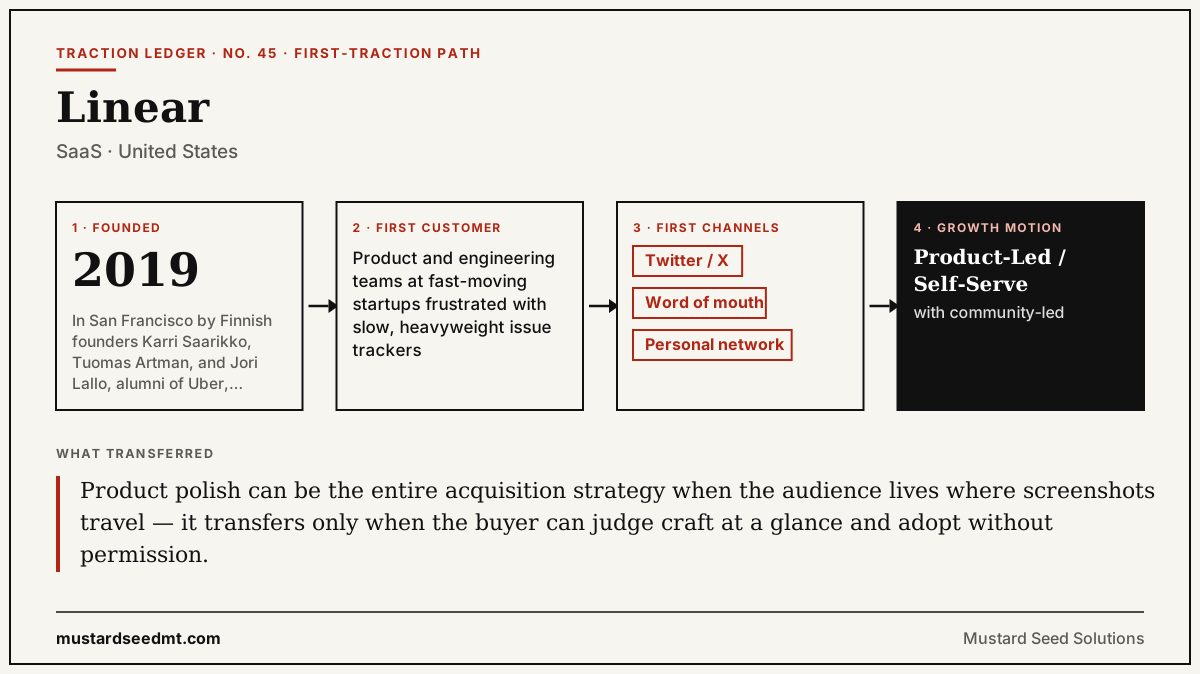
The Wedge: How Linear Got Its First Customers
Linear got its first users through an invite-only beta run off a waitlist: founders Karri Saarikko, Tuomas Artman, and Jori Lallo — alumni of Uber, Airbnb, and Coinbase — built a deliberately fast, keyboard-driven issue tracker and let startup engineers and designers ask to be let in, converting the product's own visible polish into the marketing.
The positioning was a quality argument against an incumbent everyone already used: issue tracking was a solved category dominated by Jira, and Linear's wedge was not a new capability but the claim that the daily tool could be fast, opinionated, and pleasant — a claim aimed at exactly the small product teams most likely to feel the incumbent's weight and least bound by an enterprise procurement decision.
Founded in San Francisco by Finnish founders Karri Saarikko, Tuomas Artman, and Jori Lallo, alumni of Uber, Airbnb, and Coinbase (2019).
Linear's First Channel
The first channel was startup Twitter, where the product's interface was legible enough to sell itself in a screenshot. Respected designers and engineers posting that they'd gotten access — and showing what the tool looked like — did the early distribution, and the invite-only waitlist converted that ambient admiration into a queue the company controlled.
The founders' own credibility was part of the channel: their backgrounds at Uber, Airbnb, and Coinbase signaled that the tool was built by people who had lived the problem inside high-velocity product organizations, and the company's published essays on how software should be built — later formalized as the Linear Method — gave the audience something to circulate beyond the screenshots.
The Motion: Product-Led / Self-Serve
The motion was self-serve freemium aimed at the smallest viable buying unit: a startup team could adopt Linear free, without permission from anyone, and convert to per-seat payment as the team grew — the bottom-up SaaS pattern executed with unusual discipline about who the product was for at each stage.
Craft functioned as strategy, not aesthetics: speed and polish were the differentiator in a category whose incumbent was widely resented for lacking both, which meant every hour spent on interface quality was directly an acquisition investment for an audience that judges tools by feel and shares the ones that pass.
Scarcity did quiet work in the early motion — the invite-only period kept the earliest cohort dense with exactly the opinionated early-adopter teams whose public endorsement would carry the most weight with the next cohort.
The Turn — the motion held
The motion held. Linear's product surface expanded — roadmaps, project management, features aimed at larger organizations — and its customer base moved steadily upmarket, but the entry point stayed the same: a team adopts the tool self-serve because its members want to, and the account grows from inside. No sales-led replacement of the founding motion has been the story; the founding motion scaled.
Era: 2015+
Where It Ended Up: Private; still independent
What Transferred
"Product polish can be the entire acquisition strategy when the audience lives where screenshots travel — it transfers only when the buyer can judge craft at a glance and adopt without permission."
Sources
Related Entries
Twilio
SMS and voice as an API — pay per call, no sales conversation required.
Hacker NewsGitHub
Git hosting that made open-source collaboration social, starting with the Ruby community.
Open-source repoDatadog
Unified monitoring for DevOps teams juggling too many separate dashboards.
Webinars