
The Wedge: How Loom Got Its First Customers
Loom got its first users by shipping a feature and discarding the product around it. Joe Thomas, Shahed Khan, and Vinay Hiremath had spent roughly a year on Opentest, a user-testing service that was not working; the one part users engaged with was the recorder that captured a tester's screen. They stripped it out, rebuilt it as a free Chrome extension called Openvid, and launched it on Product Hunt in June 2016, where around three thousand people signed up in a day — more than the previous product had accumulated in six months.
The wedge was a substitution, not a new capability. Screen recording already existed; what did not exist was recording something and having a shareable link ready the moment you stopped, with no file, no upload, and no editor in between. The product traded a paragraph of written explanation for ninety seconds of talking, and aimed that trade at a moment that occurs many times a day inside any company.
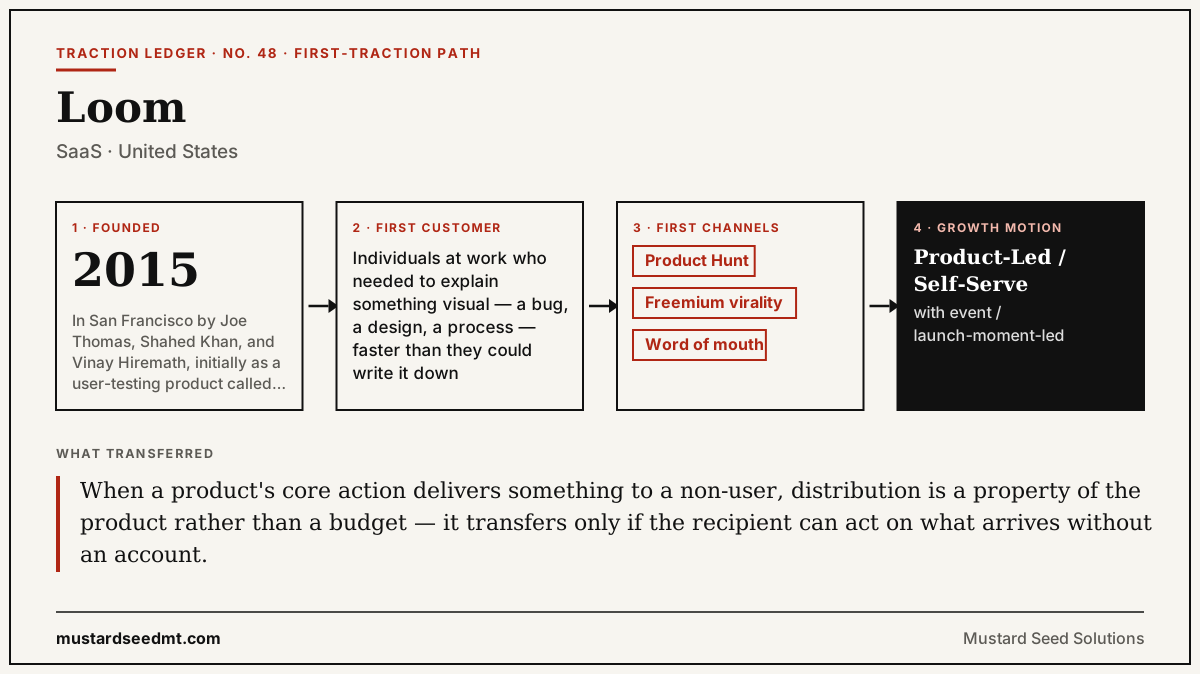
Founded in San Francisco by Joe Thomas, Shahed Khan, and Vinay Hiremath, initially as a user-testing product called Opentest (2015).
Loom's First Channel
The first channel was a launch moment chosen when the company had almost nothing left to spend. Product Hunt's audience in 2016 was disproportionately made of the exact people who would use a screen recorder for work — founders, designers, engineers, product managers — so the placement was a match rather than merely exposure, which is the difference between a launch that converts and a launch that trends.
The channel that made it durable was the artifact itself. Every Loom recording is sent as a link to someone who is usually not a Loom user, and that recipient watches it on a Loom page with an obvious way to make their own. The product's core action was also its distribution: the company never had to buy an introduction to the second user, because the first user made it for them, repeatedly, as a byproduct of doing their job.
The Motion: Product-Led / Self-Serve
The motion was product-led with an unusually short path to value: install an extension, press record, get a link. There was no configuration worth the name, no team to convince, and no meeting to book — an individual adopted it alone and the value landed on the first use, which is the property that lets a free tool spread inside an organization without anyone deciding to buy anything.
Free was a deliberate acquisition budget rather than an absent business model. Loom stayed free for individuals well past the point it could have charged, on the reasoning that every recording sent was an impression on a non-user, and that tightening the free tier would have throttled the exact loop doing the marketing.
Monetization then followed the shape the loop had already produced. The paid product was built for the team those individual users were already inside — admin controls, shared libraries, analytics, security review — so a commercial conversation typically started at a company where hundreds of employees were already sending Looms, rather than with a stranger who had to be persuaded of the category.
The Turn
There were two turns, and only the second was a choice rather than a rescue. The first was survival: abandoning Opentest for the recorder inside it, which is how the company found a product at all. The second was converting a beloved free tool into a paid one — building team and enterprise tiers on top of a base that had adopted Loom precisely because it cost nothing, which is the harder of the two and the one most free-first products never complete. That transition is what made the company acquirable; Atlassian bought Loom in 2023 to fold asynchronous video into its own work-management suite.
Era: 2015+
Where It Ended Up: Acquired by Atlassian in 2023
What Transferred
"When a product's core action delivers something to a non-user, distribution is a property of the product rather than a budget — it transfers only if the recipient can act on what arrives without an account."
Sources
Related Entries
Twilio
SMS and voice as an API — pay per call, no sales conversation required.
Hacker NewsGitHub
Git hosting that made open-source collaboration social, starting with the Ruby community.
Open-source repoDatadog
Unified monitoring for DevOps teams juggling too many separate dashboards.
Webinars