
The Wedge: How Notion Got Its First Customers
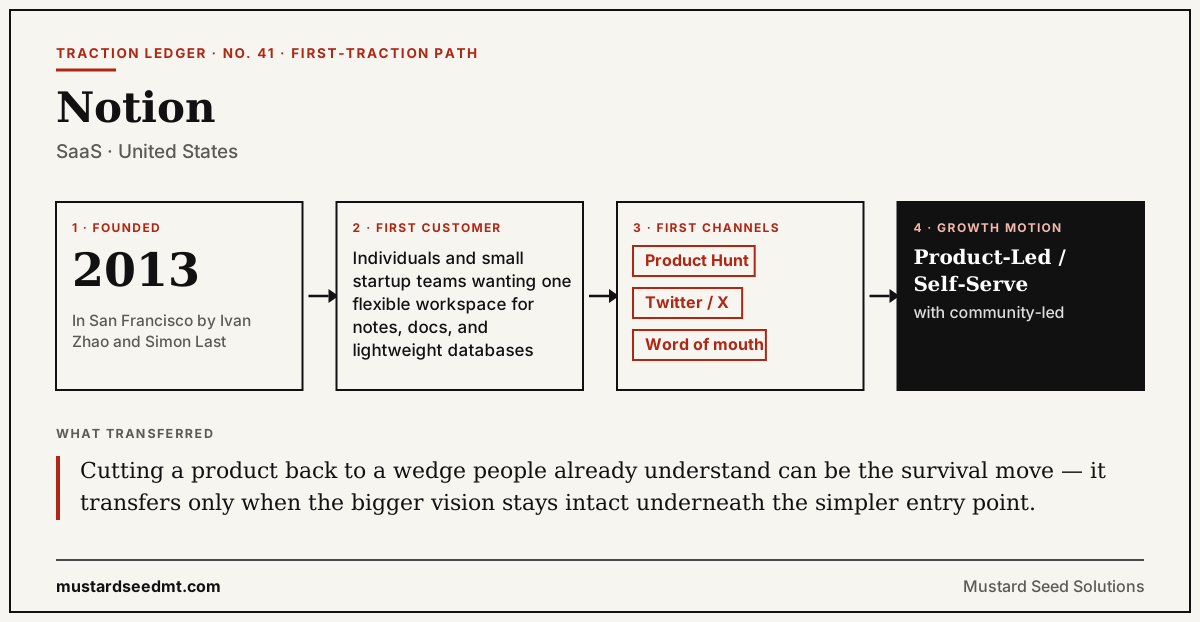
Notion got its first real user base only after a near-death rebuild: founders Ivan Zhao and Simon Last let their small team go in 2015, moved to Kyoto to rewrite the product from scratch, and relaunched a document-first workspace whose Product Hunt debuts — Notion 1.0 in 2016 and Notion 2.0 in 2018 — brought in the early adopters who became its first paying customers.
The original 2013 vision — a tool that would let anyone build software without code — was too abstract for the market it was pitched to, and the first product built toward it didn't find an audience. The rebuilt version led with something people already understood and were already shopping for: notes and documents. The flexible block-and-database engine underneath survived intact; what changed was the entry point, cut back to a category a first-time visitor could place in seconds.
Founded in San Francisco by Ivan Zhao and Simon Last (2013).
Notion's First Channel
The launch channel was Product Hunt, twice. The 1.0 launch in 2016 put the rebuilt product in front of the early-adopter audience most willing to try an unproven tool, and the 2.0 launch in 2018 — which added the database features on top of documents — became one of the platform's most celebrated launches and marked the point where growth visibly compounded.
Around the launches, the product spread through productivity enthusiasts on Twitter and YouTube who shared screenshots, workspace tours, and templates. Because a Notion page is inherently visual and inherently personal, showing off a setup doubled as an advertisement for the tool, and a template someone published could be duplicated directly into a new user's own workspace — turning the community's output into onboarding material the company didn't have to write.
The Motion: Product-Led / Self-Serve
The motion was self-serve freemium: a free personal tier generous enough to genuinely live in, with payment arriving when a user wanted collaboration or a team wanted shared workspaces. No sales conversation existed anywhere in the early funnel — the product, the templates, and the community around them did the acquisition and most of the onboarding.
Templates deserve specific credit as mechanism rather than decoration: they converted the product's greatest early liability — a blank, infinitely flexible page that new users didn't know what to do with — into a distribution asset, because every shared template was simultaneously a use case, a tutorial, and an invitation.
Bottom-up team adoption followed the classic pattern: an individual adopted Notion personally, brought it into a startup as shared docs or a wiki, and the workspace expanded seat by seat without a procurement decision ever being the entry point.
The Turn
The turn came before the traction, not after it: the Kyoto rebuild was a deliberate retreat from a too-abstract wedge to a legible one, with the larger no-code vision kept intact underneath the simpler surface. After the relaunch, the motion itself held — self-serve freemium plus community — while scope expanded toward teams and, eventually, enterprises on the same entry point.
Era: 2005-2014
Where It Ended Up: Private; still independent
What Transferred
"Cutting a product back to a wedge people already understand can be the survival move — it transfers only when the bigger vision stays intact underneath the simpler entry point."
Sources
Related Entries
Twilio
SMS and voice as an API — pay per call, no sales conversation required.
Hacker NewsGitHub
Git hosting that made open-source collaboration social, starting with the Ruby community.
Open-source repoDatadog
Unified monitoring for DevOps teams juggling too many separate dashboards.
Webinars