
The Wedge: How Semrush Got Its First Customers
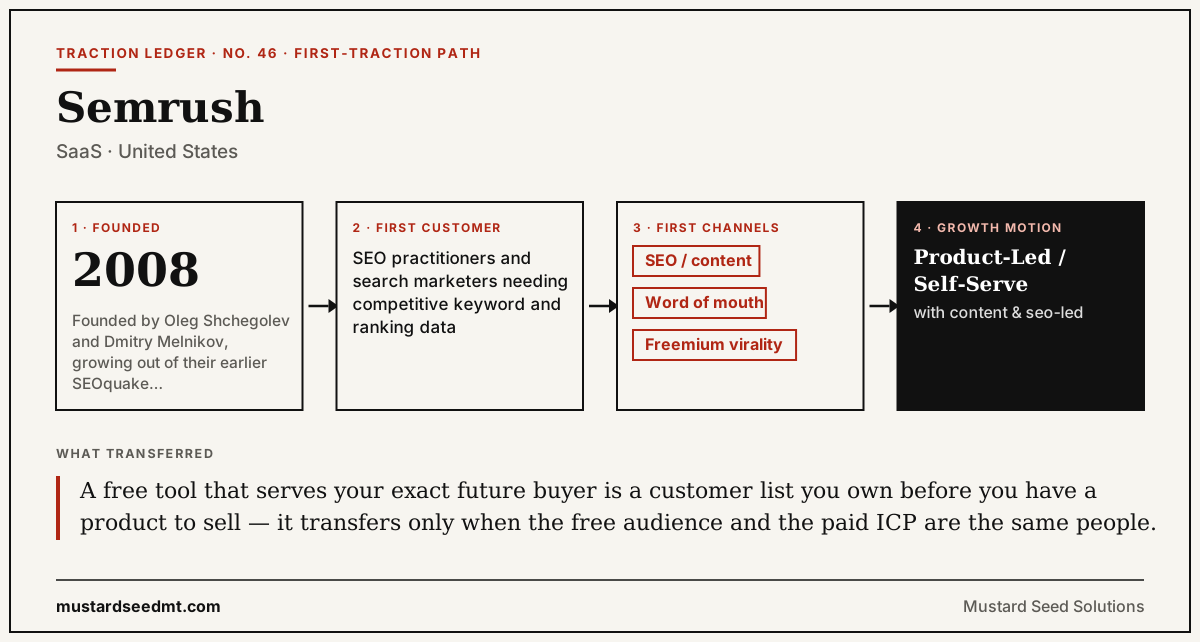
Semrush got its first customers from an audience its founders had already assembled: Oleg Shchegolev and Dmitry Melnikov built SEOquake, a free browser extension for SEO practitioners, before building the company — so when they launched a paid competitive-analytics tool, the extension's existing install base of exactly the right users became the seed market rather than a cold one.
The product wedge was competitive visibility: showing a marketer which keywords a competitor ranked for and bought ads against, at a time when that data was scattered, manual, or unavailable. The company grew for roughly its first decade without significant outside funding, a patient trajectory closer to Ahrefs' path elsewhere in this ledger than to the venture-backed norm of its era.
Founded by Oleg Shchegolev and Dmitry Melnikov, growing out of their earlier SEOquake browser-extension project, with long-time headquarters in Boston (2008).
Semrush's First Channel
The first channel was the free tool itself: SEOquake functioned as top-of-funnel long before anyone at the company would have used that phrase, putting the founders' name and competence in front of a large practitioner audience daily, inside the practitioners' own workflow, at zero marginal cost per user.
The SEO community's own habits did the rest. SEO practitioners compare tools publicly and constantly — in forums, blogs, and conference talks — as part of their professional practice, so a tool that produced genuinely differentiated data got discussed, cited in practitioners' own published analyses, and recommended between agencies without the company buying that distribution.
The Motion: Product-Led / Self-Serve
The core motion was self-serve subscription with a freemium edge: limited free access to reports let a marketer get real answers before paying, and the subscription unlocked the depth and volume a professional workflow required — a conversion path that needed no sales conversation for its core market of practitioners and small agencies.
Practitioner mobility compounded adoption structurally: SEO professionals move between agencies and in-house roles frequently, and each move carried tool preferences into a new organization — the same person could be the reason three different companies subscribed over a few years.
Content and community reinforced the loop in the manner native to this category: an SEO software company is judged partly on its own search visibility, and Semrush's blog, data studies, and free tooling marketed the product by practicing the discipline it sold, while an early affiliate program gave marketing-savvy users a direct commercial reason to recommend it.
The Turn
The turn was scope: from a keyword-and-competitor SEO tool into a broad online-visibility platform covering content marketing, advertising research, and social media management, culminating in a 2021 New York Stock Exchange listing. The mechanism underneath — self-serve subscription sold to practitioners who discovered the company through its own visibility — held throughout; what changed was how much of the marketing department the product addressed.
Era: 2005-2014
Where It Ended Up: Public (NYSE: SEMR) since 2021
What Transferred
"A free tool that serves your exact future buyer is a customer list you own before you have a product to sell — it transfers only when the free audience and the paid ICP are the same people."
Sources
Related Entries
Twilio
SMS and voice as an API — pay per call, no sales conversation required.
Hacker NewsGitHub
Git hosting that made open-source collaboration social, starting with the Ruby community.
Open-source repoDatadog
Unified monitoring for DevOps teams juggling too many separate dashboards.
Webinars