
The Wedge: How Substack Got Its First Customers
Substack got its first customer by asking one person. In October 2017 co-founder Hamish McKenzie approached Bill Bishop — a writer whose China newsletter Sinocism had a large, devoted free readership and no practical way to charge for it — and Sinocism became the first publication on the platform. By Bishop's own later account it passed six figures of annualised subscription revenue almost immediately, which functioned less as a growth statistic than as a proof, delivered publicly, that the model worked.
The wedge was not publishing software; it was the removal of a business. A writer with an audience already had the hard part — the readers and the reason they showed up — and lacked the payments, membership management, billing, and infrastructure that turning attention into income requires. Substack supplied all of it and charged nothing until the writer earned, so the pitch asked for no money, no migration risk, and no commitment beyond trying.
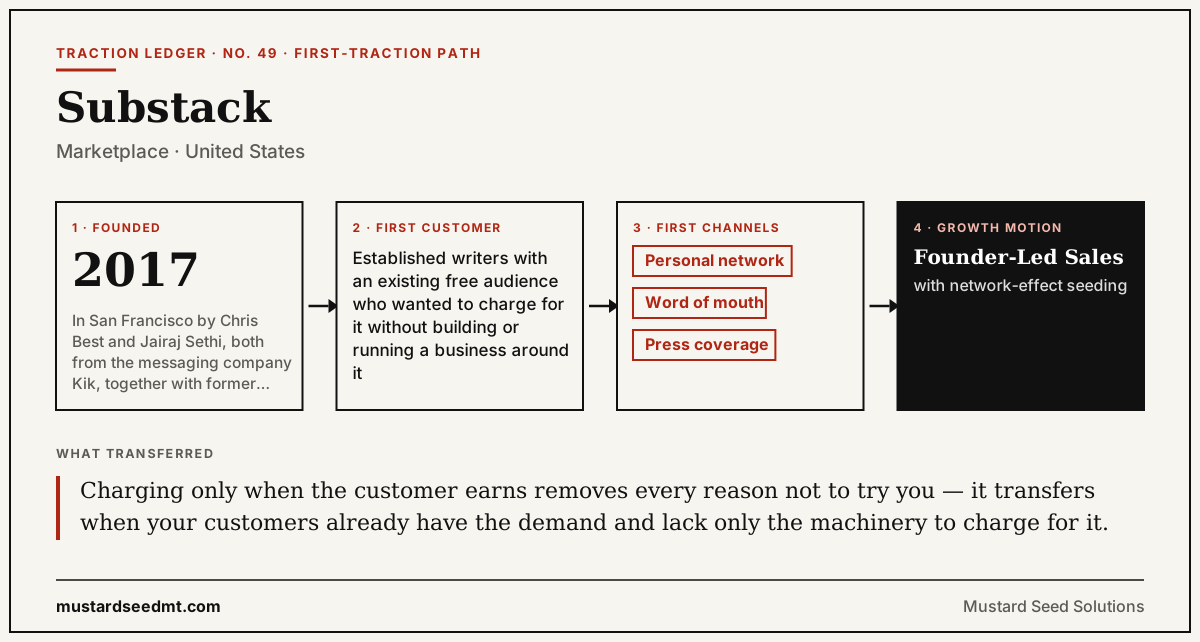
Founded in San Francisco by Chris Best and Jairaj Sethi, both from the messaging company Kik, together with former technology journalist Hamish McKenzie (2017).
Substack's First Channel
The first channel was the founders approaching individual writers, one at a time. This is founder-led sales in its purest form: a small number of high-value suppliers, each recruited in a conversation, each chosen because their existing audience meant the platform would be judged on a real publication rather than on an empty product.
After the first writers, the channel became the product's own output. Every Substack publication is a public page and an email landing in thousands of inboxes with Substack's name on it, and a meaningful fraction of any writer's readers are themselves writers. The company also made its early cohort's economics visible, publishing what leading writers earned — which recruited the next cohort more efficiently than advertising could, because the argument was arithmetic rather than persuasion.
The Motion: Founder-Led Sales
The commercial model was the motion. Taking ten percent of what a writer earns, and nothing otherwise, aligned the company with the outcome its customers cared about and removed every reason not to try it. It also imposed a constraint Substack chose deliberately: revenue could only grow if writers' revenue grew, which pointed the company's incentives at helping writers get paid rather than at extracting rent from them.
Supply was seeded before demand was courted — the pattern this ledger files under network-effect seeding. Substack concentrated on getting specific, credible writers onto the platform, including, from 2020, paying selected writers up-front advances against future subscription revenue through Substack Pro, on the correct reading that readers follow writers and that a platform with ten publications people will pay for is worth more than one with ten thousand nobody will.
Positioning did quiet work throughout. By insisting that the writer owns the list, the content, and the reader relationship — and can export it and leave — Substack drove the cost of trying it close to zero, which is precisely the objection that stops an established writer with something to lose.
The Turn
The turn was from tool to network. For its first years Substack described itself as neutral infrastructure: the writer brought the audience, Substack handled the plumbing, and the company argued publicly that it was deliberately not a social platform. From roughly 2022 it built the opposite — a reader app, a recommendation system in which writers refer each other's publications, and a social feed — because the one thing writers most want, and the one thing a hosting tool structurally cannot supply, is new readers. That shift changed what Substack sells from software to distribution, and with it the nature of the dependence a writer takes on by staying.
Era: 2015+
Where It Ended Up: Private; independent
What Transferred
"Charging only when the customer earns removes every reason not to try you — it transfers when your customers already have the demand and lack only the machinery to charge for it."
Sources
Related Entries
Stripe
Payments for developers who'd rather write seven lines of code than sign a bank contract.
Personal networkShopify
An online snowboard shop whose founders built their own ecommerce software because nothing else was good enough — then sold the software instead.
SEO / contentAirbnb
Air mattresses in the founders' own apartment during a sold-out design conference, seeded city by city afterward.
Personal network