
The Wedge: How Trello Got Its First Customers
Trello got its first users by launching in public at TechCrunch Disrupt in September 2011 and announcing itself to the developer readership Joel Spolsky had spent a decade building at his Joel on Software blog — Fog Creek Software, the company Spolsky ran with co-founder Michael Pryor, put a free, visual kanban board in front of an audience that already trusted its makers.
The product was deliberately horizontal in a way Fog Creek's earlier developer tools were not: boards, lists, and cards formed a metaphor legible to anyone in seconds, and the stated ambition from the start was a tool for organizing anything — software sprints, hiring pipelines, wedding plans — rather than a product fenced inside the developer niche its launch audience came from.
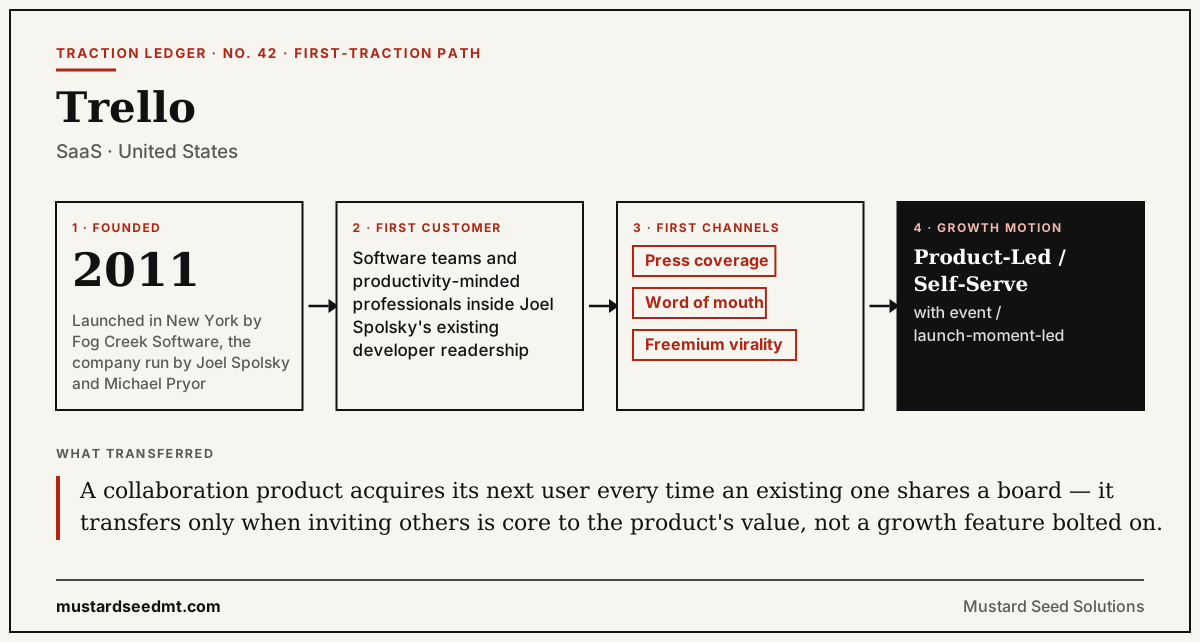
Launched in New York by Fog Creek Software, the company run by Joel Spolsky and Michael Pryor (2011).
Trello's First Channel
The first channel was a manufactured launch moment aimed at an owned audience: the Disrupt stage supplied press coverage and credibility to strangers, while Spolsky's blog announcement supplied a large, warm readership who signed up the same week because the recommendation came from a source they had read for years. Neither channel alone explains the launch working; the combination — borrowed spotlight plus owned trust — does.
What carried growth after the launch week was the product's own sharing mechanics. A Trello board is a collaborative object: using it for anything involving other people means inviting those people, and every invited collaborator arrived inside a working example of the product's value before ever seeing a marketing page.
The Motion: Product-Led / Self-Serve
The motion was product-led in its purest early form: the product was entirely free, self-serve, and spread through its own collaboration model, with the explicit strategy of growing an enormous user base first and monetizing a small fraction of it later through paid tiers — Business Class for organizations arrived well after launch.
Because each board invitation recruited a new user in the course of ordinary work, acquisition cost stayed near zero while the audience broadened beyond developers on its own — the horizontal design meant a developer's board for sprint planning could seed a spouse's board for house-hunting, a pattern no targeted marketing plan would have produced.
The free-first strategy had a known bill attached: conversion to paid came slowly and later, which was survivable inside a profitable parent company and became a deliberate bet once Trello spun out with venture funding in 2014.
The Turn
The turn was organizational and audience-shaped rather than mechanical: the motion — free, self-serve, spread by collaboration — held throughout, but the product outgrew both its developer launch audience and its parent company, spinning out of Fog Creek as an independent company in 2014 and selling to Atlassian in 2017 for a reported $425 million, by which point most of its tens of millions of users had nothing to do with software development.
Era: 2005-2014
Where It Ended Up: Acquired by Atlassian in 2017; continues as an Atlassian product
What Transferred
"A collaboration product acquires its next user every time an existing one shares a board — it transfers only when inviting others is core to the product's value, not a growth feature bolted on."
Sources
Related Entries
Twilio
SMS and voice as an API — pay per call, no sales conversation required.
Hacker NewsGitHub
Git hosting that made open-source collaboration social, starting with the Ruby community.
Open-source repoDatadog
Unified monitoring for DevOps teams juggling too many separate dashboards.
Webinars