
Weak AI brand visibility creates a risk that traditional SEO audits do not always reveal. If an AI system has little reliable information about a company, it may fill gaps using a competitor, category norm or outdated version of the brand.
The important diagnostic shift is to monitor AI outputs, not only your own website. A brand can have technically sound pages and still be represented inaccurately when buyers ask comparison, category or capability questions.
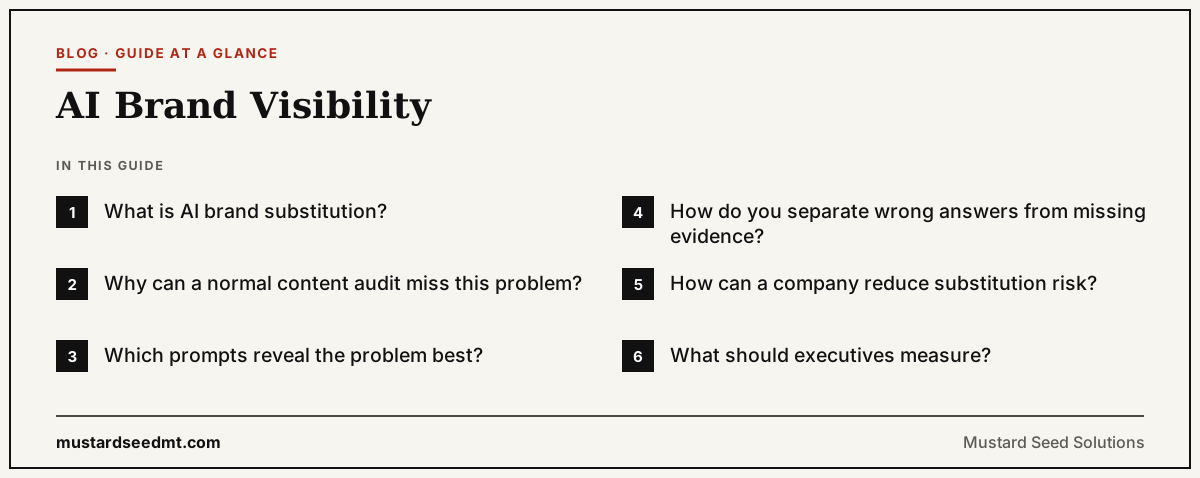
What is AI brand substitution?
Search Engine Journal contributor Duane Forrester described several forms of substitution that can appear when AI systems have thin information about a company. Examples include using a competitor's pricing model as an analogy, presenting stale information as current, treating thin evidence as consensus and applying general category knowledge to a specific brand.
The core problem is confidence. The output can sound complete even when the supporting information about the company is weak.
Read the full Search Engine Journal analysis.
Why can a normal content audit miss this problem?
A content audit examines what exists on your site: pages, headings, coverage, freshness, schema, links and technical health. Brand substitution happens in the answer an AI system generates, often using information from sources you do not control.
That means a website can pass an audit while the AI answer remains wrong, stale or borrowed from category patterns.
The solution is to add output monitoring to the audit. Ask real buyer questions across relevant AI assistants and record what each system says about the company.
Which prompts reveal the problem best?
Prompts that mention your company name directly can be misleading because the name itself gives the model a strong retrieval cue. More revealing prompts are the questions where the model has to decide whether your company belongs.
Useful test categories include:
- Category recommendation questions
- Competitor comparison questions
- Capability questions
- Pricing or implementation questions
- Best vendor questions with buyer constraints
- Questions about market, geography or industry fit
The goal is to see how the brand appears when the buyer has not already decided to ask about it.
How do you separate wrong answers from missing evidence?
Start by tracing each important claim back to a reliable source. If an AI says your product supports a capability, serves a market or follows a pricing model, ask whether that statement is clearly supported by your website or credible third party material.
Then classify the gap. Some errors require correcting owned content. Others reveal missing third party evidence, weak entity consistency or outdated external references.
This is why AI visibility should include both technical and reputation signals. Publishing one more blog post may not solve a problem caused by missing external evidence.
How can a company reduce substitution risk?
Make the company easier to understand from multiple trustworthy sources.
- Keep product and service descriptions consistent
- Publish current company and capability information
- Strengthen author and leadership entities
- Earn credible third party coverage and mentions
- Maintain accurate directory and partner profiles
- Create original research and case studies
- Monitor AI outputs for important buyer questions
- Correct stale information where you control the source
The aim is not to flood the web with repeated brand copy. It is to create enough consistent evidence that the system has less reason to guess.
What should executives measure?
Executives need a brand accuracy layer in addition to citation counts. A citation is not valuable if the answer misrepresents the company.
Track whether the brand is mentioned, how it is described, which claims are accurate, which sources are cited and which competitors appear for the same questions. Over time, this reveals where the market's machine readable understanding of the company is strong or weak.
A structured AI Visibility Audit can turn those observations into a prioritized remediation plan.