
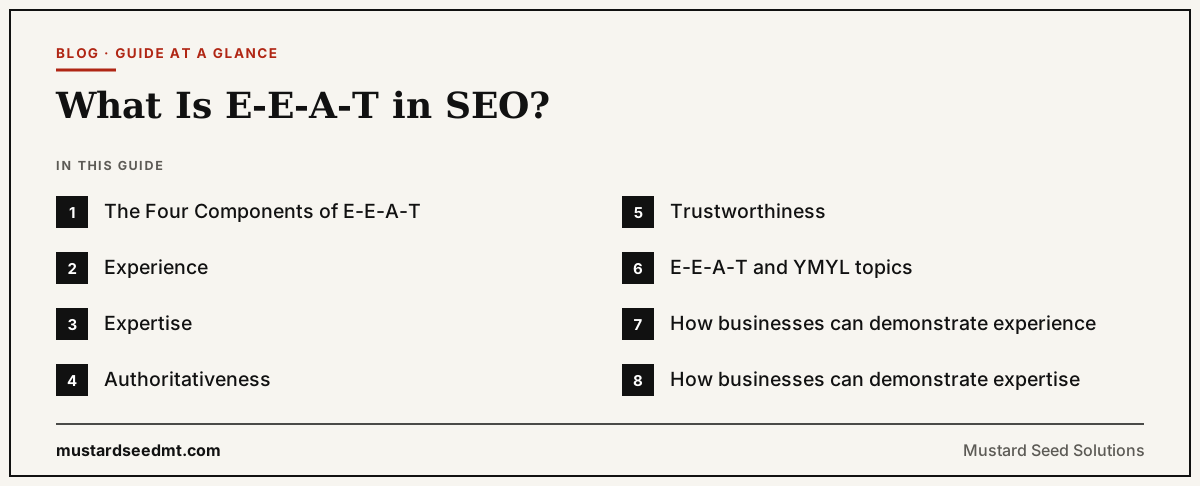
E-E-A-T stands for Experience, Expertise, Authoritativeness, and Trustworthiness.
The concept appears in Google’s Search Quality Rater Guidelines, which are used by human evaluators to assess the quality of search results and provide feedback about Google’s ranking systems.
E-E-A-T is not a technical score that website owners can view in Google Search Console. It is not a checklist where adding an author biography or several references automatically produces higher rankings.
It is a framework for thinking about whether information appears credible, useful, and appropriate for the subject.
This article explains what each part of the framework means and how businesses can demonstrate it. Whether E-E-A-T works as a ranking signal is a separate question — we cover Google’s own answer in Is E-E-A-T a Google Ranking Factor?
Google added the first E, Experience, to the earlier E-A-T framework in 2022. Google explained that some useful content depends on first hand experience, while other subjects require formal expertise.
Understanding these distinctions helps businesses create more trustworthy content without reducing E-E-A-T to superficial SEO tactics.
The Four Components of E-E-A-T
| Component | What it means | How to demonstrate it |
|---|---|---|
| Experience | First-hand or practical involvement with the subject | Case studies, described testing, photographs, original examples, screenshots, and data |
| Expertise | Knowledge or skill in a subject | Accuracy and depth, author pages with relevant qualifications, and editorial review by qualified professionals |
| Authoritativeness | The reputation of the creator, content, or website within a subject, recognised by others | Original research, citations and references from credible sources, and industry or association participation |
| Trustworthiness | Accuracy, honesty, transparency, safety, and accountability | Clear company and contact information, disclosed advertising or affiliate relationships, and correcting mistakes |
Experience
Experience refers to first hand or practical involvement with the subject.
A person reviewing a hotel may provide value because they actually stayed there.
A customer comparing accounting software may provide useful information because they used several platforms.
A mechanic explaining a recurring vehicle problem may draw on years of practical work.
Experience is particularly useful when the reader wants to understand what something is like in reality.
This does not mean personal experience is appropriate for every subject.
Someone describing their experience with a medical condition may provide emotional and practical insight, but that person may not be qualified to diagnose another patient or recommend treatment.
The required form of credibility depends on the question.
Google’s explanation of E-E-A-T makes this distinction. A software review may benefit from first hand experience, while tax filing guidance is more likely to require accounting expertise.
Expertise
Expertise refers to knowledge or skill in a subject.
It can come from formal education, professional qualifications, practical work, research, or sustained study.
The type of expertise required depends on the topic.
A licensed accountant may be an appropriate source for corporate tax guidance. A cybersecurity engineer may be appropriate for explaining a technical vulnerability. An experienced gardener may be qualified to explain how certain plants perform in local conditions.
Websites should avoid using one person as an expert on every subject.
An author who writes about finance, medicine, software engineering, and legal compliance may have professional writing ability without possessing specialist knowledge in all four fields.
This does not mean professional writers cannot create valuable content.
They can interview specialists, verify information, structure explanations, and work with qualified reviewers.
The important question is whether the final content reflects reliable knowledge.
Authoritativeness
Authoritativeness concerns the reputation of the creator, the content, or the website within a subject.
Authority is not created only by stating that someone is an expert.
It develops when other credible people and organisations recognise the source.
This recognition may appear through citations, links, professional positions, media references, industry participation, research, customer trust, or a history of useful work.
Authority is also contextual.
A respected marketing strategist may have authority in digital marketing without being an appropriate source for medical advice.
A well known hospital may have authority for health information but limited relevance to software purchasing.
Businesses should focus on earning recognition in the markets they genuinely serve.
Trustworthiness
Trustworthiness is the most important part of E-E-A-T in Google’s current explanation.
Experience, expertise, and authority can contribute to trust, but they do not replace it. Google also notes that content does not necessarily need to demonstrate every E-E-A-T component equally. The required combination depends on the purpose and subject.
Trust includes accuracy, honesty, transparency, safety, and accountability.
A product review may demonstrate experience but become untrustworthy if the author hides a paid relationship.
A qualified expert may lose trust by making unsupported claims.
A business may have strong brand authority but create distrust through hidden ownership, unclear contact information, misleading prices, or fake reviews.
Trust is not only a writing characteristic.
It reflects the wider behaviour of the website and organisation.
E-E-A-T and YMYL topics
E-E-A-T receives particular attention for subjects that can significantly affect a person’s health, financial stability, safety, or wider wellbeing.
These are often called Your Money or Your Life topics, commonly shortened to YMYL.
Examples may include medical treatment, financial decisions, legal matters, major safety questions, and information that could seriously affect society.
Google says its systems place greater weight on signals associated with strong E-E-A-T for topics where poor information could cause significant harm.
This does not mean every business blog requires a licensed professional.
It means the standard of evidence and expertise should match the possible consequences.
An article about choosing a colour palette requires a different level of verification from an article about treating a serious illness.
How businesses can demonstrate experience
Companies should show real involvement with the subjects they discuss.
Case studies can explain the problem, process, decisions, and results of actual projects.
Product reviews can describe how testing was conducted.
Service articles can include lessons from customer work, common implementation difficulties, and realistic expectations.
Photographs, original examples, screenshots, data, and detailed observations can support claims of practical experience.
The objective is not to repeatedly state, “We have experience.”
The objective is to publish information that could reasonably come from someone who has done the work.
How businesses can demonstrate expertise
Expertise should be visible through accuracy and depth.
Explain complex ideas clearly. Identify important limitations. Distinguish facts from opinions. Use appropriate sources. Review sensitive content with qualified professionals.
Author pages can include relevant experience, qualifications, professional roles, and areas of responsibility.
However, an author biography cannot rescue weak content.
A page written under the name of a qualified expert should still be accurate, useful, and properly reviewed.
Businesses should also establish clear editorial processes.
Readers may benefit from knowing who wrote the content, who reviewed it, when it was updated, and how the information was produced.
How businesses can build authority
Authority requires recognition beyond the company’s own claims.
Publish original research. Contribute expert commentary to credible publications. Participate in professional associations. Develop partnerships. Speak at relevant events. Earn references from customers and industry sources.
Useful work creates reasons for others to mention the company.
Authority can also grow through a focused content strategy.
A website that consistently publishes useful information about a defined subject is easier to understand than a website that publishes shallow articles about every popular topic.
Businesses should choose the areas where they have a legitimate contribution and build depth there.
How websites can improve trust
Trust begins with accurate information.
Clearly identify the company operating the website. Provide contact details, service terms, privacy information, and transparent commercial relationships where relevant.
Do not use fake authors, invented credentials, misleading reviews, or exaggerated results.
Correct mistakes when they are discovered.
Keep important information current, particularly when prices, laws, product features, or safety advice change.
Secure the website and protect customer information.
Make it clear when content includes advertising, affiliate relationships, sponsorship, or other incentives.
Trust grows when the organisation behaves consistently and transparently.
E-E-A-T is not an SEO decoration exercise
Businesses sometimes try to improve E-E-A-T by adding author boxes, awards, references, and badges across every page.
These elements can provide useful evidence when they are genuine.
They become meaningless when they are added mechanically.
An author box cannot create expertise that the author does not possess.
A trust badge cannot correct misleading claims.
A list of references does not prove that the article interpreted those sources accurately.
The focus should be on substance.
Who created the content? What do they know? What experience supports the claims? Is the information accurate? Can the reader identify the organisation responsible for it?
A practical way to use E-E-A-T
Treat E-E-A-T as a quality assessment framework.
Review whether the content reflects suitable experience or expertise. Examine whether the author and company have relevant recognition. Confirm that the page is accurate, transparent, and safe for its intended purpose.
Do not try to maximise all four elements on every page.
A customer review may rely mainly on experience. A technical guide may rely on expertise. A financial advice page may require strong expertise, authority, and trust.
The correct standard depends on the reader’s need.
E-E-A-T helps businesses think more carefully about credibility.
It works best when it reflects real experience, genuine expertise, earned authority, and trustworthy behaviour.