
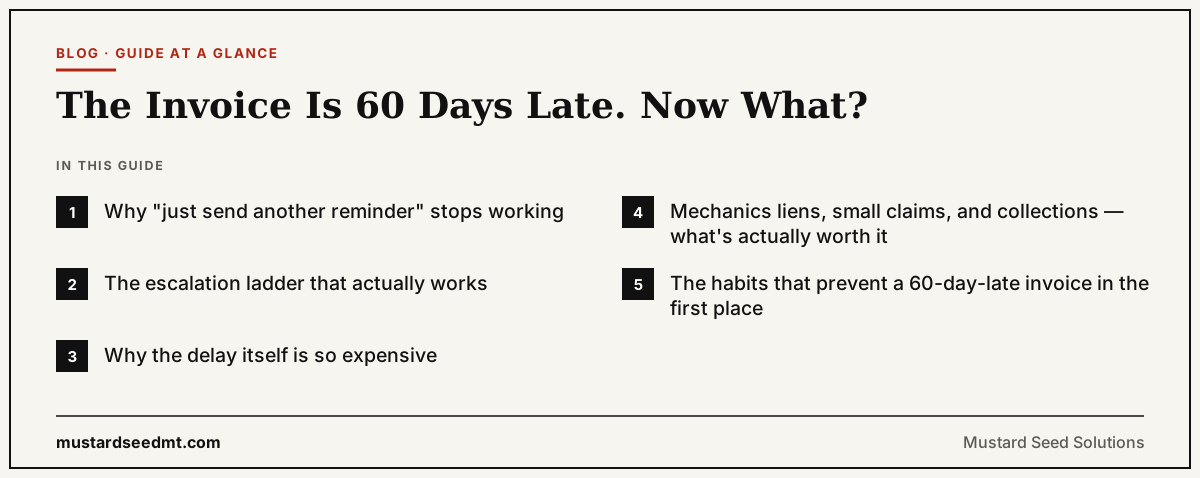
At 60 days late, an unpaid invoice stops being a scheduling hiccup and becomes a decision point: keep sending reminders, or escalate with real consequences attached. Real cases show the same escalation ladder gets solopreneurs paid — firm written notice, a late fee or lien threat, then small claims or a collections attorney — beats waiting on a client alone.
One small remodeling contractor described finishing a kitchen project the client had signed off on happily, sending a final invoice for just over $14,000, and then hearing nothing for two months despite a steady escalation from polite emails to calls to a text that was read and never answered. He admitted the honest reason he hadn't gone to court yet: it would cost him a week of his life and real money to chase money he was already owed, with no guarantee the client would actually pay even after losing in court.
That hesitation is common and rational — legal action costs time and money you don't get back immediately, even when you win. But the responses to his post point to something else: the contractors and tradespeople who treat collection as a routine, practiced part of the job, rather than an emotionally loaded last resort, tend to get paid faster and more often. Chasing a single overdue invoice is one piece of the larger discipline covered in our Getting Paid guide.
Why "just send another reminder" stops working
By the time an invoice is 60 days late, a polite reminder has usually already been tried, and it hasn't worked — which is exactly why it's at 60 days. Commenters responding to the remodeling contractor's account were blunt about this: if the work and the invoice were legitimate, the business owner needed to get comfortable exercising real legal leverage — filing a lien, sending a demand letter, or starting a lawsuit — as a normal, recurring part of doing business, not an exception. One put it directly: without that comfort, "you're going to get cleaned out once in a while."
The escalation ladder that actually works
Pulled together from accounts describing what actually got them paid, a realistic ladder looks like this:
- A friendly reminder the moment the invoice becomes overdue — assume good faith first.
- A firmer, written follow-up within one to two weeks that restates the amount, the due date, and any late fee already specified in your contract.
- A direct call, not just another email — several accounts describe a client who ignored five emails responding within a day of an actual phone conversation.
- A formal notice naming the specific next step — a lien filing, a late-fee clock starting, or a handoff to a collections attorney — with a real deadline attached.
- Follow through on that next step if the deadline passes. An empty threat repeated twice trains a client to ignore the third one.
Why the delay itself is so expensive
One detail from the responses to the remodeling contractor is easy to miss but genuinely important: several people pointed out that adding a contractual interest rate to an overdue balance turns time itself into leverage. At a typical rate cited in that thread — around 7% — a $14,000 balance grows to roughly $15,000 after a year of nonpayment, and keeps compounding the longer it sits. That doesn't just compensate you for the delay; in a handful of long-running cases, it's enough that a lien filed early and simply left to accrue interest can eventually approach the value of the property it's attached to. The math rewards filing early far more than it rewards waiting to see if the client comes around.
The emotional side of the delay is just as real as the legal one. The remodeling contractor was candid that the reluctance wasn't about not knowing his options — it was the sunk cost of a week of his life and the fear of spending money on a lawyer only to end up with "a piece of paper that says I'm right" and still no payment. Commenters didn't dismiss that fear; they reframed it. One suggested treating a client who stops paying with the same seriousness as someone who took money directly from your household, specifically because that frame makes it easier to act without the guilt that keeps people stuck in the polite-email phase for months.
Mechanics liens, small claims, and collections — what's actually worth it
For contractors and tradespeople, a mechanics lien filed against the client's property came up repeatedly as fast and inexpensive relative to its leverage — one person described filing two liens in a two-year period for around $600 total combined, each taking about 20 minutes to complete online after a 24-hour written notice to the client. The tradeoff: a lien often means waiting until the property sells or refinances to actually collect, so it protects the claim without necessarily producing cash quickly.
For invoices without a property to attach a lien to, small claims court was the most frequently recommended path for amounts in the low five figures — no lawyer required, just a filing fee and a court date. Several people also described working with a collections attorney who takes a percentage of whatever gets recovered rather than an upfront fee, which removes the "spend money to chase money" problem entirely if the attorney only gets paid when you do. One caution came up consistently, though: winning a judgment is not the same as collecting the money — a client determined not to pay can still make that part difficult.
A separate account, from someone who took over billing for a family business and discovered a customer owing close to $200,000 built up over more than a year of unpaid invoices, showed what happens when this escalation never happens at all: the balance had been allowed to grow silently because nobody confronted the client directly. The advice that followed was consistent — move that client to payment-on-delivery immediately, stop extending further credit, and treat the existing balance as a formal collections matter rather than an ongoing conversation.
The habits that prevent a 60-day-late invoice in the first place
One solopreneur who described five years of running a stable one-person service business credited much of that stability to three boring weekly habits, one of which was a strict rule: deposit required upfront, scope documented in writing, and clear payment deadlines stated before any work began. He said the very first month of enforcing that rule cost him two clients who didn't want to agree to basic terms — and that after adopting it, he never had another payment dispute. The same account described a dedicated 90 minutes every Friday specifically for invoices out and overdue payments chased, calling it tedious but crediting it with catching cash problems before they became emergencies.
Getting paid on time is rarely about finding the perfect polite phrasing for a reminder email. It's about deciding in advance what happens at 30 days, 45 days, and 60 days — and being willing to follow through. Use our late payment calculator to see exactly what a client's overdue balance is costing you before deciding your next move, and see the full Getting Paid guide for the complete playbook. Late payment is rarely a standalone problem — it usually shows up alongside the other structural risks covered in The 50 Biggest Solopreneur Challenges.