
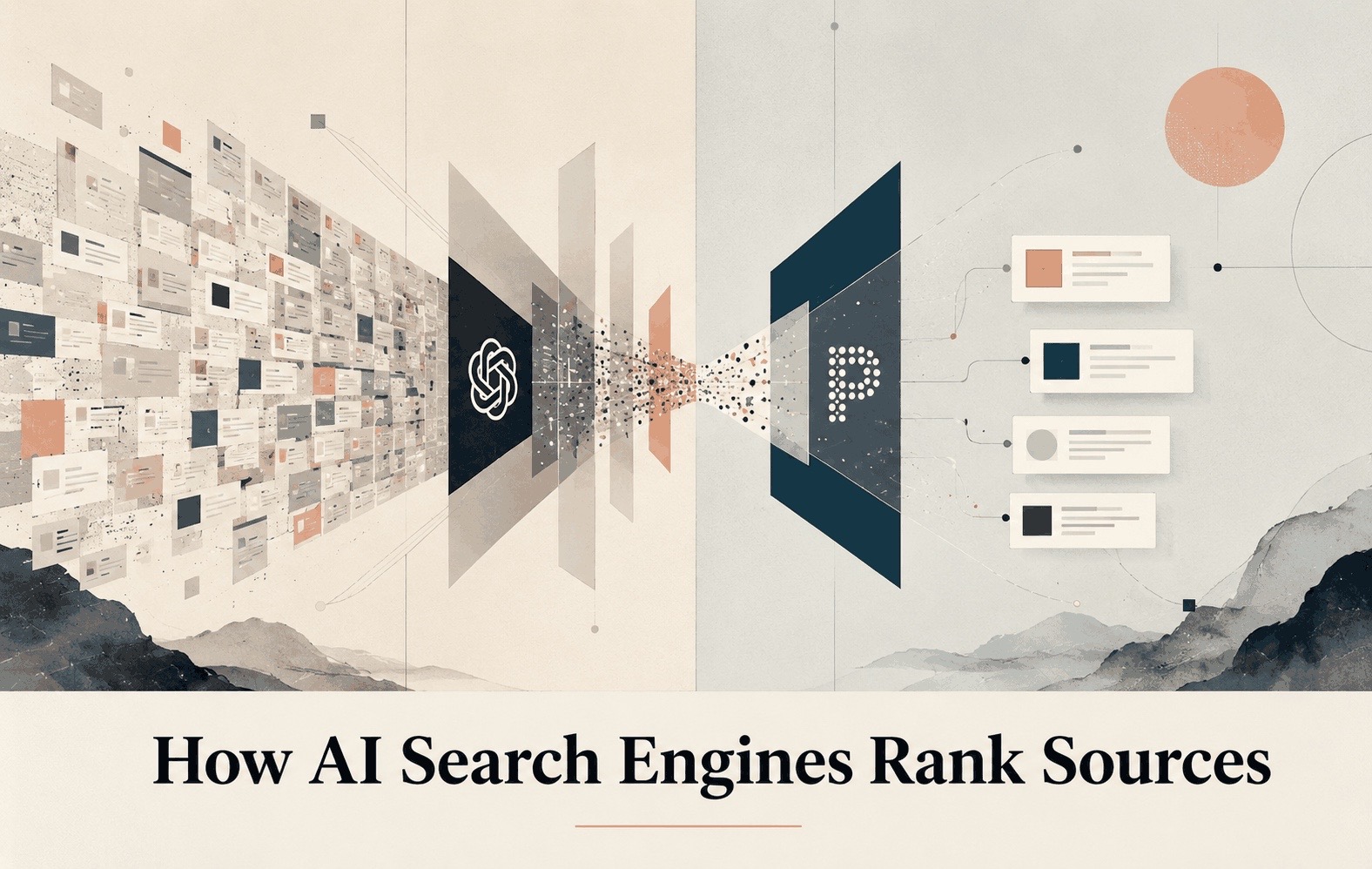
ChatGPT and Perplexity do more than find webpages. After retrieving possible sources, each system must decide which information is relevant enough, reliable enough, and useful enough to influence the final answer.
Perplexity has published considerably more technical detail about this ranking process than OpenAI. That difference matters for AEO because being discovered is only the first gate. Your content still has to survive selection before it can become part of an AI answer.
Why does source ranking continue after retrieval?
Retrieval usually produces more information than an AI model needs for one answer.
A search system therefore needs to narrow the candidate set before generation. Depending on the platform, this can involve ranking documents, evaluating passages, filtering irrelevant material, removing duplication, and deciding which evidence best matches the user's question.
A simplified path looks like this:
- Interpret the user's question
- Generate one or more searches
- Retrieve candidate pages
- Evaluate relevance
- Rank or rerank candidates
- Extract useful passages
- Generate the answer
- Select supporting citations
A page can therefore be discovered successfully and still disappear several stages before the user sees the answer — exactly the kind of drop-off an AI visibility audit traces.
What does ChatGPT disclose about source ranking?
OpenAI says ranking in ChatGPT Search is based on multiple factors intended to help users find reliable and relevant information. OpenAI does not publish a complete list of those factors or the weighting behind them.
ChatGPT can also rewrite a user's request into targeted search queries and perform additional searches after reviewing earlier results. This means ranking starts with a candidate pool that ChatGPT itself helped create.
OpenAI explains the current process in its ChatGPT Search documentation.
For marketers, the important limitation is that there is no public formula that converts a traditional search ranking into a ChatGPT citation.
A page can rank well elsewhere and still lose to another source that better supports the specific answer ChatGPT is constructing.
How does Perplexity rank retrieved information?
Perplexity has published a more detailed description of its search architecture.
Its system combines lexical retrieval with semantic retrieval, then moves candidate results through additional ranking stages. Perplexity describes using increasingly sophisticated models as the candidate set becomes smaller.
Its architecture includes:
- Keyword based retrieval
- Embedding based semantic retrieval
- Multiple ranking stages
- More computationally expensive reranking on smaller candidate sets
- Content extraction
- Passage level context selection
Perplexity describes this system in its AI first search architecture research.
Perplexity has also described newer search systems where models can control retrieval, ranking, filtering, fan out, and other search operations programmatically.
This makes source ranking a central product capability rather than a simple final sorting step.
ChatGPT vs Perplexity: how retrieved sources get ranked
| Dimension | ChatGPT | Perplexity |
|---|---|---|
| Public disclosure | Multiple factors cited, but no published list or weighting | Detailed search architecture publicly described |
| Retrieval approach | Rewrites requests into targeted search queries and can run additional searches | Combines keyword-based (lexical) retrieval with embedding-based (semantic) retrieval |
| Reranking | Not documented | Multistage ranking, with more computationally expensive models applied to smaller candidate sets |
| Passage/context selection | Not documented | Content extraction plus passage-level context selection |
| Official documentation | ChatGPT Search Help Center article | Perplexity's "AI first search architecture" research post |
What is the difference between retrieval, ranking, and citation?
These are three separate visibility problems.
Retrieval asks whether your page enters the candidate set.
Ranking asks whether your page survives comparison against other retrieved evidence.
Citation selection asks whether the model actually uses your information in the answer and connects your source to a claim.
Consider a company page about AI visibility consulting.
The system could successfully retrieve that page but later determine that:
- Another page answers the question more directly
- A third party source provides stronger evidence
- A competitor page contains more specific details
- Your page repeats information already covered elsewhere
- The relevant information is difficult to extract
- The final answer does not need the claim your page supports
The absence of a citation therefore does not automatically mean the crawler failed to find your site.
What kind of content is more likely to survive ranking?
There is no guaranteed AI ranking formula, but content becomes easier to select when it provides clear evidence for a specific information need.
Useful characteristics include:
- A direct answer near the relevant section
- Specific facts instead of generic claims
- Clear product or service definitions
- Original research or first party evidence
- Current information where freshness matters
- Meaningful comparison criteria
- Clear authorship and sourcing
- Pages focused on a coherent topic
- Information that can stand alone when extracted from the page
This does not mean writing artificially for AI systems.
The same qualities often make content more useful to human readers because they reduce ambiguity and make important information easier to verify.
Why can Perplexity cite a page that ChatGPT ignores?
The platforms can diverge before ranking even starts.
ChatGPT and Perplexity may generate different searches, retrieve different documents, and evaluate the resulting information with different ranking systems.
Imagine someone asks:
"Which marketing consultant is best for a small company trying to appear in AI search?"
One platform may focus on:
- AI visibility consultants
- AEO agencies for small businesses
- GEO consulting services
Another may investigate:
- Best AI SEO consultants
- ChatGPT optimization agencies
- Generative search marketing firms
- AI brand visibility experts
A company can be highly relevant to one retrieval path while remaining weak on another.
This is why query fan out and topical coverage matter beyond individual keywords.
How should marketers test source ranking?
Do not measure only whether your site was cited.
Compare the sources that repeatedly survive across related prompts.
Track:
- Pages that appear repeatedly
- Domains that dominate the answers
- Competitors that survive across multiple prompts
- First party versus third party citations
- Whether the same page appears in ChatGPT and Perplexity
- Which claims each citation supports
- Which customer questions consistently trigger your brand
- Which questions repeatedly exclude your brand
Then review the winning pages.
Ask what information they provide that your content does not.
That analysis is often more useful than trying to reverse engineer an invisible universal AI ranking score.
Our AI visibility advisory focuses on finding these retrieval and selection gaps before recommending new content.