
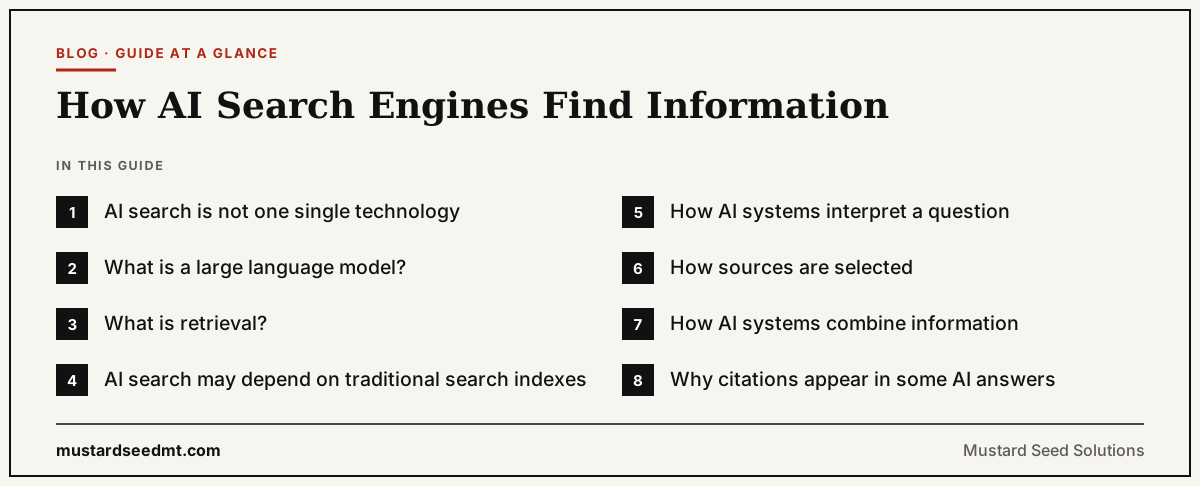
AI search engines are changing how people find information online.
Instead of showing only a list of webpages, an AI search tool can generate a direct answer, compare options, summarise several sources, and respond to follow up questions.
This experience can make search feel conversational. However, the answer still depends on information obtained from somewhere.
AI search engines may use model training data, live web retrieval, traditional search indexes, structured databases, product feeds, reviews, and other sources. The exact combination depends on the platform and the question.
Understanding how AI search works helps businesses create information that is easier to discover, interpret, and represent accurately.
AI search is not one single technology
The phrase “AI search engine” can describe several different systems.
Some tools use a large language model to generate answers from information learned during training.
Other tools search the live web, retrieve relevant pages, and use a language model to summarise the findings.
Some combine both methods.
A platform may also use specialist databases for products, locations, academic research, news, travel, finance, or other subjects.
This means there is no universal process used by every AI search engine.
The same question can produce different answers because the systems have access to different indexes, models, retrieval methods, sources, and ranking systems.
Businesses should therefore avoid building a strategy around the assumption that every AI platform works in exactly the same way.
What is a large language model?
A large language model, often called an LLM, is a system trained to recognise patterns in language.
It can generate text by predicting which words and concepts are likely to follow the information it has received.
The model does not store knowledge in the same way as a traditional database.
It learns statistical relationships between words, subjects, entities, and concepts from large collections of text.
This allows it to explain topics, answer questions, rewrite information, compare ideas, and create new combinations of language.
However, a language model can produce incorrect information.
It may confuse similar companies, rely on outdated knowledge, misunderstand context, or generate a statement that sounds plausible without strong evidence.
This is one reason many AI search tools use retrieval systems to obtain current sources before generating an answer.
What is retrieval?
Retrieval is the process of finding information that may help answer a user’s question.
When a person submits a query, the AI search engine may convert the question into a form that helps it locate relevant documents.
The system may search a web index, database, product catalogue, or collection of stored documents.
It then selects information that appears relevant to the question.
The selected information becomes context for the language model.
The model uses that context to construct an answer.
This approach is sometimes called retrieval augmented generation.
It connects the language abilities of the model with information obtained from external sources.
AI search may depend on traditional search indexes
Many generative search experiences still depend on systems similar to traditional search.
A search index contains information about webpages that have been discovered, crawled, processed, and selected for inclusion.
When an AI tool needs current information, it may search an index to identify relevant pages.
This means familiar SEO foundations remain important.
A page that cannot be crawled or indexed may be less available for retrieval.
A page hidden behind poor navigation or disconnected from the rest of the website may be harder to discover.
A page that contains vague marketing language may be difficult to match with a specific question.
AI search changes the presentation of information, but it does not eliminate the need for accessible and useful sources.
How AI systems interpret a question
A traditional keyword search may focus heavily on the words entered by the user.
AI search can analyse more detailed meaning and context.
For example, a user might ask:
“What project management software is suitable for a small construction company with remote workers and a limited budget?”
The system must identify several parts of the request.
The user wants project management software. The company is small. The industry is construction. The employees work remotely. Price is important.
The AI search engine may retrieve pages discussing construction software, small business pricing, remote collaboration, product limitations, and customer reviews.
It may then combine the findings into a recommendation.
This creates opportunities for businesses that publish specific information about use cases, customer types, industries, pricing, integrations, and limitations.
How sources are selected
AI search engines do not necessarily select sources only because they use the same words as the question.
The system may consider relevance, authority, freshness, location, source type, and the clarity of the information.
A current product comparison may be more appropriate than an old general article.
An official technical document may be useful for explaining a feature.
A review platform may provide customer opinions.
An industry publication may help identify established providers.
Different sources can serve different parts of the answer.
Businesses should not assume that their own website will always be treated as the main source of truth.
Independent sources may influence how a company is described.
How AI systems combine information
After retrieving documents, the language model may extract relevant points and create a combined response.
It may summarise common themes, identify differences, or present a recommendation.
The final answer may not repeat any source exactly.
Instead, it can combine information from several places.
This process introduces risks.
Sources may disagree. One page may be outdated. A customer review may describe an unusual experience. A comparison article may contain affiliate incentives.
The AI system must decide how to represent these differences.
Sometimes it may present uncertainty. Sometimes it may choose one interpretation. Sometimes it may make an error.
Businesses should therefore monitor how AI platforms describe their brands, products, and services.
Why citations appear in some AI answers
Some AI search tools provide citations or links beside generated statements.
Citations allow users to inspect the sources used in the response.
They can also send referral traffic to publishers.
However, a citation does not always mean that the entire answer came from one page.
The answer may combine several sources, and the citation may support only one statement.
Some generated responses may include few citations or none at all.
A business should not judge AI visibility only by whether its website receives a link.
A brand mention can influence awareness even when the answer does not generate an immediate visit.
The role of structured information
Clear and structured information can make content easier to interpret.
This includes descriptive headings, tables, product specifications, service details, prices, locations, author information, and clearly labelled sections.
Structured data can also help search systems understand certain types of information, such as products, organisations, events, jobs, or local businesses.
However, structured data does not guarantee that an AI search engine will select or recommend a source.
It is information supplied by the publisher.
The system still needs reasons to consider the source relevant and credible.
Structured information supports understanding. It does not replace authority or usefulness.
Freshness can affect retrieval
Some questions require current information.
Prices, regulations, software features, product availability, news, and market data may change frequently.
AI search tools that use live retrieval may favour current sources for these questions.
Businesses should update pages when the underlying facts change.
Changing the publication date without improving the information does not create meaningful freshness.
The content should remain accurate, and important changes should be explained clearly.
Stable topics do not always need frequent updates.
External information shapes AI answers
An AI system may learn about a company through many sources.
These may include the company website, news coverage, partner pages, directories, customer reviews, social discussions, research reports, and comparison platforms.
When these sources agree, the system has a clearer picture of the brand.
When they conflict, the generated answer may be inconsistent.
A company may describe its product as suitable for large enterprises while most public reviews come from freelancers.
It may claim global availability while directories list only one local office.
Information consistency helps reduce confusion.
How businesses can become easier to find
Businesses should begin with clear and accessible information.
Explain what the company does, who it serves, and how its offer works.
Create pages for important products, services, customer types, industries, and questions.
Use specific language rather than broad slogans.
Publish original research, case studies, documentation, and expert explanations where possible.
Build credible external recognition through customers, partners, publications, and professional communities.
Keep important company information accurate across relevant platforms.
Monitor AI answers connected to the brand and investigate the sources behind factual errors.
AI search still depends on useful sources
AI search may feel very different from traditional search, but it still needs information.
Language models can organise and explain that information, while retrieval systems help locate current sources.
The businesses most likely to be represented accurately are those that provide clear facts, useful content, strong evidence, and consistent external recognition.
AI search engines do not remove the need for websites.
They change how website information may be discovered, combined, and delivered to the user.