ChatGPT and Claude do not search the web for every question. Both can decide that a prompt needs current external information, run web searches, review the retrieved material, and then generate an answer with citations.
When a question can be answered from stable knowledge or information already supplied in the conversation, they may answer without searching at all. That distinction matters because a brand cannot be discovered through search during a response if the AI never searches in the first place.
What makes ChatGPT or Claude decide to search?
Freshness and uncertainty are two of the clearest triggers. Questions about recent events, current products, changing statistics, prices, companies, people, or information outside the model's existing knowledge are more likely to trigger web retrieval.
An explicit request such as "search the web," "find current sources," or "look this up" also gives the system a strong reason to search.
Questions built around stable information may not require retrieval.
- Basic definitions
- Established concepts
- Mathematics
- Creative writing
- Analysis of text already provided
- General brainstorming
This means two prompts about the same subject can follow completely different information paths.
How does ChatGPT decide when to search?
OpenAI says ChatGPT can automatically search when a question might benefit from information on the web. Users can also explicitly choose Search.
When ChatGPT does use outside search providers, OpenAI says it will often rewrite the original prompt into one or more targeted search queries. It may then issue additional queries after reviewing the first set of results.
For example, a broad question about a market may become several narrower searches around the company, product, location, date, or event involved.
OpenAI explains this process in its ChatGPT Search documentation.
This makes the original user prompt only the beginning of the retrieval process. The websites ChatGPT eventually sees can depend on the search queries ChatGPT creates after interpreting that prompt.
How does Claude decide when to search?
Anthropic documents Claude's search decision more explicitly. When the web search tool is available, Claude determines whether to search based on the prompt.
Anthropic says searches are particularly appropriate when a request depends on information that is current, changing, or outside Claude's training data. Claude can also perform several searches during one request, using earlier results as part of the research process.
Claude may answer directly when the question depends on stable knowledge or material already available in the conversation.
Anthropic describes this workflow in its Claude web search documentation.
Newer versions of Claude's web search system can also filter retrieved results before loading the most relevant material into the model's context. That adds another selection step between appearing in search results and actually influencing the final answer.
ChatGPT vs Claude: web search behavior compared
| Behavior | ChatGPT | Claude |
|---|---|---|
| Automatic search trigger | Can automatically search when a question might benefit from web information | Determines whether to search based on the prompt; particularly appropriate when information is current, changing, or outside training data |
| Explicit user trigger | Users can explicitly choose Search | Can be explicitly asked to search or look up current information |
| Prompt-to-query rewriting | Often rewrites the original prompt into one or more targeted search queries | — |
| Multiple searches per request | May issue additional queries after reviewing the first set of results | Can perform several searches in one request, using earlier results as part of the research |
| Result filtering before context | — | Newer versions can filter retrieved results before loading material into the model's context |
| Documentation source | OpenAI's ChatGPT Search documentation | Anthropic's Claude web search documentation |
What happens when ChatGPT or Claude does not search?
The answer is generated from information already available to the model and the current conversation context.
For marketers, this creates an important distinction between model knowledge and retrieved knowledge.
A company might be well represented on the live web but absent from a response because the system answered without searching. The opposite can also happen: a well known brand may appear because the model already associates that company with the category being discussed.
This is one reason AI visibility cannot be reduced to traditional search rankings alone.
Why can the same question trigger different behavior?
The systems make their own decisions about whether external information would improve an answer. They also interpret prompts differently.
Small changes can alter the retrieval need.
Compare the intent behind these questions:
- What is answer engine optimization?
- What are the latest changes in answer engine optimization?
- Which AEO tools are currently used by B2B marketing teams?
- Search the web and compare current AEO tools for a five person marketing team.
The first question may be answerable from stable knowledge. The others increasingly depend on current information.
This means prompt design changes what information environment the AI enters before it generates an answer.
What does this mean for AEO and AI visibility?
Brands need to think about both discovery and understanding.
If ChatGPT or Claude searches, your company needs content and third party evidence that can be retrieved for the queries the system generates. If the system does not search, broader brand recognition and clear associations between your company, category, services, and expertise become more important.
A practical AI visibility strategy therefore includes:
- Clear service and category language
- Pages that answer specific customer questions
- Search accessible website content
- Consistent company information
- Credible third party mentions
- Useful comparison and decision content
- Strong conventional SEO foundations
The goal is to make your company understandable whether an AI system reaches it through live retrieval or encounters information about it elsewhere.
Our AI visibility advisory focuses on connecting these discovery signals to real customer questions rather than trying to manipulate individual prompts.
How should marketers test ChatGPT vs Claude web search?
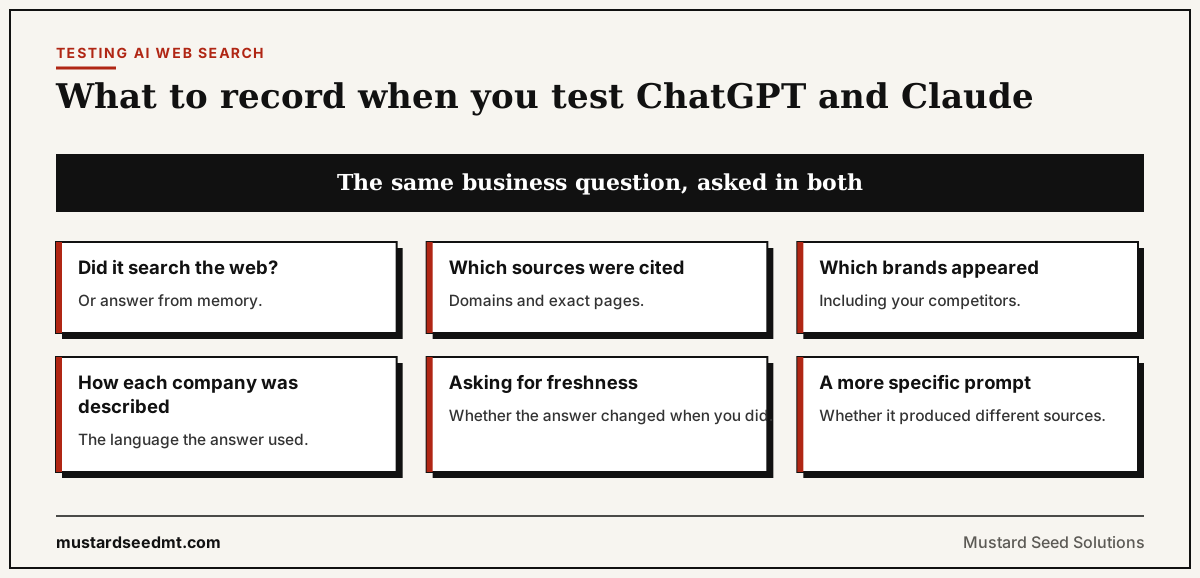
Test the same business question in both systems and focus on the process behind the answer.
Record:
- Whether web search was used
- Which sources were cited
- Which brands appeared
- Which competitors appeared
- What language was used to describe each company
- Whether the answer changed when freshness was explicitly requested
- Whether a more specific prompt produced different sources
Do not treat one response as a permanent ranking. AI answers can change as prompts, models, indexes, search results, and source availability change.
The useful signal is the pattern across repeated commercially relevant questions.