
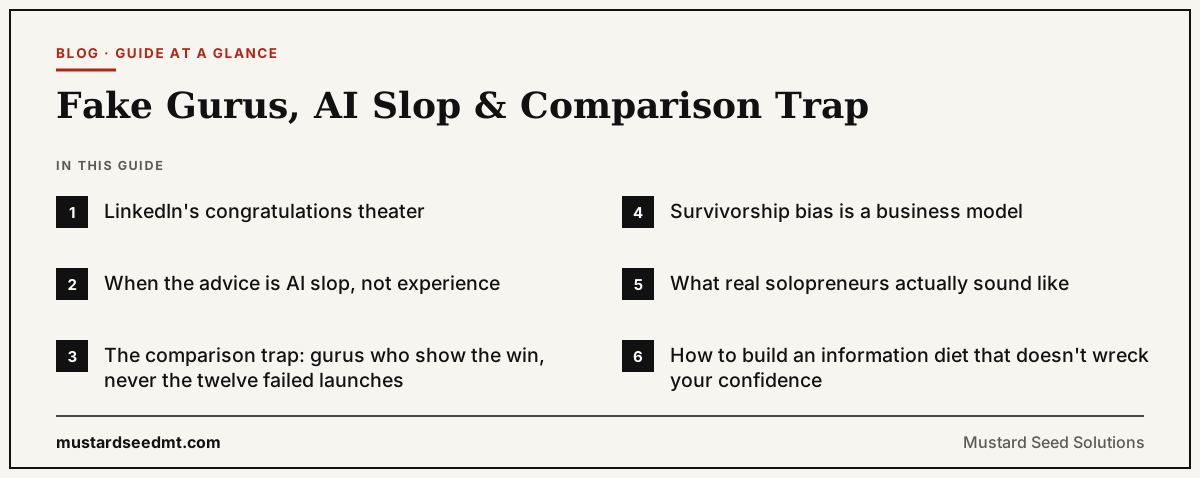
The fake-guru problem isn't just annoying — it's a quiet tax on the mental health of solopreneurs who measure their real, unglamorous progress against manufactured highlight reels, AI-flavored advice threads, and "beach in Bali" income claims that rarely survive a second look. Recognizing the pattern is the first real step to tuning it out.
One of the more telling posts on a small business forum wasn't advice at all — it was a plea. The author begged the community not to let "marketing agencies and salesmen" turn the sub into another feed of screen-recorded income claims, warning that it always starts small before every post becomes "how I make $2 million a day." The replies, hundreds of them, turned into a genuinely funny pile-on of fake guru voice: mock book pitches for "the half-hour work week," parody promises to "retire at 23," a running joke about commenting "info" for the secret. Underneath the humor was real relief — for the people running actual businesses, that sub was one of the few places left where the vent-and-solve conversations felt honest.
That tension — a small, non-performative space getting crowded out by performance — shows up constantly in the discussions behind Mustard Seed's solopreneur mental health research, and it's worth taking seriously rather than dismissing as internet noise. The content isn't just distracting. It's actively distorting what solopreneurs think "normal" looks like.
LinkedIn's congratulations theater
A separate, widely-discussed post asked a simple question: is LinkedIn a "complete circle jerk," or is that just one person's algorithm bubble? The replies leaned heavily toward "it's the whole platform." One commenter pointed out that because LinkedIn is explicitly professional, the only content that's safe to post is performative positivity — "congrats on your new role," "10 inspiring things adversity taught me" — because anything more honest risks being seen by an employer or client.
The same thread surfaced an unsolicited pitch mid-conversation: an invitation to a "Masterclass" with someone billed as a "RevOps Hitman," promising to teach visitors how to "engage, capture, and convert" leads. Another commenter cited research suggesting well under 1% of LinkedIn users ever create or share content at all — meaning the loudest, most confident-sounding voices in any solopreneur's feed are a tiny, self-selected, performance-optimized minority. That's not a representative sample of how business is actually going for people. It's a highlight reel with a distribution advantage.
When the advice is AI slop, not experience
A small law-firm owner described being pitched, repeatedly, by people trying to sell him an "LLM program" for his practice — despite courts already sanctioning attorneys for filing AI-hallucinated case citations. He wasn't alone; other business owners piled on with their own AI-scam pitches, including one for AI-powered bookkeeping that a commenter flatly called "a catastrophe." The shared frustration wasn't about AI itself — several commenters use it carefully and usefully — it was about people selling AI as a replacement for judgment, aimed at whoever was least equipped to catch the mistake.
A related pattern showed up in a long LinkedIn-style post promising "the brutal truth nobody mentions" about content marketing. Multiple commenters immediately flagged it as AI-generated — one even ran an unprompted breakdown of the exact rhetorical techniques being used, purely to illustrate the pattern. It's a small case study in a bigger problem: business advice that reads confident and structured can still be hollow, and the volume of that kind of content is only growing.
The comparison trap: gurus who show the win, never the twelve failed launches
One of the rawer posts on a solopreneur forum came from someone who had shipped six or seven AI-assisted apps over roughly two and a half years. Every one of them went nowhere — a few hundred visitors from a single Reddit post, occasional signups, "the longest stretch any of them stayed relevant was 48 hours." He described feeling humiliated watching "gurus" in the same solo-builder space post huge follower counts and what looked like steady monthly income, while he sat at zero, questioned by his own family.
The most useful reply in that thread didn't offer a tactic — it offered a reframe: don't compare your behind-the-scenes to someone else's highlight reel, because the visible "solo founder" success story usually leaves out years of failed projects, consulting income on the side, personal savings, or a partner with a stable job quietly funding the runway. That's not a cliché. It's a direct description of what several commenters, in their own words, admitted was true of their own "overnight" wins.
Survivorship bias is a business model
A viral hustle-culture post argued that persistence alone explains every famous success — citing a well-known UFC fighter, a podcaster, a vacuum inventor, and a fried-chicken franchise founder as proof that "sticking around" is the whole game. The most-upvoted replies didn't disagree that persistence matters; they pointed out the math being skipped. For every widely known success story, there are thousands of people who did the same grinding, persistent work and never got anywhere near that outcome — plus a meaningful amount of luck, timing, and starting capital that the "just be an animal about it" framing quietly erases.
That's the guru pitch in miniature: real effort is necessary, but it's being sold as sufficient, because sufficient sells better than "necessary but not guaranteed."
This is also where the research behind the 50 biggest solopreneur challenges is useful as a corrective — it's built from what a large number of real operators actually describe struggling with, not from the subset of stories confident enough to go viral.
What real solopreneurs actually sound like
Maybe the most honest post in this whole space came from a software engineer in his 40s, quietly burned out on tech and wanting to start something small and physical — mugs, water bottles, a simple product business. What stopped him wasn't lack of an idea. It was the feeling that every niche looked saturated, dominated by people "killing it" on Instagram and TikTok, and that the entrepreneurial space seemed to run on a "fake-it-till-you-make-it" performance he didn't want to fake. In his own words: he saw gurus "selling the dream but lying through their teeth," and would rather stay broke than do the same.
The replies were unusually gentle for that kind of forum — several people recognized the exact feeling, named it as a common burnout pattern rather than a personal failing, and pushed back gently on the idea that a saturated-looking niche means there's no room left. The thread that started as "I'm a loser" ended up as one of the more grounded, useful conversations in the whole dataset — proof that the honest version of this content exists. It's just quieter than the version selling a course.
How to build an information diet that doesn't wreck your confidence
- Treat any post promising a specific income number with no product, no numbers, and a DM at the end as marketing, not evidence.
- Notice which platforms reward performance over honesty — professional networks especially — and weight what you read there accordingly.
- Look for the comment sections that push back. A community willing to call out survivorship bias or "AI slop" in real time is a better filter than any single post.
- When a success story impresses you, ask what isn't in it — savings, a partner's income, years of unpaid effort, previous failed attempts — before comparing it to your own timeline.
- Follow operators who post losses and plateaus, not just wins. The ratio of what you see should roughly match the ratio of what actually happens.
None of this requires cynicism about every success story. It requires remembering that the loudest stories are self-selected for being loud — not for being representative.