
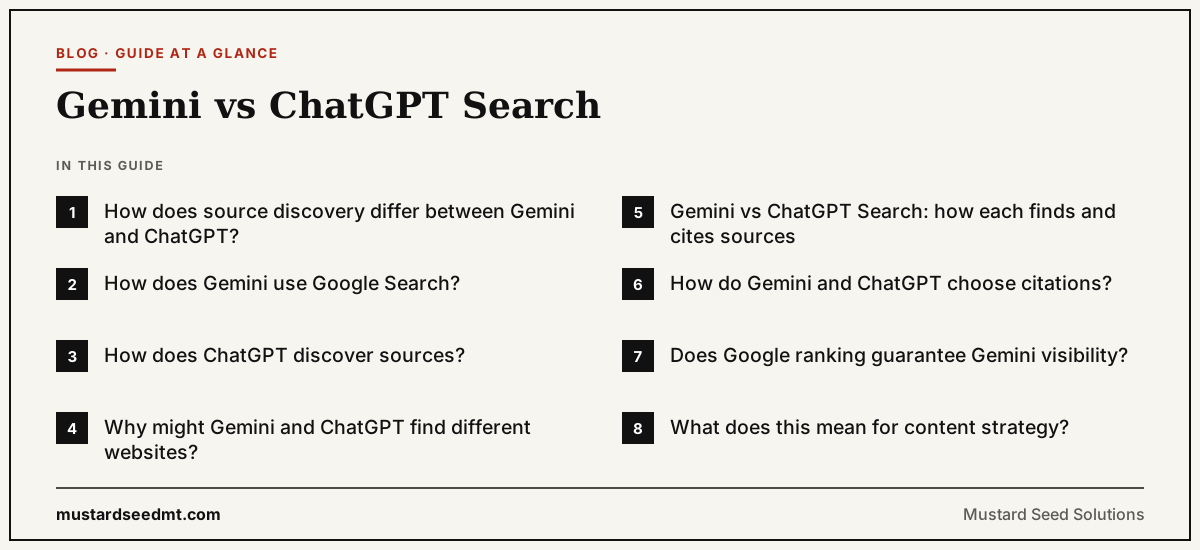
Gemini takes its web sources from Google Search: it writes one or more Google queries, reads the results and cites the pages it used. ChatGPT search takes its sources from third-party search providers, with Microsoft Bing the one named publicly, plus content from publishing partners and pages its own crawler, OAI-SearchBot, can reach. Different pipelines produce different citations.
That difference matters because the same customer question can expose each system to a different source set. A brand that is visible in Gemini is therefore not automatically visible in ChatGPT.
Gemini AI sources vs ChatGPT sources: comparison table
| Dimension | Gemini | ChatGPT search |
|---|---|---|
| Where sources come from | Google Search, through Grounding with Google Search | Third-party search providers (Bing is the one named publicly), content from publishing partners, and pages OAI-SearchBot can reach |
| Crawler and robots.txt control | Googlebot crawls for Google Search. The Google-Extended token controls whether your content is used for Gemini training and for grounding in Gemini Apps; it does not affect Google Search inclusion | OAI-SearchBot surfaces pages in ChatGPT search, and blocking it keeps a site out of search answers. GPTBot is a separate training crawler |
| Query generation | Generates one or multiple Google Search queries from the prompt | Rewrites the request into one or more targeted queries sent to search providers |
| Follow-up searches | Not documented as a separate step, but one prompt can trigger several searches | May send additional, more specific searches after reviewing initial results |
| How sources are shown | Citation annotations attached to specific parts of the response | Inline citations plus a Sources panel listing the pages used |
| Index and freshness | Google Search's index | A mix of provider indexes, partner content and OAI-SearchBot's crawl, each with its own freshness |
| Does ranking guarantee a citation? | No. A page must still fit the specific searches Gemini generates | No. Neither system promises that every retrieved page will be cited |
| What marketers should check | Indexing and clear answers in Google Search, covering the subquestions Gemini may search for | Bing indexing (Bing Webmaster Tools), OAI-SearchBot allowed in robots.txt, and answers to the underlying decision criteria |
In short: if Google does not index or rank your pages, Gemini has little of yours to cite. If Bing does not index them, or you block OAI-SearchBot, ChatGPT search has little of yours to cite. Strength in one does not carry over to the other.
How does source discovery differ between Gemini and ChatGPT?
Both systems begin by interpreting the user's question, but the retrieval paths can separate quickly.
Gemini's documented Google Search grounding workflow can automatically determine that search would improve an answer, generate one or multiple Google Search queries, process the results, and return a grounded response with citations.
ChatGPT can also determine that a question would benefit from web information. OpenAI says ChatGPT Search commonly rewrites a user's request into targeted queries when working with search providers and can issue additional searches after reviewing initial results.
The similarity is important: neither system should be viewed as simply sending the user's exact sentence to a search box.
How does Gemini use Google Search?
Google describes Grounding with Google Search as an integrated workflow between Gemini and Google Search.
When the search tool is enabled, Gemini can:
- Analyze the prompt
- Decide whether Google Search would improve the answer
- Generate one or multiple searches
- Execute those searches
- Process the retrieved information
- Synthesize a response
- Attach citations to specific parts of the answer
Google documents the workflow in its Gemini Search grounding documentation.
This creates a direct connection between Gemini's reasoning process and Google's search infrastructure.
For marketers, it reinforces the importance of being understandable and discoverable within the broader Google ecosystem while also creating content that answers the specific subquestions an AI system may generate.
How does ChatGPT discover sources?
ChatGPT also transforms prompts before retrieval.
OpenAI says ChatGPT Search can rewrite a request into one or more targeted searches that are sent to search providers. After reviewing those results, ChatGPT may send additional, more specific searches.
The final answer is therefore influenced by both the original prompt and ChatGPT's interpretation of what it needs to investigate.
OpenAI documents that process in its ChatGPT Search guide.
On where results come from, OpenAI's launch post says ChatGPT search "leverages third-party search providers, as well as content provided directly by our partners." Microsoft Bing is the provider named publicly. OpenAI also runs its own search crawler, OAI-SearchBot, which it describes as the bot used to surface websites in ChatGPT's search features. OpenAI has not said how much of any answer comes from each source.
This means visibility in ChatGPT cannot be understood only by checking where a page ranks for the exact words a customer typed.
Why might Gemini and ChatGPT find different websites?
Different retrieval paths produce different candidate sources.
Gemini's grounding system connects directly to Google Search. ChatGPT has a separate search orchestration process and can work with external search providers. Each model can also formulate different searches for the same user intent.
Several differences can therefore compound:
- Different generated queries
- Different search indexes or providers
- Different ranking signals
- Different freshness signals
- Different source filtering
- Different passage selection
- Different follow up searches
- Different answer generation decisions
The final citation list represents the end of this process, not the complete set of pages either system considered.
How do Gemini and ChatGPT choose citations?
A citation is evidence selected to support part of the generated answer.
Google's Gemini API documentation shows citation annotations associated with sections of the model's response after Google Search grounding. ChatGPT similarly presents citations and a source panel when search contributes information to an answer.
Neither system promises that every page retrieved during research will receive a citation.
That distinction matters for AEO measurement.
A missing citation could mean:
- The page was never retrieved
- The page ranked below stronger candidates
- The useful passage was not selected
- Another source supported the claim more clearly
- The model did not need that information in its final answer
Citation monitoring tells you where your brand appears. It does not automatically diagnose why it failed to appear elsewhere.
Does Google ranking guarantee Gemini visibility?
No.
Strong Google visibility can create a favorable discovery environment because Gemini's grounding workflow uses Google Search. But Gemini can generate multiple searches around a question and then synthesize selected information from the results.
The page still needs to be relevant to the actual searches Gemini generates and useful to the answer being constructed.
This is where conventional SEO and AI search optimization overlap.
Good technical accessibility, clear topical relevance, credible evidence, useful page structure, and strong external recognition can help both human searchers and AI retrieval systems understand a business.
You can explore the broader relationship in our AI visibility advisory.
What does this mean for content strategy?
Content teams should optimize around customer questions and the information needed to answer them, not only a single keyword.
Suppose a prospect asks:
"Which CRM is best for a two person consulting company?"
An AI system could need information about:
- Pricing
- Number of users
- Contact management
- Automation
- Ease of setup
- Integrations
- Customer support
- Alternatives
- Limitations
- Suitability for consultants
A page that answers only "best CRM" may be less useful than a resource that provides clear information across the decision criteria surrounding that question.
This is the practical value of understanding query fan out: one natural language question can create several retrieval opportunities.
How should brands test Gemini vs ChatGPT Search?
Start with prompts that represent real buying decisions rather than generic questions about your company.
Use categories such as:
- Best provider for a specific customer type
- Alternatives to a known competitor
- Product or service comparisons
- Local provider recommendations
- Cost questions
- Implementation questions
- Problems your service solves
- Questions about trust, risk, or suitability
Run the same prompt in Gemini and ChatGPT. Then record the sources, brands, claims, and recommendation logic.
The goal is to understand where your public information footprint is strong and where competitors provide clearer or more retrievable evidence.