
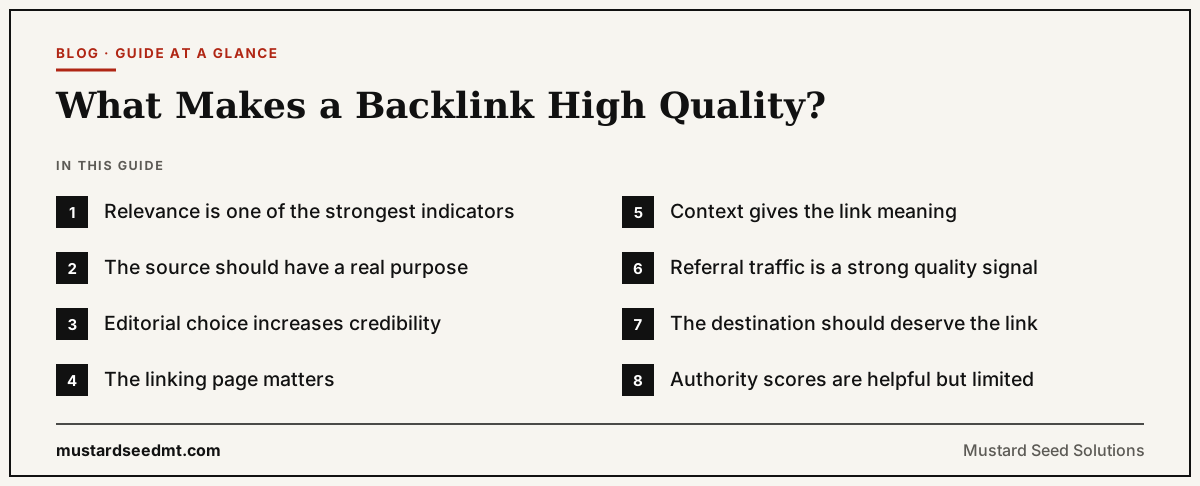
A high quality backlink is a link that provides credible, relevant, and useful recognition from one website to another.
It may help search engines discover a page, understand its subject, and evaluate how the wider web references it.
It can also send referral traffic, introduce a business to potential customers, and strengthen brand authority.
Many companies judge backlink quality through one number from an SEO tool.
Authority scores can provide context, but they do not tell the complete story.
A backlink should be evaluated through its source, relevance, placement, audience, purpose, and relationship to the destination.
Relevance is one of the strongest indicators
A backlink is easier to understand when the linking page and destination share a clear subject.
A cybersecurity publication linking to a security consultancy has obvious relevance.
A local business association linking to one of its members also makes sense.
A backlink from an unrelated website may have less meaning unless the surrounding content explains the relationship.
Relevance can exist across the entire website, the individual page, or the specific paragraph containing the link.
For example, a general business publication may cover many industries. A link from an article specifically about marketing analytics can still be highly relevant to an analytics consultancy.
The question is whether the reference makes sense to the reader.
The source should have a real purpose
A strong linking website usually serves a genuine audience.
It may be a publication, company, association, university, community, directory, research organisation, or professional resource.
The site should exist for a reason beyond selling links.
Warning signs include large numbers of unrelated sponsored articles, vague ownership, copied content, artificial author profiles, and pages created primarily to host backlinks.
A website can have a high authority score and still be a poor source when its editorial standards are weak.
Review the actual website.
Ask who reads it, why it exists, and whether its content demonstrates care.
Editorial choice increases credibility
A high quality backlink is usually placed because an editor, writer, partner, or organisation decided that the destination was useful.
This editorial decision creates credibility.
The publisher has evaluated the page and chosen to reference it.
The link may support a claim, recommend a resource, identify a partner, or give readers additional information.
Links placed automatically or purchased without review provide weaker evidence.
An editorial link does not need to come from a major newspaper.
A small industry blog with strong standards can provide valuable recognition when its audience and subject are relevant.
The linking page matters
The quality of the entire domain is important, but the individual page also deserves attention.
A link from a useful and well referenced article may carry more meaning than a link hidden on an abandoned page.
Review whether the page is indexed, relevant, readable, and connected to the rest of the website.
Consider whether people are likely to find it.
A homepage link, article link, directory profile, partner page, and footer link all serve different purposes.
There is no universal best placement.
The strongest placement is the one that accurately represents the relationship.
Context gives the link meaning
Search engines and readers use surrounding text to understand why a link exists.
A natural sentence may cite a report, identify the source of data, or recommend a tool.
This context explains the connection.
A random link placed in an unrelated sentence provides little useful meaning.
Businesses often focus heavily on anchor text, which is the clickable wording of the link.
Descriptive anchor text can help explain the destination. However, forcing exact commercial keywords into every backlink can create an unnatural pattern.
Brand names, article titles, website addresses, and natural phrases are normal forms of anchor text.
The publisher should choose wording that fits the content.
Referral traffic is a strong quality signal
A backlink can be valuable even before considering rankings.
When the linking website has a relevant audience, visitors may click the link and visit the destination.
This traffic can produce enquiries, subscriptions, partnerships, or sales.
A backlink that sends qualified visitors has clear business value.
It proves that the link is visible and useful to real people.
By contrast, a link hidden on a page with no audience may increase a backlink count without producing any direct benefit.
Businesses should monitor referral traffic in analytics platforms and evaluate the behaviour of those visitors.
The destination should deserve the link
High quality backlinks depend partly on the quality of the destination.
A publisher needs a reason to send readers there.
Original research, detailed guides, tools, case studies, expert explanations, templates, and useful data can all earn links.
A weak sales page may be difficult to reference unless the linking page is discussing a specific provider or partnership.
This is why link building begins with creating strong assets.
Outreach cannot permanently solve the problem of having nothing worth referencing.
The destination should fulfil the promise created by the link.
Authority scores are helpful but limited
SEO platforms estimate the strength of domains and pages using their own link data.
These metrics can help compare potential sources.
However, no third party platform has complete access to Google’s internal systems.
Scores can be outdated, incomplete, or manipulated.
A website may build a high score through questionable links while attracting no genuine audience.
Another website may have a modest score but be highly influential within a specialist market.
Use metrics as filters, not final decisions.
Qualitative review remains necessary.
A relevant small website can be valuable
Companies often reject backlink opportunities from smaller websites because their authority scores appear low.
This can be a mistake.
A niche publication, local association, specialist consultant, or growing industry community may reach exactly the right audience.
Its backlink can support topical relevance, referral traffic, relationships, and brand recognition.
Smaller sources can also grow over time.
A relevant link that is useful today may become more influential as the source develops.
Backlink strategy should not focus only on the largest websites.
Link placement should be natural
A link within the main body of relevant content is often valuable because the reader encounters it while learning about the subject.
However, other placements can also be legitimate.
A partner page may confirm a business relationship. A directory listing may help customers locate a provider. A resource page may collect useful tools. A speaker biography may identify an expert.
The placement should match the purpose.
A footer link displayed across thousands of unrelated pages may appear less natural than one clear reference on a relevant page.
Scale can change the meaning of a link pattern.
Geographic relevance can matter
For local businesses, location can be an important quality indicator.
Links from local newspapers, chambers of commerce, neighbourhood organisations, event websites, suppliers, and community partners can reinforce the company’s connection to a place.
These sources may not have the highest global authority scores.
They can still be useful because they are relevant to the market and audience.
A local backlink strategy should reflect real participation in the community.
Sponsoring an event, contributing expertise, partnering with nearby businesses, or supporting a local organisation can create legitimate references.
The link should have a durable reason to exist
Strong backlinks often remain because they are connected to lasting value.
A research citation, case study, professional membership, product integration, or partnership has a clear reason to stay online.
Links created through temporary transactions may disappear when payments stop or website ownership changes.
Durability is difficult to predict, but the reason for the link provides a clue.
A backlink based on real information or a real relationship is more likely to remain useful.
Signs of a low quality backlink
A weak backlink may come from a website that publishes unrelated paid content, copies other sources, hides ownership, or has no identifiable audience.
The surrounding article may be poorly written or generated only to include commercial links.
The link may use unnatural anchor text or appear with many unrelated references.
The website may promise guaranteed rankings or sell hundreds of placements as a package.
One warning sign does not always prove that a link is harmful.
A combination of weak signals should make the business cautious.
A practical backlink evaluation process
Before pursuing a backlink, review the source manually.
Confirm that the website is relevant and active.
Read several articles. Check whether the content appears useful and whether real people or organisations are involved.
Review the specific page and the proposed placement.
Ask whether the link would help a reader.
Consider possible referral traffic, brand exposure, and relationship value.
Use authority metrics as additional information.
Avoid opportunities that exist only because a publisher sells ranking influence.
Quality reflects real recognition
A high quality backlink is not defined by one tool score or one technical feature.
It combines relevance, credibility, context, editorial choice, audience value, and a destination worth visiting.
The strongest links often come from activities that would still matter without SEO.
Research, partnerships, media coverage, customer success, professional participation, and useful resources all create legitimate reasons for websites to connect.
That is the central test of backlink quality.
Would the link still make sense if search engines did not exist?
When the answer is yes, the backlink is usually built on a stronger foundation.