
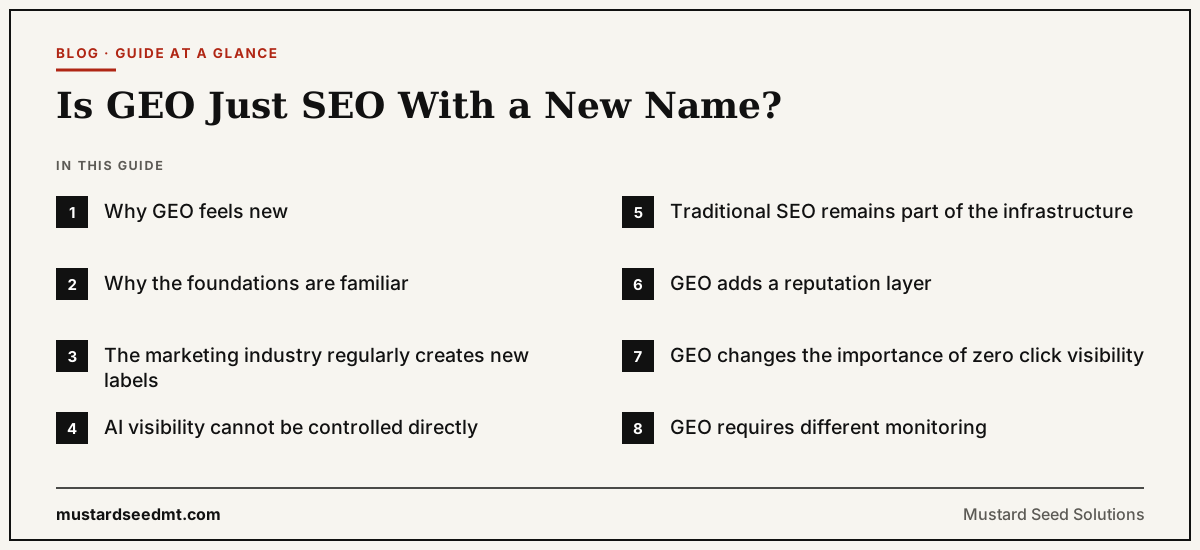
Generative Engine Optimization has become one of the most discussed terms in digital marketing.
Agencies are launching GEO services. Software companies are creating AI visibility tools. Consultants are publishing new frameworks for improving brand mentions in generative search.
This activity raises an obvious question.
Is GEO a genuinely new discipline, or is it traditional SEO presented under a new name?
The most accurate answer lies between the two extremes.
GEO does not replace the foundations of SEO, and many services sold as GEO are established SEO, content, public relations, and brand activities under new packaging.
However, generative search has changed the way information is presented, measured, and experienced by users.
GEO can therefore be useful as a new strategic lens, even when many of its methods are not new.
Why GEO feels new
Traditional search usually provides a list of links.
The user decides which pages to open and how to compare them.
Generative search can produce a combined answer.
The system may summarize sources, mention brands, compare products, and present a conclusion without requiring the user to visit several websites.
This changes the visible outcome.
A company is no longer concerned only with whether its page ranks.
It also wants to know whether the brand appears in the summary, how it is described, which competitors are included, and which sources influence the response.
These are legitimate new questions.
They justify additional measurement and reputation analysis.
Why the foundations are familiar
Most practical recommendations associated with GEO existed before the term became popular.
Businesses are advised to publish clear content, answer customer questions, earn credible mentions, build strong backlinks, maintain accurate company information, improve technical accessibility, and create original research.
These are established SEO, content marketing, public relations, and brand building practices.
Generative systems still require information.
That information must be available somewhere, whether through model training data, searchable web pages, product feeds, reviews, directories, or other sources.
A company that is invisible across the web is unlikely to become prominent simply because it adds “GEO” to its marketing plan.
The marketing industry regularly creates new labels
Marketing terminology changes quickly.
New names can help professionals explain an emerging behaviour. They can also make familiar services appear new and easier to sell.
Growth hacking, inbound marketing, content engineering, answer engine optimization, and generative engine optimization often include activities that overlap with earlier disciplines.
A new label is not automatically meaningless.
The question is whether the label helps businesses make better decisions.
GEO is useful when it reminds companies that AI generated answers are becoming another discovery surface.
It becomes less useful when agencies claim to possess secret techniques that bypass normal search, reputation, and authority systems.
AI visibility cannot be controlled directly
Some GEO marketing presents AI systems as if they contain a simple ranking checklist.
Businesses may be promised that adding specific schema, publishing a certain format, collecting reviews on one platform, or repeating brand statements will guarantee recommendations.
These claims should be treated cautiously.
Generative systems are complex and variable.
Different platforms may use different models, indexes, retrieval systems, data sources, and citation methods.
Answers can change based on the wording of the prompt and the information available at that moment.
There is no universal GEO button.
A business can improve the quality and availability of information, but it cannot fully control how every system will summarize that information.
Traditional SEO remains part of the infrastructure
When a generative platform retrieves current web information, it needs sources.
Search visibility can influence which sources are easily available.
Pages that are accessible, indexed, relevant, and externally recognised have a stronger opportunity to be discovered.
This means SEO remains important.
Keyword research helps identify what people want to know. Content optimization helps pages answer those needs. Technical SEO helps systems access the information. Links and mentions help establish credibility.
GEO does not remove these requirements.
It extends the range of outputs that businesses monitor.
GEO adds a reputation layer
One meaningful difference is the importance of the wider information environment.
Traditional SEO campaigns can concentrate heavily on the company’s own pages and backlinks.
GEO draws greater attention to how the brand is described across many sources.
An AI answer may summarize customer reviews, publication coverage, directories, forums, and comparison websites.
This makes reputation consistency more visible.
A company cannot rely only on a carefully written homepage when external sources describe a different experience.
Customer service, public relations, product quality, community engagement, and partner relationships can all influence the information available to generative systems.
These factors were always important to marketing.
GEO brings them closer to search strategy.
GEO changes the importance of zero click visibility
SEO has traditionally aimed to generate clicks.
A high ranking page attracts visitors who then enter the company’s website and conversion process.
Generative answers may satisfy the user without a click.
A business can gain visibility through a mention while receiving no direct visit.
This creates a measurement challenge.
The mention may still influence a later branded search, direct visit, sales conversation, or purchase.
Companies need to consider awareness and assisted discovery alongside direct referral traffic.
This is not entirely new. Featured snippets, local results, knowledge panels, and review platforms already created zero click interactions.
Generative search expands the pattern.
GEO requires different monitoring
Traditional ranking trackers measure where a webpage appears for a keyword.
GEO monitoring attempts to identify whether a brand appears within generated answers.
This may involve testing important prompts, recording citations, comparing competitor mentions, and monitoring referral traffic from AI tools.
The process is less stable than normal rank tracking.
Generated responses can vary, and a limited set of tests may not represent what all users see.
Businesses should avoid treating a dashboard as a complete picture of AI visibility.
The data is more useful for identifying patterns and potential information gaps.
What GEO keeps from SEO vs what it adds
| Dimension | Traditional SEO | GEO |
|---|---|---|
| Visible outcome | A list of links; the user decides which pages to open | A combined generated answer that may summarize sources and mention brands without a click |
| Scope | The company's own pages and backlinks | The wider information environment — reviews, publications, directories, forums, comparison sites |
| Click model | High-ranking pages attract clicks into the site | Zero-click visibility — a mention with no direct visit, which may still influence a later search or purchase |
| Monitoring | Ranking trackers measure where a page appears for a keyword | Testing prompts, recording citations, and comparing competitor mentions — less stable than rank tracking |
| Controllability | Influenced through keyword research, content optimization, technical SEO, and links | No universal GEO button — a business can improve information quality but can't fully control how systems summarize it |
| What stays identical | Accessible pages, useful content, credible external recognition | Same foundation — generative systems still need this information to draw on |
Some GEO recommendations are unnecessary
The popularity of GEO has encouraged the creation of complicated checklists.
Businesses may be told to restructure every article, add excessive markup, create special files for AI crawlers, or produce large volumes of machine focused content.
Not every recommendation has clear evidence behind it.
Before investing, ask what problem the activity solves.
Does it improve accessibility?
Does it make important information clearer?
Does it create a useful source?
Does it increase credible external recognition?
Does it improve customer understanding?
When the answer is no, the activity may be more useful to the service provider than to the client.
GEO agencies should explain their methods
A credible GEO provider should be able to explain the actual work.
The service may include technical SEO, content strategy, digital public relations, brand monitoring, customer review analysis, competitor research, and measurement.
These can be valuable activities.
The agency should not hide them behind mysterious terminology.
Clients should ask which platforms are being targeted, how success will be measured, which sources will be improved, and how the work differs from the existing SEO strategy.
They should also ask how the agency handles uncertainty.
Any provider promising guaranteed AI recommendations should be approached carefully.
When the GEO label is useful
GEO is useful when it changes business behaviour in productive ways.
It can encourage teams to run an AI visibility audit of how generative systems describe the brand.
It can reveal inconsistent product information, weak external recognition, outdated profiles, missing comparisons, or insufficient answers to customer questions.
It can help SEO, public relations, product marketing, and customer experience teams collaborate.
It can also encourage businesses to measure discovery beyond traditional clicks.
In this form, GEO is not a replacement for SEO.
It is an expanded framework for managing visibility across a new interface.
When GEO becomes repackaging
GEO becomes empty repackaging when an agency renames ordinary SEO tasks without changing the strategy or measurement.
It also becomes misleading when the provider claims that traditional search no longer matters.
Businesses should compare the proposed GEO work with their current activities.
If the plan consists only of writing articles, adding keywords, building links, and installing schema, it may simply be a standard SEO package with a new title.
The value should come from the work and the results, not the label.
A practical position
Businesses do not need to choose between SEO and GEO.
They need a strong digital presence that can be discovered, interpreted, and trusted across several platforms.
That requires accessible pages, useful content, accurate business information, credible external recognition, and clear measurement.
Traditional SEO remains central because search engines and web indexes continue to organise online information.
GEO adds attention to generated answers, citations, brand representation, and zero click discovery.
GEO is therefore partly SEO with a new name.
It is also a useful response to a genuine change in how users receive information.
The sensible approach is to keep the proven foundations, adopt the useful new measurements, and reject the unsupported promises.