
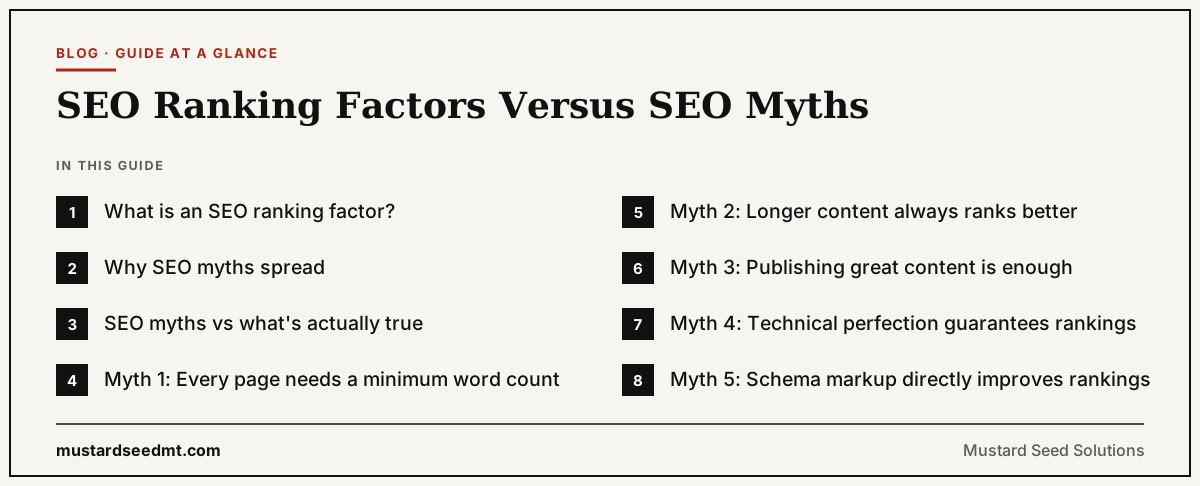
SEO is full of confident advice.
Businesses are told that every article must reach a specific word count, every website needs dozens of technical fixes, every page requires schema markup, and every old piece of content must be updated regularly.
Some recommendations are useful in certain situations. Others are exaggerations, misunderstandings, or myths repeated so often that they begin to sound like established facts.
To build an effective SEO strategy, businesses must learn the difference between a real ranking consideration and an industry belief with little practical evidence behind it.
What is an SEO ranking factor?
An SEO ranking factor is an element that search engines may use when deciding which pages should appear for a query.
Examples can include relevance, links, location, freshness, language, usability, and the reputation of the source.
However, the phrase “ranking factor” can create the wrong impression.
Search engines do not apply every factor equally to every query.
Freshness may matter greatly for breaking news, current prices, sports results, or software updates. It may matter very little for a stable historical topic.
Location may be critical for searches involving nearby services. It may be almost irrelevant for a general educational question.
Ranking is therefore contextual.
A factor can matter in one situation and have limited importance in another.
Why SEO myths spread
SEO myths spread because search engines do not publish every detail of their ranking systems.
Professionals must often work with incomplete information. They observe changes, run tests, compare websites, and form theories.
The problem begins when a theory becomes a universal rule.
A marketer may update an article and see rankings improve. They may conclude that freshness caused the result. However, the improvement could have come from stronger internal links, better search intent, new backlinks, a changed title, or an algorithm update.
Human beings naturally look for patterns. In SEO, that tendency can turn correlation into certainty.
Software companies also have an incentive to create checklists. The more problems a tool identifies, the more valuable the subscription appears.
Agencies may have a similar incentive. A complicated list of technical tasks can make a service look more sophisticated, even when many of the tasks have little effect on the client’s commercial results.
SEO myths vs what's actually true
| The myth | The reality |
|---|---|
| Every page needs a minimum word count | No universal word count guarantees rankings; length should match search intent |
| Longer content always ranks better | Length is only a visible characteristic; the goal is complete coverage, not maximum length |
| Publishing great content is enough | Good content still needs demand, discovery, relevance, internal links, and authority |
| Technical perfection guarantees rankings | Technical SEO removes obstacles but does not automatically create authority, demand, or relevance |
| Schema markup directly improves rankings | Schema helps search engines interpret content, but search engines still need independent reasons to trust and rank the page |
| Every old article must be updated regularly | Freshness matters only when the underlying facts change; updating the date alone creates no real value |
| Domain age creates authority | Accumulated links, brand recognition, content, and relationships create authority, not time itself |
| More backlinks are always better | Link quality matters more than quantity; one relevant link can outweigh hundreds of unrelated ones |
| One SEO checklist works for every website | Needs differ by business model and market; strategy should reflect intent, competition, and business type |
Myth 1: Every page needs a minimum word count
One of the most common SEO myths is that Google requires pages to contain a minimum number of words.
Some businesses are told that every article must contain at least 1,000, 1,500, or 2,000 words.
There is no universal word count that guarantees rankings.
The correct length depends on the question.
A simple definition may require only a few paragraphs. A detailed comparison may require several thousand words. A local service page may need enough information to explain the offer, location, process, and reasons to choose the provider.
Adding unnecessary text does not automatically make a page more useful.
Content should be long enough to satisfy the search intent and clear enough to help the reader take the next step.
Myth 2: Longer content always ranks better
Long content often ranks well because complex topics require detailed answers.
That does not mean length itself caused the ranking.
A long article may cover more subtopics, attract more links, answer more questions, and match a broader range of searches. These advantages may improve performance.
The word count is only a visible characteristic.
Businesses should avoid expanding an article simply to reach an arbitrary number. Repetition weakens clarity and can make the page harder to use.
The goal is complete coverage, not maximum length.
Myth 3: Publishing great content is enough
“Create great content” is one of the most repeated statements in SEO.
The advice sounds reasonable, but it is incomplete.
Quality is subjective. Different readers value different writing styles, examples, formats, and levels of detail.
More importantly, good content still needs demand, discovery, relevance, and authority.
A company may publish an excellent article on a topic that almost nobody searches for. The article may receive little traffic despite being well written.
Another company may publish a useful page but fail to connect it through internal links. Search engines may not understand how important the page is.
A strong content strategy must consider customer demand, search intent, competition, internal structure, and external recognition.
Myth 4: Technical perfection guarantees rankings
Technical SEO is important.
Broken pages, incorrect redirects, blocked content, and serious performance problems can prevent a website from succeeding.
However, technical perfection does not guarantee visibility.
A website can have excellent Core Web Vitals, clean code, structured data, and a complete sitemap while still receiving no qualified traffic.
Technical SEO removes obstacles. It does not automatically create authority, demand, or relevance.
A technically reliable website with a strong offer is more valuable than a technically perfect website with weak content and no market recognition.
Myth 5: Schema markup directly improves rankings
Schema markup helps search engines interpret certain types of information.
It can support rich search features for products, events, recipes, jobs, hotels, reviews, and other structured content.
Its usefulness does not mean that adding schema automatically increases rankings.
Schema is information provided by the publisher. Search engines still need independent reasons to trust and rank the page.
Businesses should use schema when it supports a genuine search feature or clarifies important information.
They should not treat it as a substitute for relevant content, authority, or customer value.
Myth 6: Every old article must be updated regularly
Content freshness matters when the information changes.
Articles about regulations, software, pricing, statistics, or current events may require frequent updates.
Other topics remain stable for years.
A historical explanation does not become inaccurate simply because it was published three years ago. Updating the date without adding meaningful information does not create real value.
Businesses should update content when facts, examples, products, laws, or customer needs change.
They should not change pages only to create the appearance of freshness.
Myth 7: Domain age creates authority
Older websites sometimes rank better than newer websites.
This does not prove that age itself is the cause.
An established domain may have accumulated links, brand recognition, content, traffic, customer references, and industry relationships over many years.
Those assets create authority.
A domain that sits unused for ten years does not automatically become trusted.
Time gives a business the opportunity to build authority. Time alone is not the same as authority.
Myth 8: More backlinks are always better
Backlinks can support rankings because they provide external recognition.
However, link quantity does not equal link quality.
A relevant link from a respected industry source may be more useful than hundreds of unrelated directory links.
Search engines also attempt to identify manipulative linking patterns.
Businesses should focus on earning links through useful resources, partnerships, research, public relations, and genuine industry participation.
The objective is credible recognition.
Myth 9: One SEO checklist works for every website
A local electrician, an international software company, an online retailer, and a news publisher have different SEO needs.
The electrician may depend heavily on location, reviews, and local relevance.
The software company may need educational content, comparison pages, technical authority, and industry links.
The retailer may require product data, category structure, inventory accuracy, and merchant integrations.
The news publisher may depend heavily on speed, freshness, and frequent crawling.
Using one checklist for every business ignores these differences.
SEO strategy should reflect the market, the search intent, the business model, and the competitive environment.
How to evaluate an SEO claim
When you hear a new SEO rule, ask several questions.
Is the claim supported by official documentation, credible testing, or clear evidence?
Does it make sense for every type of query?
Could another change have caused the reported result?
Is someone selling a tool or service connected to the claim?
Does the recommendation improve the user experience or business outcome?
These questions do not eliminate uncertainty, but they reduce the risk of following weak advice.
Focus on principles instead of myths
Search algorithms change, but several principles remain useful.
Create pages that answer real customer needs.
Make those pages accessible to search engines.
Use clear internal links.
Build recognition through real relationships and useful work.
Match content to search intent.
Measure leads, sales, and qualified enquiries instead of focusing only on rankings.
SEO becomes more effective when businesses stop chasing every new theory and start building durable assets.
Ranking factors matter, but they must be understood in context.
The best strategy is not the one with the longest checklist. It is the one that connects search visibility with genuine customer value and measurable business growth.