
E-E-A-T is one of the most frequently misunderstood ideas in SEO.
The term stands for Experience, Expertise, Authoritativeness, and Trustworthiness. It appears in Google’s Search Quality Rater Guidelines and in Google’s guidance for creating helpful, reliable content.
If you want the full framework — what each of the four parts means and how to demonstrate them — start with What Is E-E-A-T in SEO? This article answers a narrower question: does E-E-A-T work as a ranking factor?
Because Google discusses E-E-A-T publicly, many marketers describe it as a ranking factor.
That description is not precise.
Google states that E-E-A-T itself is not a specific ranking factor. Google also explains that its systems use a mixture of factors that can help identify content demonstrating aspects of E-E-A-T.
The distinction matters.
E-E-A-T is not one score or switch within the algorithm. It is a framework that describes qualities Google wants its systems to recognise.
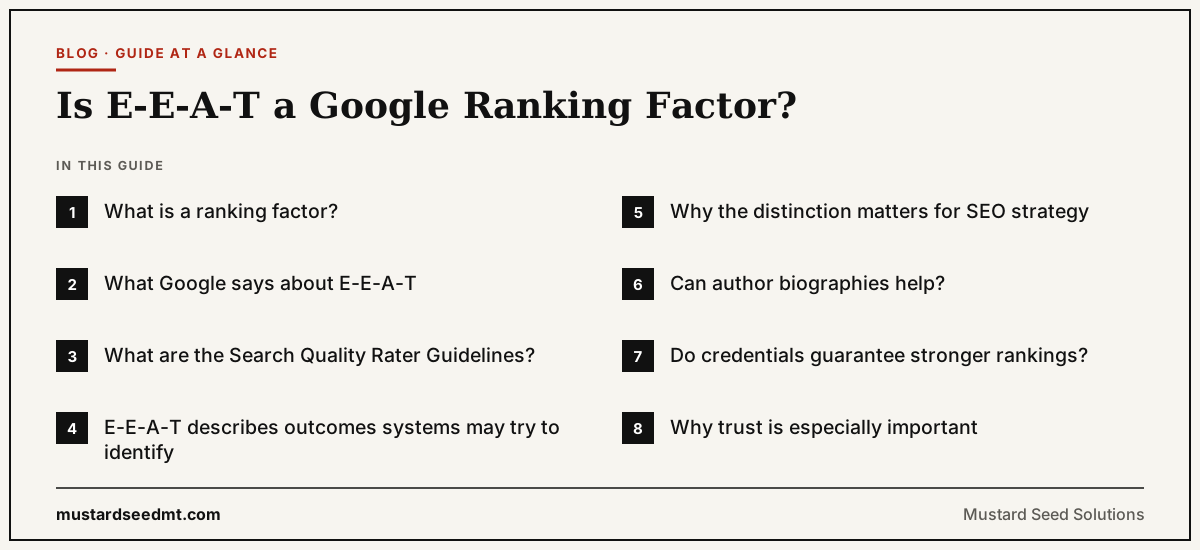
What is a ranking factor?
A ranking factor is an input or signal used by a search system when evaluating pages.
Examples may involve relevance, links, freshness, location, language, or page usability, depending on the query.
Google uses many automated systems and signals to evaluate large amounts of content and select relevant results.
Marketers often use the phrase “ranking factor” more broadly than Google does.
They may call any activity associated with successful websites a ranking factor.
This creates confusion.
A characteristic can be common among high ranking pages without being a direct algorithmic input.
For example, respected experts may attract more links, receive more brand searches, and produce more accurate content. These outcomes can support visibility without Google needing a simple “expert author” score.
What Google says about E-E-A-T
Google’s current helpful content guidance explains that its automated systems use many factors to rank content.
After identifying relevant pages, those systems aim to prioritise information that appears helpful.
Google says its systems identify a mix of factors that can help determine whether content demonstrates experience, expertise, authoritativeness, and trustworthiness.
It then makes the central clarification: E-E-A-T itself is not a specific ranking factor.
This means website owners should not look for one technical implementation that turns E-E-A-T on.
There is no E-E-A-T tag, score, plugin, or schema property that guarantees an improvement.
What are the Search Quality Rater Guidelines?
Google uses human quality raters to evaluate examples of search results.
The raters follow detailed guidelines to assess whether the results meet user needs and demonstrate appropriate quality.
Their assessments help Google evaluate how well its ranking systems are performing.
Google has repeatedly explained that individual rater scores do not directly change the rankings of the pages being reviewed.
A rater cannot give a page a low score and directly push it down in search.
The feedback is used to evaluate systems and proposed changes more broadly.
The guidelines are therefore important, but they should not be mistaken for a public copy of the ranking algorithm.
E-E-A-T describes outcomes systems may try to identify
Search systems need ways to distinguish credible information from weak or misleading information.
They may evaluate signals that indirectly relate to E-E-A-T.
For example, credible sources may receive links and references from other respected websites.
A recognised specialist may be mentioned in professional publications.
A trustworthy ecommerce website may provide clear customer service information, secure transactions, accurate product details, and a strong reputation.
A useful review may contain evidence of first hand testing.
These are observable patterns.
The search system does not necessarily need to understand E-E-A-T as one human concept. It can use many signals that collectively help produce results people perceive as experienced, expert, authoritative, and trustworthy.
Why the distinction matters for SEO strategy
When businesses treat E-E-A-T as one ranking factor, they often search for shortcuts.
They add author biographies to every article, display qualification badges, create excessive About pages, or add structured data identifying everyone as an expert.
Some of these actions can improve transparency.
They do not automatically improve rankings.
An author biography is useful when it helps readers understand who created the content and why that person is qualified.
It is not useful when the biography makes exaggerated claims or has no relationship to the subject.
The goal should be credible evidence, not decorative optimization.
Can author biographies help?
Author biographies can support trust and transparency.
They identify the person responsible for the content and may explain relevant experience or qualifications.
This is particularly useful for technical, financial, medical, or other sensitive subjects.
However, Google has not stated that adding an author biography creates a universal ranking boost.
The biography should be treated as part of the reader experience and editorial accountability.
A strong biography cannot compensate for inaccurate, copied, or unhelpful content.
The content and the evidence behind it remain central.
Do credentials guarantee stronger rankings?
Formal credentials can be important when the subject requires professional expertise.
A medical article reviewed by a qualified doctor may be more appropriate than one written by an unqualified generalist.
However, credentials alone do not guarantee that the page is the best result.
The content must still match the query, be accessible, explain the subject clearly, and provide useful information.
For other topics, practical experience may matter more than formal education.
Someone who has used a product extensively may produce a more useful review than someone with an unrelated academic qualification.
Google’s E-E-A-T explanation specifically recognises that different questions require different forms of credibility.
Why trust is especially important
Google identifies trust as the most important aspect of E-E-A-T.
The other elements can contribute to trust, but content does not necessarily need to demonstrate all of them equally.
A person may have real experience but still publish misleading information.
An expert may possess strong qualifications but hide a commercial conflict.
An authoritative company may make inaccurate claims.
Trust requires accuracy, honesty, transparency, and responsibility.
This is why E-E-A-T cannot be reduced to author credentials or brand popularity.
E-E-A-T and high risk subjects
Google says that signals aligned with strong E-E-A-T receive greater weight for subjects that could significantly affect health, financial stability, safety, or society.
These are commonly known as Your Money or Your Life topics.
The standard of evidence should reflect the possible harm.
A casual opinion about office decoration does not require the same review process as medical treatment advice.
Businesses publishing sensitive information should use appropriate specialists, verify claims, cite reliable evidence, explain limitations, and review content when facts change.
This is good practice regardless of whether a specific ranking benefit can be measured.
E-E-A-T is not a score businesses can track
Many SEO tools attempt to convert complex quality concepts into scores.
These estimates may help teams organise audits, but they are not official Google E-E-A-T measurements.
Google Search Console does not provide an E-E-A-T score.
A business should be cautious when an agency claims it can increase E-E-A-T from one number to another.
The more useful measurements are connected to real evidence.
These can include relevant backlinks, brand mentions, customer reviews, citations, qualified traffic, conversions, returning users, and direct searches for the company or its specialists.
Even these metrics do not represent E-E-A-T directly.
They provide indicators of recognition and trust.
How to improve the qualities behind E-E-A-T
Create content that matches the needs of the audience.
Use suitable experts or experienced contributors.
Explain who created the information and how it was produced.
Publish original examples, research, case studies, and practical observations.
Build recognition through credible relationships, professional participation, and useful work.
Maintain accurate company and contact information.
Disclose sponsorships, affiliate relationships, and commercial incentives.
Correct errors and update important information when facts change.
These actions do not manipulate an E-E-A-T score.
They build the substance that search systems and users may interpret as credible.
The correct conclusion
E-E-A-T is not a specific Google ranking factor.
It is a quality framework used in Google’s rater guidance and public advice to describe the kinds of content and sources that users may consider credible.
Google’s systems use many factors that can help identify qualities associated with E-E-A-T, particularly for sensitive topics.
Businesses should therefore avoid two opposite mistakes.
The first mistake is treating E-E-A-T as a direct score that can be increased through a checklist.
The second is dismissing it completely because it is not one ranking factor.
Experience, expertise, authority, and trust still matter to customers.
They also influence the evidence and signals available to search systems.
E-E-A-T should guide quality and credibility decisions.
It should not be sold as an algorithmic button.