
A business can show healthy annual revenue and still pay its owner less than minimum wage once every non-billable hour is counted. Revenue looks fine on an invoice, but admin work, unpaid revisions, marketing, and email are unpaid hours quietly diluting the real rate down to a number most people would never accept from an employer.
The math itself isn't complicated, which is exactly why it's so easy to avoid. True hourly rate is take-home pay, after overhead and taxes, divided by every hour actually worked — not just the hours a client agreed to pay for. Most solopreneurs never run that calculation, because the invoice rate feels like the real number. It isn't.
One story from a small business discussion online shows exactly how this plays out when someone finally does the math.
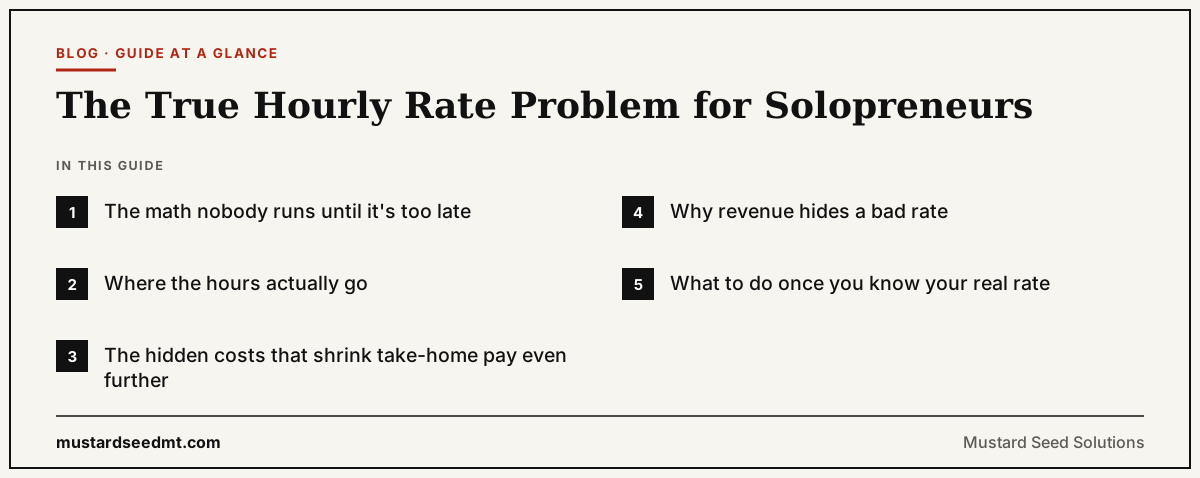
The math nobody runs until it's too late
A digital marketing freelancer described three years of charging rates set when they had zero experience and needed any client they could get. They hadn't given themselves a raise since. When they finally sat down and accounted for actual hours worked, software costs, and taxes across all 22 clients on their books, the number that came out was roughly $14 an hour — for skilled, in-demand work, delivered to real clients who were paying on time. On paper, the business looked like a functioning freelance practice, billing real invoices every month. In reality, the owner was earning less per hour than many entry-level jobs, and had been for years without noticing, because the revenue total was the only number they were actually watching.
That's the core trap: revenue and take-home pay per hour are two completely different numbers, and only one of them shows up automatically. Nobody sends you a notification when your effective rate quietly drops below minimum wage — the invoices keep looking the same either way.
What makes this story useful isn't just the low number, it's what changed once they finally saw it clearly. Once the math was in front of them, the fix wasn't complicated: a 40% rate increase, phased in with three months' notice. The clients who left were, almost without exception, the ones generating the most non-billable admin in the first place — the haggling, the extra revision rounds, the back-and-forth that never showed up as billable hours but ate real time all the same.
Where the hours actually go
A separate solo founder captured the other half of the problem well, describing the feeling of working 16-hour days without being able to point to where the time actually went, and asking outright how to figure out where the hours were disappearing to. Their best guess was that email alone was eating a disproportionate chunk of the day. Replies pushed back gently on the assumption itself: the poster likely wasn't working 16 real hours so much as feeling like it, and the only way to know the difference was to actually track time for a week or two rather than estimate it from how exhausted the day felt.
That's a common pattern across solopreneur discussions — the hours that never make it onto an invoice are frequently the majority of hours worked. Admin, client communication, invoicing, proposal writing, unpaid revision rounds, and marketing all compete with billable work for the same limited hours in a day, and almost none of them get tracked. A true hourly rate calculation only works if that hidden time gets counted alongside the billable hours, not treated as a rounding error.
The hidden costs that shrink take-home pay even further
An hourly rate math that stops at "revenue divided by hours" is still missing pieces most employees never have to think about. Solopreneurs cover their own health insurance, their own retirement contributions, their own paid time off, and self-employment tax on top of income tax — none of which show up in a simple revenue figure, and all of which a fair comparison to an employee salary needs to account for. A rate that looks competitive against a friend's day-job salary can turn out to be well behind it once those gaps are priced in, which is exactly why a real freelance rate calculation should build the safety-net gap into the number from the start rather than treating it as a nice-to-have.
One commenter, reacting to a solopreneur pricing a full branding package at only a few hundred dollars, put a sharper number on how thin the margin can get in low-priced service work: at roughly $600 per project, you'd need around 100 clients a year just to clear $60,000 in revenue — before accounting for a single hour of the admin, marketing, and non-billable work required to land and service each one. Revenue figures that look reasonable in isolation can hide an hourly reality that isn't, especially once you account for how much unpaid time it takes to actually close 100 separate clients a year rather than a handful of larger ones.
Why revenue hides a bad rate
Revenue only counts money that shows up. It says nothing about how many hours it took to earn, how much of that time was unpaid, or how sustainable the pace actually is. One offhand comment elsewhere summed up the grind end of this spectrum bluntly: low pay and long hours, 60 to 80 hours a week, is simply what many early-stage service businesses run on — often without anyone stopping to calculate what that works out to per hour. A separate thread about staying organized while doing everything solo described the same load from the inside: wearing every hat at once — product, admin, planning, client work — with the hardest part being less the work itself and more keeping any of it from getting scattered across a day with no real boundaries.
That's why a true hourly rate calculation matters more than watching the revenue line. It's the only version of the math that answers the actual question: is this business, per hour of your life, actually working, or does it just look like it is from the outside?
What to do once you know your real rate
Start by logging every hour for two weeks — billable and non-billable both. Run the total against your take-home pay using our true hourly rate calculator, and compare the result against your local minimum wage as a baseline, not an aspiration. If the number is low, you generally have three levers: raise your prices (our piece on underpricing covers what actually happens when solopreneurs do this), cut or reprice the services eating the most unpaid time, or drop the clients generating the most non-billable friction. Our pricing guide walks through all three in more depth. None of the three require reinventing your business — the freelancer in the story above didn't change what they did, only what they charged for it, and the results showed up within a single billing cycle.
This exact gap between revenue and real hourly pay was one of the clearer patterns across the 270 threads we analyzed for our solopreneur challenges report, and it rarely fixes itself without someone running the numbers on purpose.