
Artificial intelligence is changing how people search for information.
Instead of receiving only a list of links, users can now receive generated explanations, comparisons, recommendations, and summaries. Google Search includes AI Overviews and AI Mode, while other platforms provide conversational answers based on web information and model knowledge.
These developments have led some marketers to claim that traditional search engine optimization is becoming irrelevant.
That conclusion is premature.
AI may change how search results are presented, but it does not remove the need for discoverable, accessible, relevant, and credible information. In fact, many of the principles that support traditional SEO also support visibility within AI search experiences.
Google’s current guidance states that established SEO best practices remain relevant for AI features in Search. Pages must still be indexed and eligible to appear in Google Search before they can be shown as supporting links in AI Overviews or AI Mode. Google also says there are no separate technical requirements or special schema needed solely for these AI features.
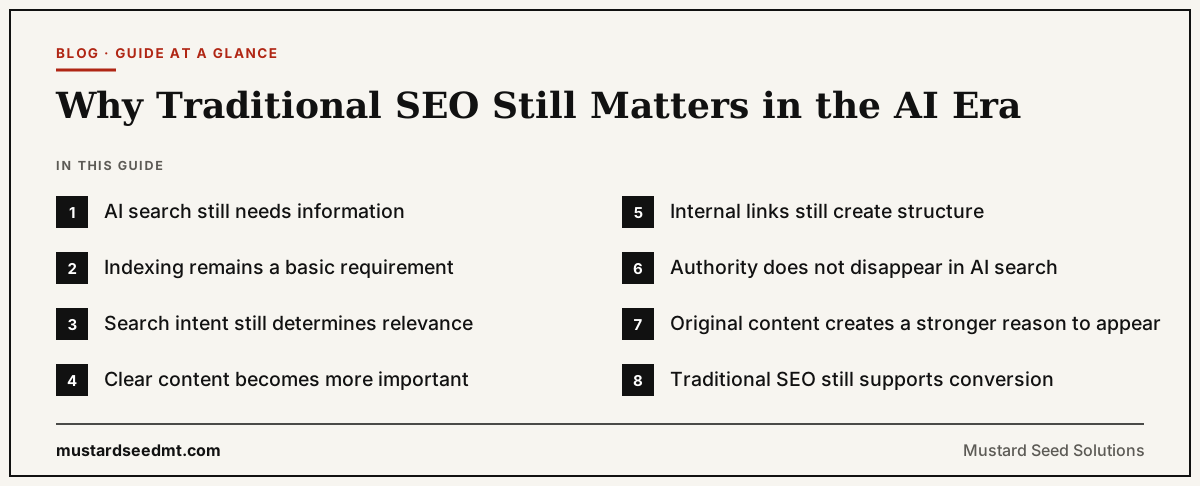
AI search still needs information
An AI system cannot create a reliable answer without information.
That information may come from model training, live web retrieval, search indexes, product databases, local listings, reviews, or structured sources.
When an AI tool retrieves current web information, it needs pages that can be found and processed.
This is where traditional SEO remains important.
Search engines still need to discover URLs, crawl pages, understand their subjects, and evaluate whether they are relevant enough to include in search experiences.
A company with an inaccessible website, weak internal linking, unclear content, and limited public recognition will not become visible simply because customers begin using AI tools.
AI changes the interface between the user and the information. It does not eliminate the information infrastructure underneath it.
Indexing remains a basic requirement
A webpage cannot contribute much to Google’s AI features if it is not eligible for normal Google Search.
Google explains that a page must be indexed and eligible to appear with a search snippet before it can be shown as a supporting link in AI Overviews or AI Mode. Meeting these requirements does not guarantee inclusion, but failing them limits the opportunity.
This makes technical SEO relevant.
Businesses still need to ensure that important pages are not accidentally blocked by robots instructions, incorrect canonical tags, login requirements, broken redirects, or server problems.
Important content should be available in accessible text. Pages should be connected through useful internal links. Navigation should help users and search systems understand the website.
Technical SEO does not guarantee rankings or AI citations. It creates the conditions required for consideration.
Search intent still determines relevance
People use AI search to complete many of the same tasks they previously completed through traditional search.
They want definitions, instructions, comparisons, products, providers, recommendations, and solutions.
The queries may become longer and more conversational, but the underlying need remains.
A person might traditionally search for “best CRM for small business.”
In an AI search tool, the same person might ask, “Which CRM is suitable for a ten person consulting company that needs simple reporting and does not have a dedicated sales operations team?”
The second query contains more context, but it is still a search intention.
Businesses need content that explains who their product is for, what problems it solves, how it compares with alternatives, and what limitations customers should understand.
Keyword research remains useful because it reveals the language and concerns of the market.
The goal is not to repeat exact phrases mechanically. It is to understand what customers need and create pages that answer those needs.
Clear content becomes more important
AI systems may extract, summarize, and combine information from several pages.
Vague content provides little useful material for this process.
A homepage claiming to offer “innovative solutions for the modern world” does not explain the company’s actual services.
A clearer page identifies the service, intended customer, location, process, deliverables, and expected outcome.
Google recommends making important information available in textual form and focusing on helpful, reliable, people-first content. Its current AI guidance also emphasizes valuable, unique information rather than content created only to satisfy a new optimization trend.
Clear writing benefits traditional rankings, AI summaries, and human readers.
Internal links still create structure
Internal links help search systems discover pages and understand their relationships.
A website may contain excellent content, but that content can remain isolated when nothing links to it.
Strong internal structure shows which pages are central and which pages provide supporting detail.
A main guide about SEO could link to related articles about crawling, backlinks, content quality, and AI search. Those articles could link back to relevant services.
This structure helps distribute attention across the website and makes it easier for users to continue their research.
Google’s guidance for AI features specifically includes making content easy to find through internal links.
Authority does not disappear in AI search
AI systems need ways to judge which information is credible enough to use.
A company’s own website is only one source.
Independent publications, professional associations, customers, partners, researchers, and industry communities may also describe the brand.
Traditional SEO has always considered external recognition important. Backlinks can help search engines discover pages and understand which sources receive references from others.
In the AI era, brand mentions and reputation across external sources may become even more visible.
A generated answer can combine official product information with reviews, comparisons, media coverage, and customer discussions.
Businesses therefore need more than optimized pages. They need real authority within their markets.
Public relations, partnerships, research, customer success, and community participation can support both SEO and AI visibility.
Original content creates a stronger reason to appear
Generic information is easy to reproduce.
Thousands of websites can publish the same basic definition or list of tips.
AI systems are particularly good at summarizing common information, which may reduce the value of publishing another version of what already exists.
Businesses need reasons to become sources.
Original research, case studies, proprietary data, useful tools, expert analysis, and practical experience create information that other people can reference.
Google’s guidance for AI search encourages content that is valuable, unique, and non-commodity.
Originality does not require inventing a completely new subject.
A company can add value by explaining what it has learned from real work, presenting evidence, showing tradeoffs, or documenting a process more clearly than competitors.
Traditional SEO still supports conversion
AI answers may reduce some clicks because users can obtain information directly within the search experience.
However, customers still need websites when they want to evaluate a provider, review detailed information, request a proposal, create an account, or make a purchase.
The company website remains a controlled destination.
It allows the business to explain its offer, present evidence, answer objections, and guide the visitor towards action.
SEO supports this process by attracting people with relevant needs.
A brand mention in an AI answer may create awareness, but a well designed website helps convert that awareness into a business result.
SEO measurement is evolving
Traditional SEO has been measured through rankings, impressions, clicks, traffic, leads, and revenue.
AI search introduces additional indicators, including generated citations, brand mentions, AI referral traffic, and assisted discovery.
Google has introduced dedicated reporting for visibility within generative AI Search features, while continuing to include that activity within wider Search performance data.
Businesses should expand their measurement rather than abandon established metrics.
Organic traffic and conversions still matter. Brand searches, direct visits, AI referrals, and customer discovery responses can provide additional context.
The objective is not to win an AI visibility score.
The objective is to generate meaningful business opportunities.
SEO and AI visibility should be one strategy
Businesses do not need completely separate SEO and AI search departments.
The foundations overlap.
Create technically accessible pages. Understand customer search intent. Publish clear and useful information. Build logical internal links. Earn credible external recognition. Maintain accurate business details. Measure qualified traffic and conversions.
Then monitor how AI systems represent the brand and identify gaps.
Traditional SEO still matters because AI search does not operate in an information vacuum.
The companies most likely to succeed are those that are easy to discover, easy to understand, and credible enough to reference.
The presentation of search is changing.
The need for strong SEO foundations is not.