
AI for Solopreneurs: Threat and Toolkit
AI is already cutting into some solopreneur income streams — search traffic, template-based freelance work — while handing solo operators tools that once required a whole team. The honest answer isn't simply "will AI replace you." It's which parts of your business AI strengthens, which parts it genuinely threatens, and how to get found when clients ask AI instead of Google.
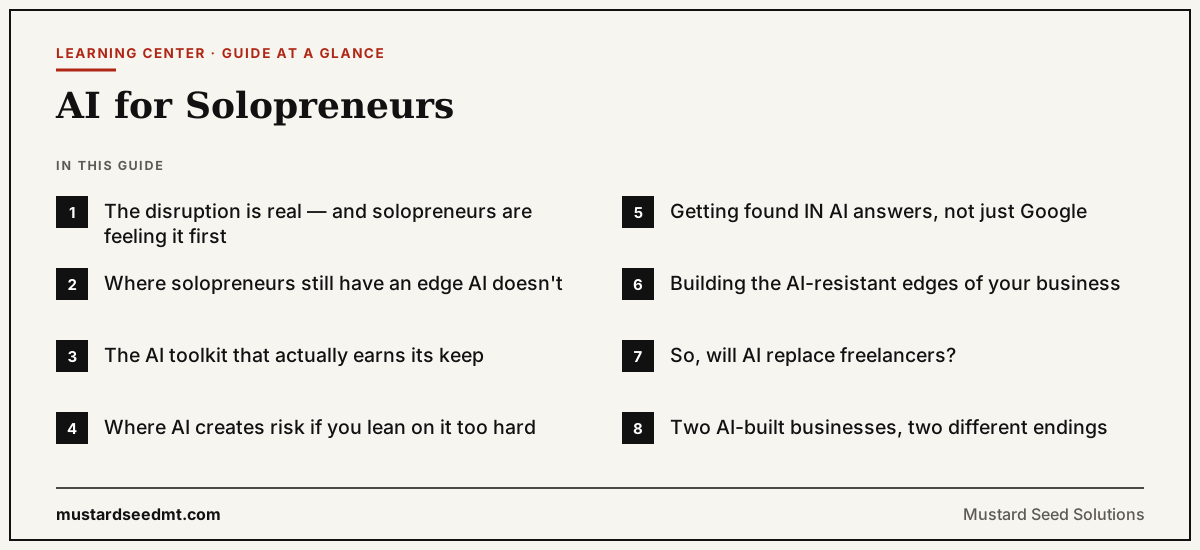
Both halves of this are real, and solopreneurs online are living through both at once — often in the same week, sometimes in the same person. A founder who watched a decade-old business lose search traffic to ChatGPT and a founder who used AI-assisted coding to build a profitable tool from nothing are not two different audiences; they're two possible outcomes for the same skill set, depending on what part of the business AI touches. This guide covers the disruption honestly, the toolkit that's actually earning its keep day to day, the risk of leaning on it too hard, and the part almost no small competitor is working on yet: showing up when AI itself is asked who to hire.
1. The disruption is real — and solopreneurs are feeling it first
This isn't a strawman worry, and treating it like one would insult the people living through it. Solo operators with long, profitable track records describe watching demand shift within a single year of ChatGPT's release — not a hypothetical future disruption, but one already logged in their revenue charts.
- One founder who'd run a profitable script-generation SaaS for over a decade watched sales climb every year, then invert almost exactly when ChatGPT launched — "people just go to AI instead of Google," cutting off the organic search traffic the entire business model depended on
- That same founder had already integrated their product with ChatGPT and made it a genuinely better tool than raw AI alone — and it still wasn't enough to offset the loss of top-of-funnel discovery, because fewer people were searching for the problem at all
- AI-assisted ("vibe") coding has made building software nearly free — but as one founder who built seven apps with no paying users put it, "it's now easier to build, but it's very difficult to sell because so many people can do the same"; a commenter summarized the shift even more bluntly as "barrier to entry 0, barrier to revenue 100"
- Some freelance and service tasks that used to require a person — first-draft copy, boilerplate documents, simple scripts, template-based deliverables — are now a free prompt away for many buyers who would previously have hired someone
- The anxiety shows up as a practical business problem, not abstract fear: falling top-of-funnel traffic, harder differentiation, and in at least one case, a successful founder actively job-hunting again after well over a decade of running their own business
2. Where solopreneurs still have an edge AI doesn't
The businesses most exposed to AI are the ones selling something fully genericizable, with nothing else attached. Judgment, accountability, and relationships are harder to automate away — and the people most skeptical of AI in client-facing work tend to be the ones with the most on the line if it's wrong.
- Someone has to be accountable when AI is wrong — courts have sanctioned attorneys for filing briefs with AI-hallucinated case citations, and that professional liability doesn't move onto the AI vendor no matter how confident the output sounded
- One small business owner described "the catastrophe that is AI-powered bookkeeping" as a cautionary example — output that looks confident and correct still needs a human who can catch a wrong answer, and most non-experts can't reliably do that verification themselves
- Direct relationships, a track record, and specific in-context experience are exactly what a generic AI answer can't fake — several small business owners describe active fatigue with vendors pitching "AI-powered" versions of tools with no real new capability behind the label
- A law firm owner summed up a common professional stance bluntly: after watching courts sanction attorneys for AI-generated errors, they will not incorporate an LLM into client work, full stop — a reminder that in accountability-heavy work, the human stays the product being sold
- Even AI's most enthusiastic small-business users draw a hard line at unedited output — one operator's advice on using AI for something like a podcast summary was explicit: get a draft, then "YOU edit that summary into a coherent description" before it goes anywhere near a client
3. The AI toolkit that actually earns its keep
Set the anxiety aside for a moment — solopreneurs are also getting real, measurable leverage from AI tools, day to day, on the boring parts of running a business alone. The honest reports (not the vendor pitches) cluster around a handful of genuinely useful jobs.
- Research and first drafts: several solo operators use AI search tools for product research and competitive scans, describing them as "way better than google now for research" and faster than manually scrolling through search results one tab at a time
- Content production: AI-assisted video and content editing tools are letting solo operators produce far more content in the same time, by automating tedious cleanup work — trimming filler words, cutting long recordings into shorter clips — that used to eat hours per week
- Recurring operations: one founder described running a set of scheduled AI workflows every week — pulling Search Console data, drafting SEO recommendations, and prepping blog and newsletter content automatically — calling the shift not just "using AI tools" but "building systems where agents work together with clear roles," with each agent handling one narrow, defined job rather than one tool trying to do everything
- Shipping the product itself: a non-developer used AI-assisted coding to build a desktop LinkedIn automation tool from scratch — something they couldn't have built alone a few years earlier — and generated roughly $3,600 in revenue in its first three months with no formal engineering background
- Organizing the business itself: solo operators also use general-purpose AI tools to turn messy personal notes into documented procedures, so a one-person operation has something closer to an actual operations manual instead of everything living in one person's head
- Total monthly spend on a working AI stack is often modest relative to the time saved — one operator estimated their combined tools cost roughly $200–250 a month while saving an estimated 20 hours a week, time redirected straight into higher-value client and growth work
4. Where AI creates risk if you lean on it too hard
The same solopreneurs getting real value from AI are also the ones warning most loudly about its failure modes — usually from having been burned, or having watched a peer get burned, not from generic caution.
- Treating AI output as verified fact instead of a first draft is the single most commonly reported mistake — "the amount of people... that take whatever ChatGPT spits out as gospel is insane," as one small business owner put it, describing it as a growing, not shrinking, problem
- "Just put it into ChatGPT" is genuinely risky advice for legal, financial, or compliance-sensitive work — one commenter called it "such alarming advice" precisely because the professional and reputational exposure lands on the business owner, not the tool that generated the mistake
- Being pitched an "AI-powered" version of something you already use, with no real advantage, is common enough that owners describe outright fatigue with the sales approach — one business owner asked other founders to share "the most ridiculous business case you've been pitched by the AI-scammers," and the replies came fast
- Speed of building isn't the same as a real business — a founder who shipped multiple AI-assisted apps in a year got "total silence" from several of them, because AI solved the build problem, not the distribution problem, and no amount of additional building fixed that
- Leaning on AI output without editing it is a habit that spreads inside organizations too — one commenter described a founder who would "copy and paste unedited output from chatgpt and call that 'brainstorming'" while dismissing genuinely original ideas from actual team members
5. Getting found IN AI answers, not just Google
This is the shift solopreneurs are already noticing but few are acting on yet: when a prospective client asks ChatGPT, Perplexity, or Claude who to hire, is your business part of the answer — or does the model recommend a competitor, a generic category, or nothing specific at all?
- The mechanism is different from classic SEO — AI answer engines synthesize a direct answer from sources they trust and can cite, rather than returning a ranked list of links for a human to click through and evaluate themselves
- Solopreneurs are already naming this shift themselves, from direct experience: one founder facing declining search traffic advised that "ChatGPT has its own kind of SEO to get recommended and referred within ChatGPT, it's like the new google... research best practice and make sure you optimize for ChatGPT to find you"
- Citation-based tools are becoming a default research habit for buyers, not just curiosity — one operator called Perplexity's citation feature "clutch when you need to back up data," and another described it as having "caught Google off guard" by building a fundamentally different answer experience rather than competing on Google's own terms
- If your expertise, content, or business isn't part of what these models can retrieve or reference, you're effectively invisible in that answer even if you'd rank #1 on Google for the exact same query — ranking and being cited are no longer the same achievement
- Almost no small competitors are actively working on this yet, which is precisely why it's an opportunity rather than a saturated tactic — the founders naming the shift out loud in the evidence above are describing something they're reacting to, not something they've already solved
6. Building the AI-resistant edges of your business
The goal isn't to out-build AI at scale — it's to make the parts of your business that depend on judgment, reputation, and relationships load-bearing enough that a generic AI answer can't route around you.
- Distribution built on relationships and reputation is harder to disintermediate than pure search traffic — one indie founder responding to a peer's AI-driven traffic decline described what's working now as "distribution via narrative: building in public, sharing failures/learnings, and showing how your tool saves people time better than generic AI"
- Keep at least one owned channel — an email list, a direct client relationship — that doesn't depend on being discovered through any single layer, AI-powered or not; the founders who felt the ChatGPT traffic drop hardest were the ones whose entire funnel ran through organic search alone
- Specialize toward what depends on your specific judgment and experience; the more generic and template-like an offer is, the more exposed it is to a free AI equivalent, and the more a client is really paying for your name and accountability, the less exposed it is
- Treat showing up in AI answers as an extension of your marketing plan, not a replacement for having a distinct, well-positioned offer in the first place — an AI model can only cite a business that's actually differentiated enough to be worth citing
So, will AI replace freelancers?
Not as a single event, and not evenly. The clearest damage shows up where AI can fully substitute the deliverable — a 14-year SaaS business built on generating sales scripts watched its search-driven growth curve invert almost exactly when ChatGPT launched, because buyers who used to search now just generate the thing themselves. That's a real, documented loss of top-of-funnel demand, not a hypothetical.
At the same time, "AI made it easy to build" is not the same as "AI made it easy to sell." Founders using AI-assisted coding to launch products describe the opposite failure mode: shipping fast, then hearing nothing, because — as one founder who built several apps with zero paying users put it — the barrier to build dropped to zero for everyone at once, which made distribution, not development, the bottleneck. This mirrors a pattern our research into the 50 biggest solopreneur challenges surfaced repeatedly: the hard part of a one-person business has rarely been the making — it's being found and chosen.
So the realistic framing isn't "AI will replace me" or "AI can't touch me" — it's an honest audit of which parts of your specific offer are generic enough for AI to fully substitute, and which parts depend on judgment, accountability, or a relationship no model can stand in for.
Two AI-built businesses, two different endings
Two stories from solo operators using AI-assisted coding to build products land on opposite ends of the same tool, and the difference between them isn't the technology.
One founder, working in sales and frustrated with existing LinkedIn automation tools that kept triggering account warnings, used AI-assisted coding to build a desktop-based alternative designed specifically to look more natural to LinkedIn than the cloud and browser-plugin tools already on the market. They built it primarily to solve their own problem, then promoted it themselves — running their own outreach campaigns with the tool, posting about it on LinkedIn and Reddit, and optimizing the site for organic search. Roughly $3,600 in revenue followed within three months.
Another founder, two years into full-time "vibe coding" after leaving a job they saw as a dead end, described a very different outcome: repeated apps met with total silence, no paying users, and mounting debt, despite genuinely capable products. A commenter's explanation of the gap was blunt — building has gotten easy for everyone at once, "so while it's now easier to build, it's very difficult to sell." The founder had solved for the wrong constraint.
The difference wasn't skill with AI tools — both founders could clearly build. It was that the first had a specific, personally-felt problem, an existing professional network to promote into, and a plan to be the one distributing the product. The second had a product and hoped distribution would follow. AI collapses the cost of building; it does nothing to collapse the cost of being found, trusted, and chosen — that part is still, stubbornly, a marketing and relationships problem.
Getting found in AI answers: the practical next step
Search engines used to be the front door. Increasingly, an AI answer is. When someone asks ChatGPT, Perplexity, or Claude "who should I hire to do X near me" or "what's the best tool for Y," the model either names your business as part of its answer, or it doesn't — and right now, almost none of your small competitors are actively working on which outcome happens. That's a genuinely open opportunity, the same way early SEO was before most small businesses had heard of it.
This discipline goes by a few names — AI visibility, generative engine optimization (GEO), answer engine optimization (AEO) — and it's distinct from traditional SEO even though the two overlap. It rewards the same underlying habits good SEO always has (clear, specific, well-structured content that actually answers a real question), but the mechanism an AI model uses to decide who to cite is different enough from a ranking algorithm that treating them as identical leaves real visibility on the table. Most solopreneurs haven't audited this yet, which is exactly why doing it now is worth more than doing it in a year.
Want to know what AI currently says about your business? Mustard Seed's AI Visibility Audit checks whether ChatGPT, Perplexity, and Claude currently recommend you, what's missing for them to cite you with confidence, and where the fastest wins are.
The pattern worth noticing: the solopreneurs who are already naming "optimize for ChatGPT to find you" as a real strategy are the same ones who watched their old search traffic decline. They're not guessing — they're reacting to a shift they lived through first, and the businesses that act on that pattern before it's common knowledge get the same early-mover advantage that early SEO adopters got a decade earlier.
Where to start this month
Treating "AI strategy" as one big decision tends to produce paralysis. Splitting it into four small, concrete moves — one from the toolkit side, one from the risk side, and two from the AI-visibility side — is more realistic for a business with one person running it.
Toolkit
Pick one recurring task (research, first drafts, or content cleanup) and hand it to an AI tool for 30 days
Risk
Name the one client-facing task where AI output absolutely must be human-verified before it goes out
Visibility
Ask ChatGPT and Perplexity what they know about your business today — write down exactly what they say
Visibility
Publish or update one clear, specific page about what you actually do — the raw material AI models need to cite you
Frequently Asked Questions
Will AI replace freelancers and solopreneurs?
Not evenly, and not as one event. The evidence points to real disruption for generic, template-based work and for search-driven traffic — one 14-year SaaS founder watched sales drop as soon as ChatGPT launched, describing buyers going straight to AI instead of searching for a tool at all. But work built on accountability, judgment, and direct relationships (the kind courts still hold humans responsible for, and clients still hire specific people for) is proving much harder to automate away. The realistic risk is concentrated in offers that AI can fully replicate with nothing else attached — the more your work depends on your specific judgment, track record, or relationship with the client, the more that risk shrinks.
What AI tools are actually useful for a one-person business?
Solopreneurs most often cite AI search tools for research and competitive scans, AI-assisted writing tools for first drafts (that a human still edits before anything goes to a client), AI video/content editing tools that cut production time, and scheduled AI workflows for recurring tasks like content audits or note cleanup. Several also report using AI-assisted ("vibe") coding to ship real products without a formal engineering background — one non-developer built a desktop tool and generated meaningful revenue within three months. The common thread isn't any single tool; it's using AI for the repeatable, verifiable parts of the work and keeping judgment-heavy decisions with a human.
How do I get my business mentioned by ChatGPT or Perplexity?
It starts with the same foundation as good SEO — clear, specific, well-structured content about what you actually do — plus making sure your expertise is publicly documented somewhere these models can find and trust it. Solopreneurs who've watched their own search traffic decline are already describing this shift directly: optimizing specifically for AI models to find and recommend you, not just for a search engine to rank you. This is a distinct, newer discipline (often called AI visibility, GEO, or AEO) rather than a setting you flip on. A dedicated audit is the fastest way to see where you currently stand.
Is AI visibility the same thing as SEO?
Related, but not identical. Traditional SEO earns a ranked position in a list of links a human clicks through and evaluates themselves. AI visibility is about whether an AI model synthesizes and cites your business directly inside its answer, skipping the click entirely — a different mechanism that rewards clarity, structure, and trustworthy sourcing, but doesn't guarantee visibility just because a page ranks well on Google. A business can rank on page one and still never get mentioned in an AI answer to the same question.
Should a solopreneur use AI to write client-facing work directly?
Treat AI output as a first draft, not a finished deliverable — especially for legal, financial, or technical work where an error carries real professional risk. Courts have already sanctioned attorneys for filing AI-hallucinated citations. The pattern that works: use AI to accelerate a draft, then apply the judgment and verification a client is actually paying you for.
What's the biggest risk of relying on AI tools in a solo business?
Treating AI output as verified fact instead of a draft that still needs a human check. The second-biggest risk is a distribution illusion — AI makes building something fast and cheap, but several solo founders who shipped multiple AI-assisted products describe getting no users at all, because AI solves the build problem, not the "why would anyone choose this" problem.
Can I build a product with AI even if I'm not a developer?
Yes — this is one of the clearest wins in the evidence. A non-developer used AI-assisted coding to build a working desktop LinkedIn automation tool and generated roughly $3,600 in revenue within three months, using their own professional network and existing sales experience to distribute it. Contrast that with another founder who shipped several AI-assisted apps and got no users at all — the harder part, consistently, isn't the building, it's distribution once the product exists.
How is an AI visibility audit different from just using ChatGPT more?
Using AI tools well helps you run your business; an AI visibility audit looks at the opposite direction of the relationship — whether AI models recommend your business to other people asking. It's a distinct diagnostic: what do ChatGPT, Perplexity, and Claude currently say (or not say) about your business, and what's missing for them to cite you confidently.
Related resources
Be findable, human and AI alike
Want a marketing plan built for the AI-answer era?
Mustard Seed Solutions helps solopreneurs use AI as a toolkit without losing what makes them hireable — and helps them get cited, not just ranked.
Book a consultation