
SEO isn't dead, but it's no longer the only place people look for answers — and for solopreneurs, that shift matters more than the average marketing take suggests. A fourteen-year-old SaaS business watched its organic traffic bend downward the same period ChatGPT launched. The lesson isn't panic. It's that visibility now has to be earned in two places at once: search results and AI answers.
That business sold sales scripts — cold-call openers, email templates, objection responses — and had built years of solid organic SEO traffic around exactly those keywords. Its owner described sales climbing every year, then turning down almost immediately after ChatGPT's release, even after integrating the product with ChatGPT and making it genuinely more useful than a raw AI prompt. His read on it: people simply stopped Googling for templates and started typing the request straight into an AI tool instead.
That single case is a clean, real-world instance of a pattern showing up across the research behind Mustard Seed's AI for Solopreneurs pillar: the businesses feeling this first aren't large brands with diversified acquisition channels. They're one-person operations whose entire top of funnel ran through a single search engine.
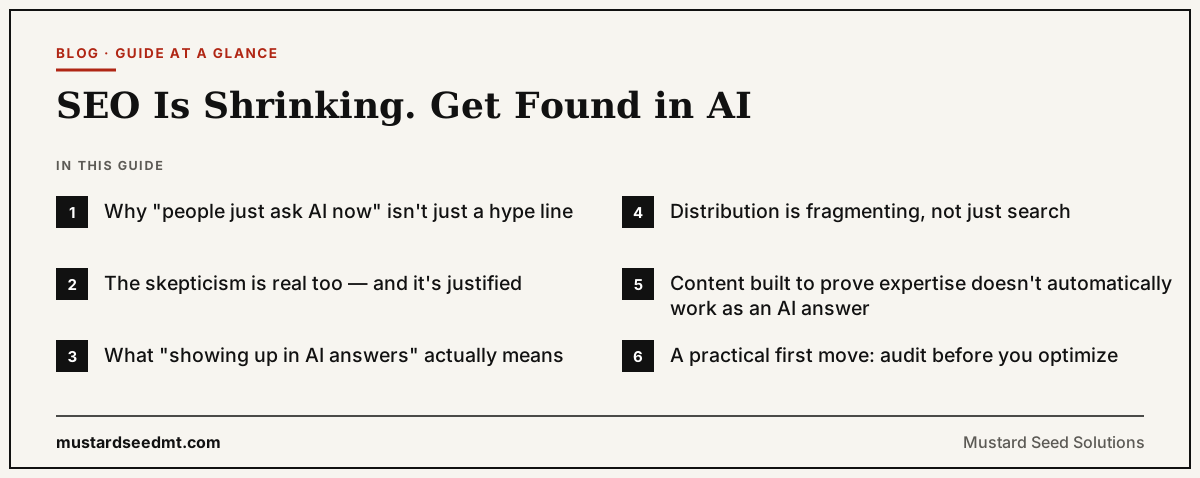
Why "people just ask AI now" isn't just a hype line
The replies to that founder's post reinforced the pattern rather than disputing it. Several people agreed the shift was from "search" to "generation" — the game had changed underneath tools that used to rely on people typing a query into Google, and the businesses that adapted fastest were treating AI systems the way they used to treat search engine rankings: something to actively optimize for, not just react to.
A separate discussion about AI tools made the same shift concrete from the customer's side. Multiple small-business operators described using Perplexity specifically because it had become "better than Google now" for research — faster than digging through search results, with citations built in. One commenter put it plainly: a genuine incumbent had been caught off guard by how quickly people redirected research questions they used to Google straight to an AI tool instead.
Neither of these is a global statistic. They're two independent, specific accounts of the same behavior change, from people with no reason to exaggerate it — one losing revenue because of it, the other switching tools because of it.
The skepticism is real too — and it's justified
None of this means solopreneurs should trust every AI pitch that lands in their inbox. A small law-firm owner's frustration with being sold "AI programs" by people with no understanding of his industry — after courts had already sanctioned lawyers for AI-hallucinated citations — was echoed by other business owners describing their own run-ins with AI-scam pitches, including an "AI-powered bookkeeping" product one commenter called a flat catastrophe.
That skepticism is healthy, and it's a different claim from "AI hasn't changed how people find things." Both can be true at once: most AI business pitches are noise, and the underlying shift in where people go to ask a question is real. Conflating the two — dismissing the whole shift because a lot of the sales pitches around it are bad — is how a solopreneur ends up with no plan for either one.
What "showing up in AI answers" actually means
GEO — generative engine optimization — isn't a rebrand of SEO with a new acronym. It's a parallel discipline built around how AI systems actually decide what to say:
- AI answers favor content that states a fact plainly and early, rather than building up to it across several paragraphs.
- Consistency matters more than volume — the same name, service description, and location repeated accurately across your site, directories, and other pages tends to reinforce what an AI system "knows" about you.
- Being cited by other sources (reviews, directories, guest posts, forum mentions) functions similarly to a backlink — it's evidence the AI model can point to.
- A page that's easy for a crawler to read cleanly — clear headings, real sentences, no content locked behind heavy scripts — is easier for both a search engine and an AI system to use.
None of this replaces good SEO. It sits on top of it. A page invisible to Google is generally invisible to an AI system trained on the same web.
The fastest way to know where you actually stand is to check it directly rather than guess.
Run a free AI visibility auditDistribution is fragmenting, not just search
A widely discussed post on building an online business argued that "distribution is the new moat" — that the barrier to creating content is now essentially zero, competition for attention is brutal, and the attention any single channel gives you is rented, not owned, because algorithm reach can change without warning. That framing lines up with what's happening to search specifically: it was never guaranteed to be a stable, permanent channel, and treating it as the only one was already a risk before AI accelerated the shift.
The practical takeaway isn't to abandon search. It's to stop treating any single channel — Google, a social platform, or an AI tool — as the whole strategy. This is the exact gap the 50 Biggest Solopreneur Challenges research surfaces: solopreneurs consistently over-rely on whichever channel worked when they started, long after it's stopped being reliable on its own.
Content built to prove expertise doesn't automatically work as an AI answer
One solopreneur's account of six months spent on content marketing is a useful preview of what this shift rewards. After publishing well over a hundred pieces — LinkedIn breakdowns, Twitter threads, long-form articles — built around demonstrating expertise, the results were thin: a few hundred followers, close to zero clients. The shift that changed things wasn't more output. It was reframing every piece around a specific, uncomfortable problem the reader already has, instead of a framework the writer wanted to teach.
That reframe matters for AI visibility specifically, not just engagement. AI systems generating an answer are matching a specific question to a specific, extractable statement — not rewarding whoever sounds most like an expert. A page that opens with "here's why your sales page converts at 0.8% when it should hit 3%" gives an AI system something concrete to lift into an answer. A page that opens with "five proven copywriting techniques" gives it a generic list indistinguishable from a thousand others.
The lesson generalizes past content marketing: whether it's a blog post, a service page, or an FAQ section, the copy that survives the shift to AI-mediated discovery is the copy written around the exact question someone is asking, stated as plainly as the asker would state it themselves.
A practical first move: audit before you optimize
Before changing anything, it's worth establishing a baseline:
- Ask ChatGPT, Perplexity, and Google's AI Overview a question a prospective customer would actually type, and note whether you appear at all.
- Check Google Search Console for branded queries — people searching your business name directly is a signal worth protecting either way.
- Confirm your core facts (what you do, who you serve, your pricing model) are stated as plain, extractable sentences somewhere on your own site — not buried in a hero image or a PDF.
- Look for places your business is mentioned inconsistently across the web (old addresses, outdated service lists) and clean those up first — AI systems weigh consistency heavily.
A free AI visibility audit does the first two steps systematically instead of one manual prompt at a time, and gives a solopreneur a concrete starting point rather than a vague sense that "something's changed" — which is exactly the feeling the sales-script founder described before he started adapting.