
The Outsourced Marketing Department: Rent the Function, Not the Headcount
A marketing department is five jobs, not five people. A company of 5 to 50 staff can cover all five for less than the loaded cost of its second marketing hire, because AI has compressed the production jobs while leaving the judgement job intact. This guide sets out the five jobs, what an empty seat looks like, what in-house really costs, and when renting stops being the right answer.
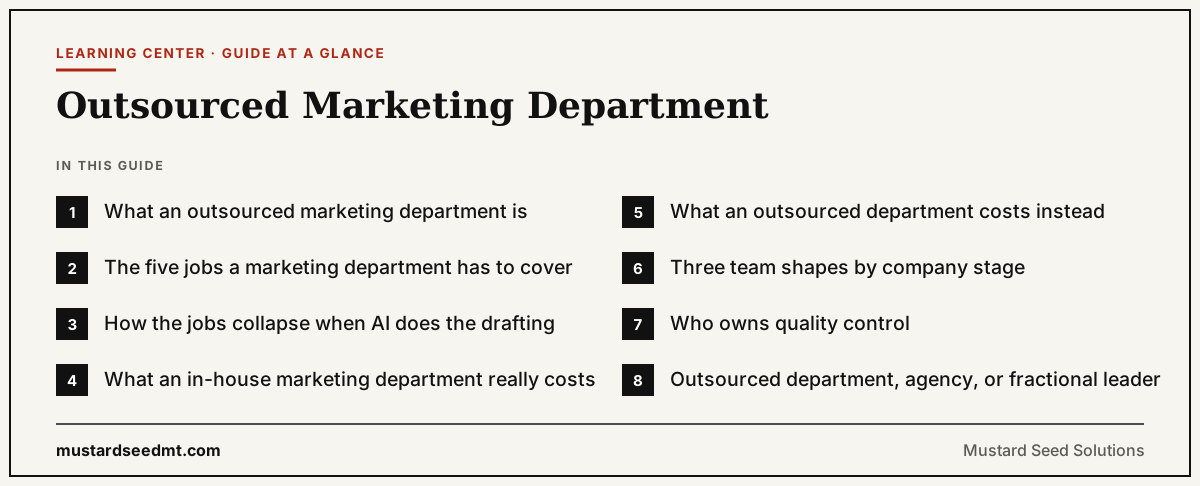
What I am, before you read on
Mustard Seed Solutions is one senior marketer working with AI tooling, not a department and not a bench of people waiting on standby. Where a specialist is genuinely required I bring in a named individual and you know exactly who is doing the work. If what you need is a team with cover, shift patterns and formal service levels, this page will still be useful to you, but I am not the supplier.
What an outsourced marketing department is
An outsourced marketing department is an external arrangement that covers the standing marketing function, meaning strategy, demand generation, content, production and analytics, instead of hiring staff into those roles. It is bought as an ongoing function rather than as a project, which is the distinction that separates it from an agency.
An agency sells campaigns and projects: a defined start, a defined end, a deliverable you can point at. A department arrangement covers the parts nobody puts in a proposal because they are permanent and unglamorous. The reporting cadence that runs whether or not there is a campaign. The tooling that has to be paid for, connected and kept clean. Vendor management. Institutional memory, so that the answer to why did we stop doing that exists somewhere other than in one head.
People searching for an outsourced marketing team, a fractional marketing team, or the phrase rent a marketing department are usually asking the same question at a specific moment: they are about to write a job description and are not certain the job exists in the shape they were about to describe. That is the right instinct, and the next section is why.
The five jobs a marketing department has to cover
This is the working model I use when a company asks how many marketing people it needs. Five jobs must be covered by somebody. How many bodies that takes is a separate question, and the answer has changed. For each job below: what it actually decides, what it looks like when the seat is empty, and how much of it AI can now absorb.
The owner and strategist
Decides: Who you sell to, what you claim, which bets get funded this quarter and which do not.
Empty seat: Every channel is judged on its own terms, nothing compounds, and no month can be explained.
AI: AI absorbs almost none of this job.
Demand generation
Decides: Where demand comes from, what a qualified lead costs, and when to stop funding a channel.
Empty seat: Pipeline arrives by referral only, and a good month cannot be repeated on purpose.
AI: AI absorbs research, list building and sequence drafting, not the channel bets.
Content
Decides: What gets said, to whom, in what order, and what is deliberately left out.
Empty seat: The site answers none of the questions buyers actually ask before they enquire.
AI: AI absorbs a large share of drafting. It does not choose the angle.
Design and production
Decides: How decisions become assets: pages, decks, diagrams, ads, video.
Empty seat: Everything looks provisional and each salesperson rebuilds the same deck.
AI: AI absorbs a large share, once someone has defined what correct looks like.
Operations and analytics
Decides: Tooling, tracking, data hygiene, and the reporting cadence the business is run on.
Empty seat: Nobody trusts the numbers, so decisions get made on anecdote and the loudest meeting.
AI: AI absorbs routine reporting and summarisation, not instrumentation decisions.
Most small companies have jobs three and four half-covered by whoever is willing, job five covered by a spreadsheet nobody trusts, and jobs one and two vacant. That combination produces the most expensive failure available at this size: real output, no direction, and a founder who concludes that marketing does not work.
How the jobs collapse when AI does the drafting
AI genuinely absorbs research, first drafts, variant production, data summarisation and routine reporting. It does not absorb positioning judgement, channel bets, taste, or anything that requires a person to be accountable for a promise a customer will hold you to. That line is not a philosophical position; it is the practical boundary between work that can be checked quickly and work that has to be decided.
Apply that boundary to the five jobs and they do not compress evenly. Content, design and operations compress hardest, because a large share of each is production. Strategy and demand generation barely move, because they are mostly decisions. The shape that falls out is three jobs rather than five: an accountable lead who decides, one builder who ships, and one rotating specialist for whichever channel matters this quarter.
Now the honest part, and the reason this is an argument rather than a measurement. Compressing production does not remove the constraint, it moves it. When drafts arrive faster than anyone can read them, the bottleneck becomes review capacity. A lean AI-assisted team fails when nobody has time to judge the output, not when the output is weak. Everything in the quality control section further down exists to address that single failure mode.
What an in-house marketing department really costs
The smallest in-house department that can actually cover the five jobs is a marketing lead plus one generalist, with tooling. Salary is the number people compare, and it is the smallest part of the answer. Here are the seven components, and where to get each number for your own market rather than from an article.
| Cost component | Where the number comes from |
|---|---|
| Marketing lead, base salary | Your local market rate for a senior generalist who can decide, not only execute. |
| Generalist or executor, base salary | Local market rate for a mid-level marketer who ships. |
| Employer overhead | Payroll taxes, benefits, equipment and software seats. Commonly planned at 1.25 to 1.4 times base. |
| Recruiting | Agency fee or the internal hours spent hiring, plus the cost of a mis-hire at this size. |
| Ramp | Three to six months before a new marketing lead is deciding rather than learning. |
| Tooling | Automation, analytics, SEO and design seats, billed per user per month. |
| Key-person risk | One resignation zeroes the function until the cycle above repeats. |
The arithmetic is simple once the inputs are yours: add the two base salaries, multiply by the overhead factor, add tooling and the amortised cost of recruiting, then add a quarter or two of ramp during which the function is being learned rather than run. Do that honestly and the annual figure is usually well above what founders assume when they price the decision as two salaries.
Two things that table does not price. A single departure zeroes the function until the recruiting and ramp lines repeat, which at this size is a two-quarter hole. And seniority is lumpy: the decisions a marketing lead makes are episodic, so a full-time senior salary buys continuous availability for intermittent work. That is the whole economic case for renting the function, and it stops being true the moment the decisions become continuous.
What an outsourced department costs instead
Three shapes exist. They differ far more in what you get than in what they charge, which is why comparing monthly fees across them tells you almost nothing.
Full-service agency as the department
Highest throughput and the most process. You pay for an account layer, and the person who understands your market is rarely the person doing the work.
Senior lead plus a freelancer bench
One accountable lead selects and briefs named specialists. Strong on quality per discipline; the lead is the constraint, and coordination is real work.
Senior lead with AI-leveraged delivery
One experienced marketer owns direction and compresses production with AI tooling. Highest judgement per dollar, lowest raw throughput, no redundancy.
The published ladder
- $600 Visibility Starter. Fixed scope, not a department: a site and social direction.
- $1,000 SMB Growth Plan. Fixed scope: messaging, SEO, AEO and GEO strategy, lead generation plan.
- $3,000 Channel Growth Plan. Where retained leadership starts, charged monthly.
- Enterprise. Custom.
Retained leadership starts at $3,000 per month and is scoped individually above that. The two fixed-scope products are alternatives for buyers who do not need a retained leader, not a cheap way in to one. See the pricing page for what each includes, and how to allocate a marketing budget if the question is how much of the total should go to people at all.
Three team shapes by company stage
| Stage | Shape | Delivers | Cannot deliver | Trigger to move on |
|---|---|---|---|---|
| A. Under 20 staff, no marketing function yet | One lead who also executes, AI-assisted, everything else bought on demand. | Positioning, a site that converts, one or two channels run properly. | Sustained multi-channel volume, or same-week turnaround on everything. | Move on when the lead spends more than half the time producing rather than deciding. |
| B. 20 to 80 staff with a junior marketer | Outsourced senior lead, one in-house executor, one specialist per quarter. | A repeatable content and demand engine with context held inside the building. | Enterprise-scale campaigns or heavy paid media across many markets. | Move on when the in-house executor is fully loaded and demand is steady, not lumpy. |
| C. 80+ staff with a sales team | Senior lead, in-house team, external specialists for depth. | Multi-channel programmes, sales enablement, formal reporting. | Stay cheap. At this point marketing is a cost centre with a budget line. | Hire the lead full-time when the decisions become continuous rather than episodic. |
Directionally, shape A costs a fraction of shape C and delivers a fraction of the volume, which is the correct trade at that stage: a company under twenty people almost never has a volume problem, it has a clarity problem. Skipping a stage is what produces a marketing team that is busy and a pipeline that is not.
Who owns quality control
This is the objection everyone raises about lean AI-assisted teams, and it deserves a direct answer rather than reassurance. Three control points, all of which are cheap and none of which are optional.
- One named human is accountable for every published asset. Not a process, a person. If nobody signs, nobody checked.
- Every contributor works from the same written positioning document. Human or AI, the input is identical. Most quality failures are brief failures wearing a costume.
- The review step is fixed, not conditional on how busy the week is. A slot in the calendar, a cap on work in progress, and a rule for what happens to anything unreviewed.
Continuity, because one person is one calendar
A page that sells a replacement for a function has to answer what happens when the person behind it is ill, on holiday or at capacity. The honest answer is that a one-person engagement does not have redundancy, and buying one means accepting that. What it does have is documentation you own, accounts in your name, and work planned far enough ahead that a week out is a delay rather than a stop. Holidays are flagged in advance. If a hard service level matters to you, hire a team, and I will say so on the first call.
Capacity is limited by design: retained engagements are taken on in small numbers so that each one gets senior attention rather than a queue position.
Outsourced department, agency, or fractional leader
These three get used interchangeably in sales conversations and they are not the same purchase. The differences that matter are who owns the strategy and what survives when a person leaves.
| Outsourced department | Agency | Fractional leader | |
|---|---|---|---|
| What you are buying | A standing function, including the boring permanent parts. | Campaigns and projects with a defined end. | Senior decisions and accountability, part-time. |
| Who owns strategy | The arrangement owns it, with the founder approving. | Usually the client, whether or not the client realises it. | The fractional lead owns it explicitly. |
| Continuity when someone leaves | Depends entirely on documentation, so make it a deliverable. | Staff rotate; the account survives, the context often does not. | One person, so continuity is a question you must ask directly. |
| Typical commitment | Rolling monthly, with a notice period. | Six to twelve months, often with a ramp inside it. | Monthly retainer, commonly with a defined first quarter. |
| Best fit | 5 to 50 staff with no marketing function and no time to build one. | Steady high volume, meaningful paid spend, defined campaigns. | A company that knows what it needs done but not what to do. |
The hybrid that usually wins for a 5 to 50 person company
One junior person in-house who holds product and customer context. One outsourced senior lead who owns direction and is accountable for the outcome. AI tooling for production. That combination is my actual recommendation for most companies at this size, and it beats both extremes for structural reasons rather than commercial ones.
It beats a full in-house team because you are not funding continuous senior salary for episodic senior decisions, and because a junior hire supervised by an experienced lead learns faster than a junior hire supervised by a founder with no time. It beats a pure agency arrangement because context stays in the building: the person who knows why the last launch underperformed is on your payroll, not rotating off an account. And production stops being a headcount question, which is the part that changed in the last two years.
It has one requirement and one failure mode. The requirement is that the in-house person is genuinely junior-but-capable and wants to learn. The failure mode is the review bottleneck described earlier: two people producing at AI speed with nobody scheduled to judge the output. Fix the calendar before you scale the output.
How to hand over without losing institutional knowledge
Renting a function is safe when the knowledge it generates stays yours. Five conditions, all agreed before the first invoice, all cheap at the start and expensive to retrofit.
- 01
You own the accounts. Domain, ad accounts, analytics, CRM and the content management system are registered to you, and access is granted outward. Never the reverse.
- 02
Documentation is a dated deliverable. The positioning document, the channel playbooks and the reporting definitions are due on a date, not produced as a favour on the way out.
- 03
Source files are yours. Design files, spreadsheets, prompt libraries and templates transfer in editable form, written into the agreement rather than assumed.
- 04
One named internal person attends every review. That person is the institutional memory. Without the seat filled, the knowledge leaves when the arrangement does.
- 05
A written thirty-day exit plan, agreed at the start. What transfers, in what order, and who does the last handover call. Agreeing it while everyone is happy takes twenty minutes.
The same conditions make the reverse move work. Taking a department back in-house is straightforward when the accounts, documentation and playbooks already belong to you: the new hire inherits a written function instead of starting from an empty desk. If a supplier resists any of the five, that resistance is the answer to the question you were about to ask about lock-in.
Signals it is time to build in-house instead
- Marketing is now the primary growth engine. Most new revenue starts with something marketing did, rather than with a referral or a founder relationship.
- Demand is steady rather than lumpy. A specialist would be busy every week, which is the actual test of whether a full-time seat pays for itself.
- You can fund a senior lead at full-time rates and keep them busy. The decisions have become continuous rather than episodic.
- Compliance or security constraints block external access. Regulated data, customer systems or procurement rules make an outsider expensive to accommodate.
- The outsourced lead explains more than decides. When context transfer takes longer than the decision, the context should live inside the company.
Two or more of those signals together means the economics have flipped and you should hire. Saying so costs me work and is the only version of this page worth publishing: renting a function is a stage, not a destination.
Where to go next
- How to outsource digital marketing without losing control of it
- Fractional marketing leadership: how the engagement works
- Fractional marketing team versus an in-house marketing team
- What a full-time marketing leader costs against a fractional one
- AI visibility: how assistants decide which companies to mention
- How to allocate a marketing budget across channels
- How this worked for an infrastructure technology company going global
Common questions
What is an outsourced marketing department?
An outsourced marketing department is an external arrangement that covers the standing marketing function, meaning strategy, demand generation, content, production and analytics, instead of hiring staff into those roles.
What roles does it cover?
Five jobs rather than five people: an owner who sets direction, demand generation, content, design and production, and operations and analytics. AI now absorbs a large share of the production work, which is why the headcount and the job count no longer match.
How much does it cost compared with in-house?
The honest comparison is not two salaries against one invoice. The smallest credible in-house department is a marketing lead plus one generalist, and the loaded cost adds employer overhead, recruiting, tooling and a ramp period on top of both salaries, so price it against your own local market rates rather than a figure from an article. An outsourced arrangement is bought monthly instead, and what moves its price is how much senior time is included.
Is an outsourced marketing department the same as an agency?
No. An agency is usually bought for campaigns and projects with a defined end; a department arrangement covers the permanent function, including reporting cadence, tooling and institutional memory.
What is a fractional marketing team?
A group of part-time specialists covering the jobs a marketing function needs, coordinated by one accountable lead, with none of them employed full time. Unlike an agency pod, the client selects and works with each individual directly.
Can AI replace part of a marketing team?
AI absorbs a large share of drafting, research, variant production and routine reporting, and that compresses the content, design and operations jobs hardest. It does not replace positioning judgement, channel decisions or accountability, so the strategy and demand jobs barely change.
How do you keep quality up when AI does the drafting?
One named human stays accountable for every published asset, every contributor works from the same written positioning document, and a review step is fixed rather than optional. Lean AI-assisted teams fail when production capacity outruns review capacity, not when the drafts are weak.
When should we build in-house instead?
When marketing is your main growth engine, demand is steady enough to keep specialists busy, and you can fund a senior lead full-time. Before that point you are usually paying full-time rates for part-time decisions.
How big should the marketing team be for a 30-person B2B company?
Typically three effective jobs covered: an accountable lead who decides, one person who builds and ships, and one rotating specialist for whichever channel matters that quarter. Adding headcount before positioning is settled usually multiplies output without improving results.
Before you post the job ad
Price the function, not the hire
Send the roles you were about to recruit for and what you expected them to deliver. You will get back the same five jobs mapped to what can be bought part-time, what AI covers, and what genuinely needs a person on payroll.
See how the engagement worksOr send the job descriptions directly and I will map them to the five jobs.