
The Wedge: How Atlassian Got Its First Customers
Atlassian got its first customers by selling its issue-tracking product, Jira, directly online with a low, fixed price and no salesperson anywhere in the process — an unusual choice in 2002, when enterprise software was still overwhelmingly sold through direct sales teams and negotiated contracts.
Mike Cannon-Brookes and Scott Farquhar bootstrapped the company on a reported $10,000 of credit card debt, and the low-friction, low-price online purchase model was as much a necessity of having no sales budget as it was a deliberate strategic bet.
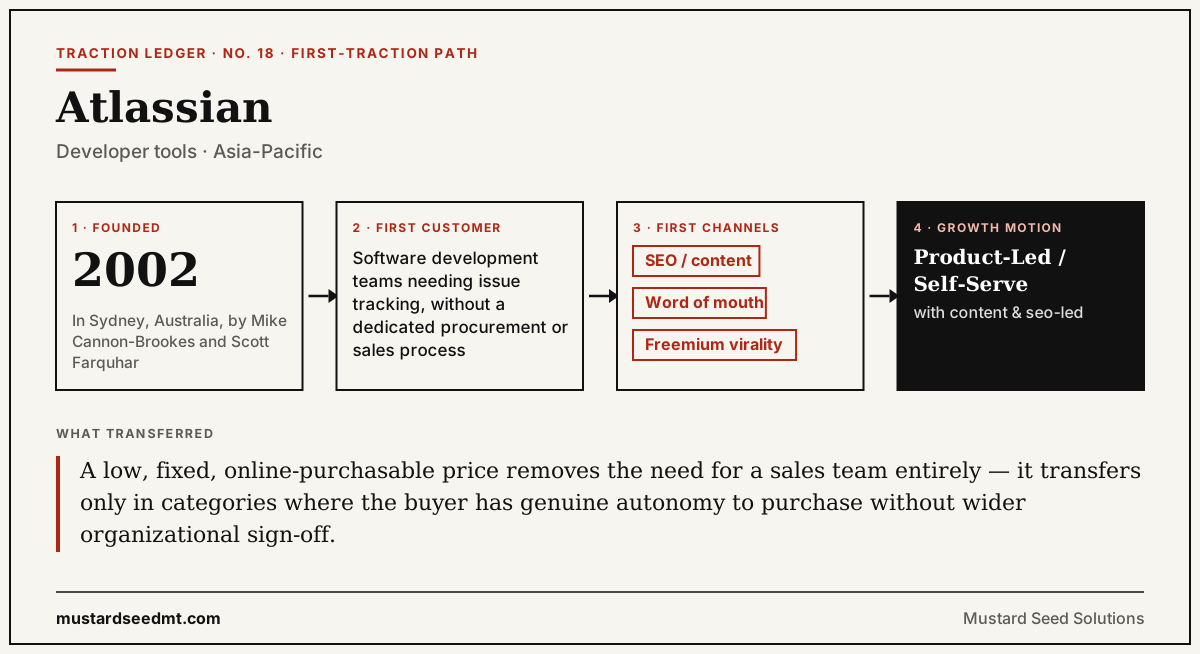
Founded in Sydney, Australia, by Mike Cannon-Brookes and Scott Farquhar (2002).
Atlassian's First Channel
The channel was search visibility and word of mouth among software development teams: a developer or engineering manager evaluating issue trackers would find Atlassian's products through search results and product comparisons, then purchase directly online.
Because the price was low and fixed, and the purchase required no negotiation, individual engineers or small teams could buy Jira on their own department's budget without a formal procurement process — removing the friction that would normally require sales involvement.
The Motion: Product-Led / Self-Serve
The entire commercial motion was self-serve: a prospective customer could evaluate, purchase, and start using the product without ever speaking to an Atlassian employee, which kept the company's cost structure unusually lean relative to its revenue for years.
Word of mouth inside the developer community substituted for the marketing and sales spend a traditional enterprise software company would have carried, since developers already talk to each other about which tools they use and recommend.
As Atlassian added products (Confluence, and later a much broader suite), each new product largely reused the same low-friction, self-serve purchasing model that had proven itself with Jira, rather than introducing a sales-led motion for the newer offerings.
The Turn — the motion held
The motion held. Atlassian became one of the most frequently cited case studies in enterprise software specifically because it sustained a no-sales-team, self-serve model at a scale (multi-billion-dollar public company) that most industry assumptions said required direct sales.
Era: pre-2005
Where It Ended Up: Public (Nasdaq: TEAM) since 2015
What Transferred
"A low, fixed, online-purchasable price removes the need for a sales team entirely — it transfers only in categories where the buyer has genuine autonomy to purchase without wider organizational sign-off."
Sources
Related Entries
Twilio
SMS and voice as an API — pay per call, no sales conversation required.
Hacker NewsGitHub
Git hosting that made open-source collaboration social, starting with the Ruby community.
Open-source repoGitLab
A self-hosted, open-source alternative to GitHub, built by a distributed team from day one.
Open-source repo