
The Wedge: How Calendly Got Its First Customers
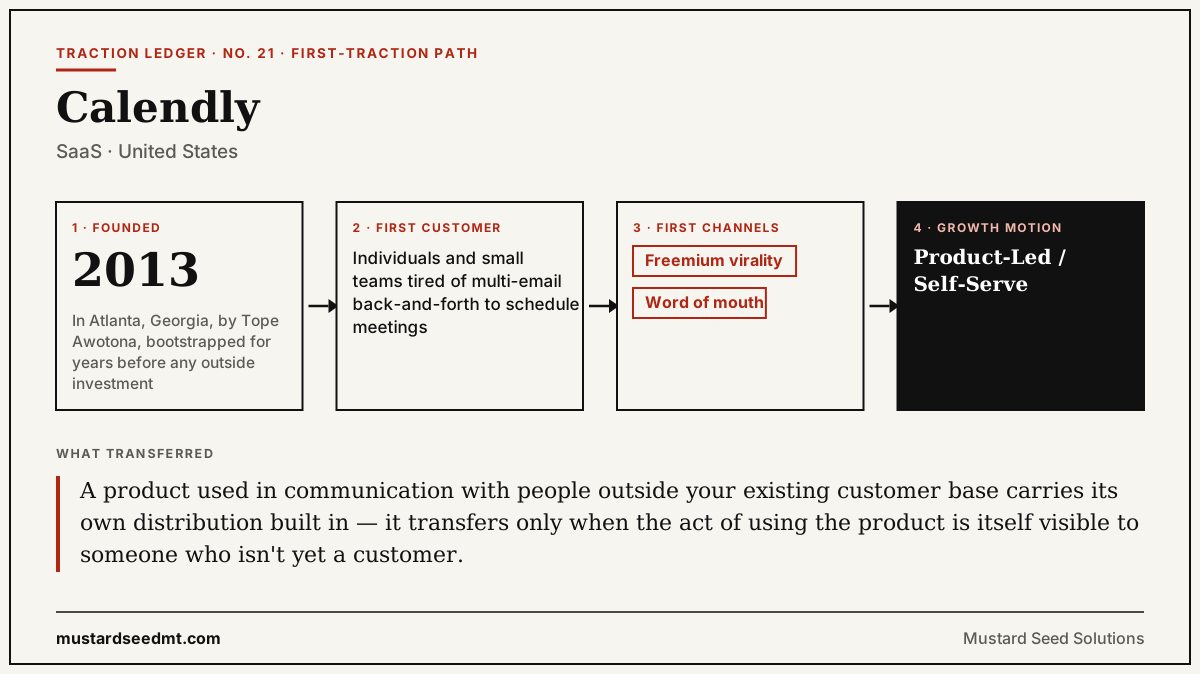
Calendly got its first users by removing a specific, universally recognized annoyance — the multi-email back-and-forth required to find a mutually available meeting time — with a simple, personal scheduling link. Tope Awotona built the product to solve this frustration in his own work, bootstrapping the company for years before raising outside capital.
The earliest adopters were individuals and small teams who adopted the free tier for their own scheduling needs, without any organizational purchasing decision required — a genuinely single-player starting point for a product that turned out to have a powerful multiplayer growth loop built in.
Founded in Atlanta, Georgia, by Tope Awotona, bootstrapped for years before any outside investment (2013).
Calendly's First Channel
The channel was structural, not a deliberate campaign: every time an existing user sent someone a Calendly link to book a meeting, that new person experienced the product directly and often signed up for their own account to reciprocate.
This built-in, usage-triggered referral loop meant growth compounded with essentially no marketing spend — the product's normal use case was itself the distribution mechanism, since a scheduling tool is inherently used in communication with people outside the existing customer base.
The Motion: Product-Led / Self-Serve
The free tier for a single event type was generous enough to solve the core problem for an individual user completely, while paid tiers monetized additional event types, team scheduling, and integrations that small businesses and larger teams needed.
Because the referral loop functioned automatically through ordinary usage, Calendly required minimal paid acquisition spend relative to its user base size, sustaining profitability and bootstrapped growth for years before the company's first institutional funding round in 2021.
The product's simplicity was maintained deliberately, since its core value — removing scheduling friction — depended on both the sender and receiver of a link finding it immediately understandable with no explanation needed.
The Turn — the motion held
The motion held. Calendly's growth mechanism — the referral loop embedded in ordinary product use — remained essentially unchanged for roughly a decade, an unusually long run for a single growth mechanism in this ledger, before the company raised its first outside venture funding.
Era: 2005-2014
Where It Ended Up: Private; still independent
What Transferred
"A product used in communication with people outside your existing customer base carries its own distribution built in — it transfers only when the act of using the product is itself visible to someone who isn't yet a customer."
Sources
Related Entries
Twilio
SMS and voice as an API — pay per call, no sales conversation required.
Hacker NewsGitHub
Git hosting that made open-source collaboration social, starting with the Ruby community.
Open-source repoDatadog
Unified monitoring for DevOps teams juggling too many separate dashboards.
Webinars