
The Wedge: How Canva Got Its First Customers
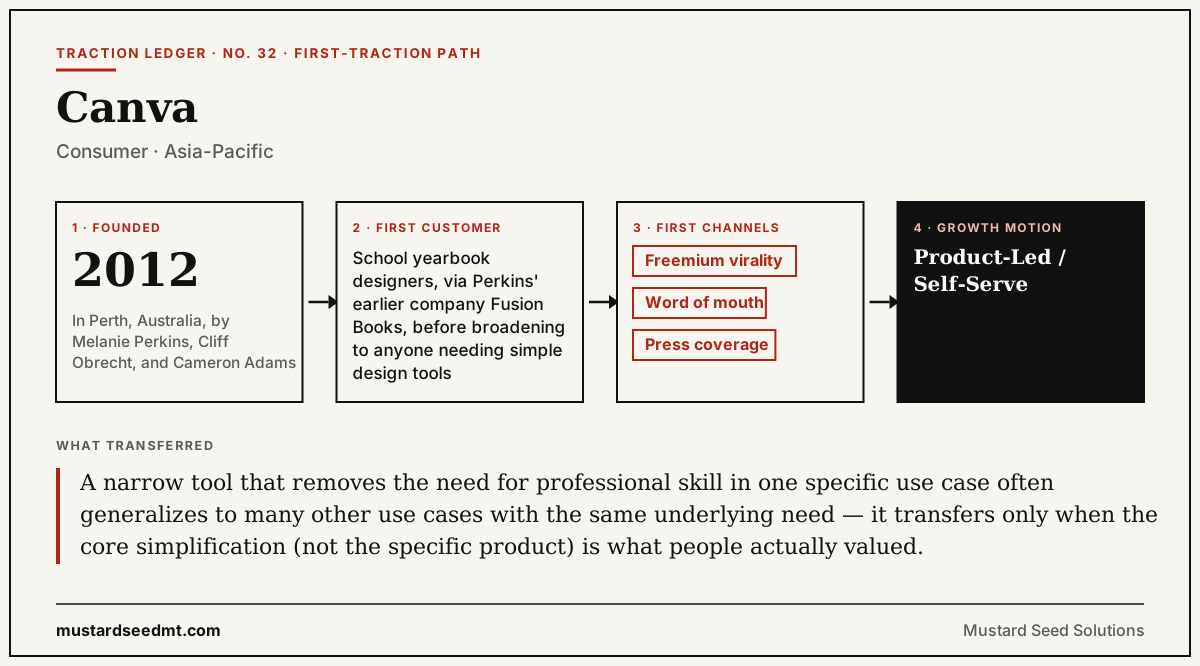
Canva's first real customer base came from Melanie Perkins' earlier company, Fusion Books, an online tool that let schools design their own yearbooks without needing professional design software — a narrow, concrete problem that proved the underlying design-simplification concept before Canva itself existed.
Perkins, Cliff Obrecht, and Cameron Adams built Canva to generalize that same idea — simple, drag-and-drop design tools accessible to non-designers — well beyond yearbooks, though the pitch to investors was famously difficult, with widely reported stories of over a hundred rejected fundraising pitches before the company secured its first backing.
Founded in Perth, Australia, by Melanie Perkins, Cliff Obrecht, and Cameron Adams (2012).
Canva's First Channel
The freemium model itself was the primary channel after Canva's 2013 public launch: anyone could create a free account and start designing immediately, with no procurement process, spreading through word of mouth as users shared or showed off what they'd made.
Extensive press coverage of Perkins' persistence in fundraising, and later of Canva's rapid growth, generated additional attention and trust well beyond what organic word of mouth alone would have produced.
The Motion: Product-Led / Self-Serve
The freemium tier gave any individual immediate, real design capability at no cost, while the paid Pro subscription monetized users who wanted additional templates, brand tools, and storage — a standard product-led upgrade path matched to genuine, growing usage.
Because the product removed the need for design software expertise entirely, it opened design tool adoption to a vastly larger population than professional design software had ever reached, expanding the addressable market well beyond Canva's original niche.
As adoption grew, Canva broadened its own positioning and feature set considerably beyond templates for personal projects, adding tools aimed at marketing teams, educators, and eventually enterprise brand management.
The Turn
The turn was scope: from a specific tool for a specific print product (yearbooks), Canva broadened into general-purpose visual design software for essentially anyone, a repositioning that multiplied its addressable market many times over relative to the original Fusion Books wedge.
Era: 2005-2014
Where It Ended Up: Private; one of the most highly valued private software companies
What Transferred
"A narrow tool that removes the need for professional skill in one specific use case often generalizes to many other use cases with the same underlying need — it transfers only when the core simplification (not the specific product) is what people actually valued."
Sources
Related Entries
Twilio
SMS and voice as an API — pay per call, no sales conversation required.
Hacker NewsGitHub
Git hosting that made open-source collaboration social, starting with the Ruby community.
Open-source repoDatadog
Unified monitoring for DevOps teams juggling too many separate dashboards.
Webinars