
The Wedge: How Databricks Got Its First Customers
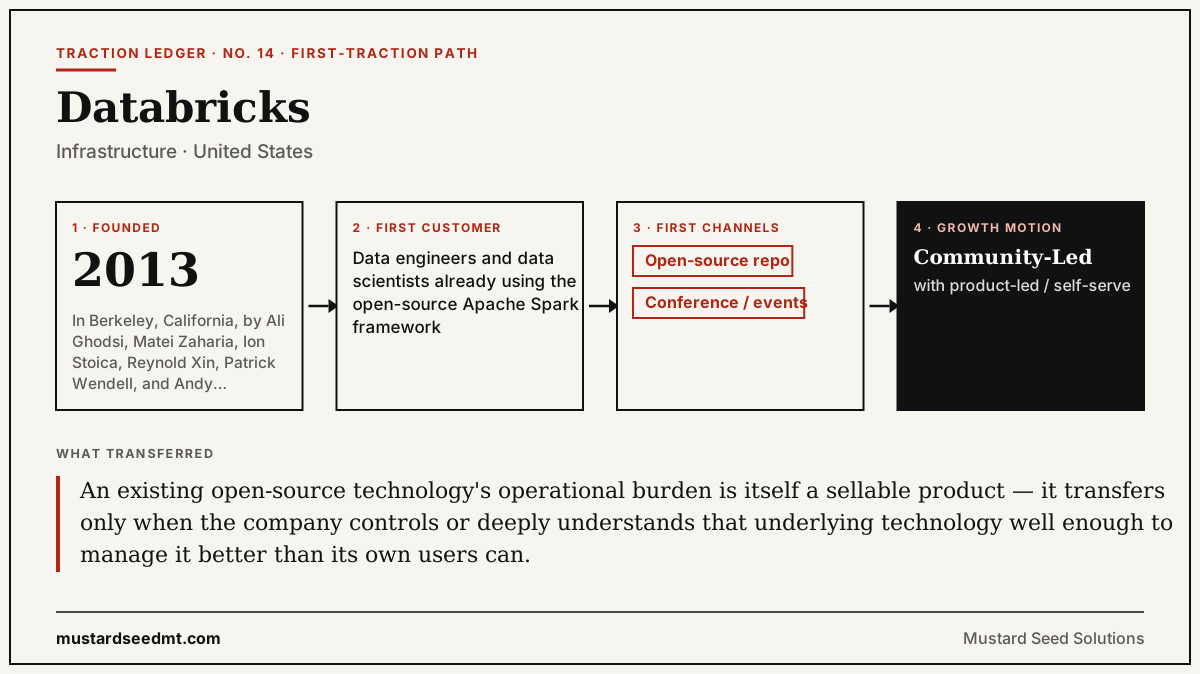
Databricks got its first customers from a population that already existed at scale before the company did: Apache Spark, the open-source big-data processing engine its founders created at UC Berkeley's AMPLab, had already been widely adopted by data engineering teams for free.
The company's founders recognized that running and scaling Spark clusters themselves was a significant operational burden for the very teams who valued the framework, and built a managed service specifically to remove that burden for people who were already committed Spark users.
Founded in Berkeley, California, by Ali Ghodsi, Matei Zaharia, Ion Stoica, Reynold Xin, Patrick Wendell, and Andy Konwinski, out of the UC Berkeley AMPLab (2013).
Databricks's First Channel
The channel was the open-source Spark community itself, reinforced through the Spark Summit conference (later Data + AI Summit) that Databricks organized, which brought the exact target audience — data engineers already using or evaluating Spark — into direct contact with the company's own team and message.
Because the underlying technology was already trusted and widely deployed, the company didn't need to establish credibility for a new idea — only to convince an already-convinced audience that a managed version was worth paying for instead of operating it themselves.
The Motion: Community-Led
The commercial model converted an operational cost (running Spark infrastructure) into a managed, usage-based service, letting existing Spark users trade the effort of self-hosting for a metered bill — an easy substitution decision once the value was clear.
Because the buyer population already understood Spark's capabilities from firsthand open-source use, the sales conversation could focus entirely on convenience, reliability, and scale rather than on explaining unfamiliar technology from scratch.
As the customer base grew, Databricks expanded the platform well beyond Spark hosting alone, adding data storage, governance, and machine-learning tooling under the same account relationship established through the original managed-Spark wedge.
The Turn
The "lakehouse" repositioning was a deliberate architectural and marketing turn: rather than being understood as a convenience layer over an open-source framework, Databricks recast itself as a full alternative to traditional data warehouses, directly widening its competitive set and addressable market.
Era: 2005-2014
Where It Ended Up: Private; one of the most highly valued private software companies
What Transferred
"An existing open-source technology's operational burden is itself a sellable product — it transfers only when the company controls or deeply understands that underlying technology well enough to manage it better than its own users can."
Sources
Related Entries
GitLab
A self-hosted, open-source alternative to GitHub, built by a distributed team from day one.
Open-source repoHashiCorp
Open-source infrastructure tools that developers adopted years before HashiCorp sold anything.
Open-source repoDocker
A container tool that went from conference lightning talk to industry standard in under two years.
Open-source repo