
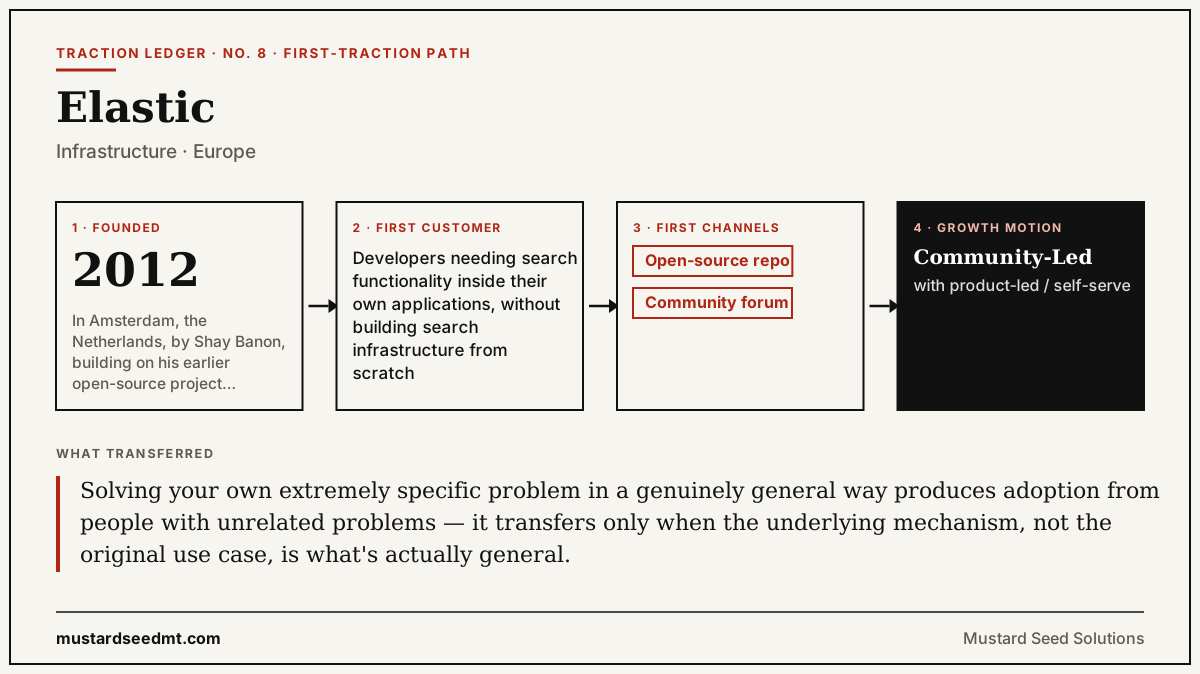
The Wedge: How Elastic Got Its First Customers
Elasticsearch's origin is one of the most specific first-customer stories in this ledger: Shay Banon originally built an earlier version of the search engine, Compass, to help his wife build a recipe search application, before rewriting it as Elasticsearch — a distributed, scalable search engine any developer could run.
That narrow original motivation shaped a genuinely general-purpose tool: because the underlying problem (fast, flexible search over changing data) is common to a huge range of applications, developers facing entirely unrelated problems recognized the same shape of need and adopted the open-source project directly.
Founded in Amsterdam, the Netherlands, by Shay Banon, building on his earlier open-source project Compass and then Elasticsearch (2012).
Elastic's First Channel
The channel was open-source distribution and community discussion — developers discovered Elasticsearch through blog posts, forums, and conference talks about solving search problems, then downloaded and integrated it themselves with no sales process involved.
Because the tool solved a well-understood, widely felt problem (bolt-on search functionality) rather than something requiring a new concept to be explained, adoption spread through ordinary developer word of mouth without a manufactured launch moment.
The Motion: Community-Led
The open-source core was, and remains, free to run — the company's monetization sits at the layer above the core engine, in commercial features, support, and hosted infrastructure through Elastic Cloud.
This let Elasticsearch spread broadly with zero adoption friction while the company built a recurring-revenue business from the fraction of that broad base that needed enterprise support, security features, or the convenience of a managed service.
As adoption matured, the company bundled Elasticsearch with two adjacent open-source projects it built or acquired — Logstash and Kibana — into the "ELK Stack," widening the product surface from pure search into log analysis and visualization for the same technical audience.
The Turn
The stack repositioning was the real turn: what began as a search library became a platform pitched primarily for observability and security use cases (monitoring infrastructure, analyzing logs, detecting threats) — a considerably larger commercial market than search alone, built on the credibility the original open-source search engine had already earned.
Era: 2005-2014
Where It Ended Up: Public (NYSE: ESTC) since 2018
What Transferred
"Solving your own extremely specific problem in a genuinely general way produces adoption from people with unrelated problems — it transfers only when the underlying mechanism, not the original use case, is what's actually general."
Sources
Related Entries
GitLab
A self-hosted, open-source alternative to GitHub, built by a distributed team from day one.
Open-source repoHashiCorp
Open-source infrastructure tools that developers adopted years before HashiCorp sold anything.
Open-source repoDocker
A container tool that went from conference lightning talk to industry standard in under two years.
Open-source repo