
The Wedge: How PagerDuty Got Its First Customers
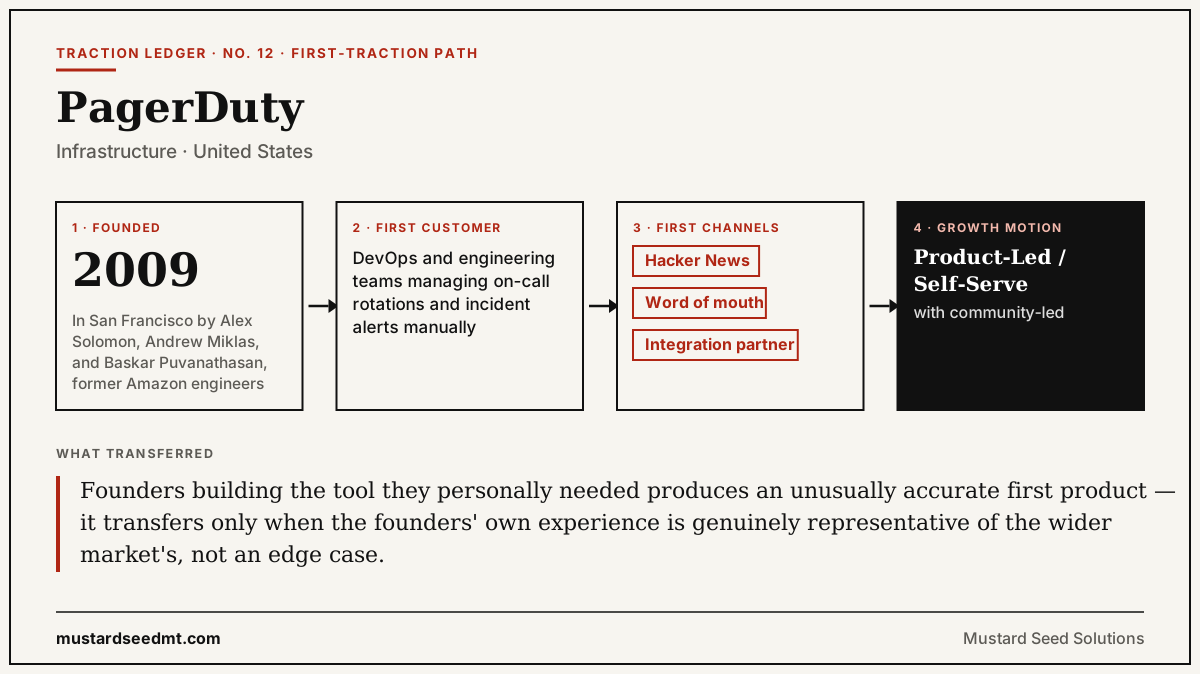
PagerDuty got its first customers by solving a problem its own founders had lived through directly: as engineers who had worked on Amazon's on-call infrastructure, Alex Solomon, Andrew Miklas, and Baskar Puvanathasan built the tool they wished existed for scheduling on-call rotations and routing alerts to the right engineer automatically.
The first adopters were engineering and DevOps teams frustrated with manual or ad hoc on-call processes — spreadsheets, shared pagers, or informal rotations — who needed something more reliable but weren't a large enough problem to warrant custom-building their own tool.
Founded in San Francisco by Alex Solomon, Andrew Miklas, and Baskar Puvanathasan, former Amazon engineers (2009).
PagerDuty's First Channel
The channel was primarily developer community discussion — Hacker News threads and word of mouth among engineering teams who had faced the same on-call pain and recommended the tool to peers at other companies once they'd adopted it themselves.
Integrations with common monitoring tools reinforced discovery, since engineers already using those tools to detect problems needed a way to route the resulting alerts to a person, which is exactly the gap PagerDuty filled.
The Motion: Product-Led / Self-Serve
The self-serve motion let an individual engineer or small team sign up, configure a rotation, and start receiving properly routed alerts within the same day, with per-user pricing that scaled naturally as a team grew.
The free trial removed the biggest friction point for something as operationally sensitive as incident alerting — a team could prove to itself that the tool worked reliably before committing budget to it.
As the product matured, PagerDuty broadened from alert routing into fuller incident response workflows and analytics, continuing to sell primarily to the same engineering and operations buyers who had adopted the original alerting tool.
The Turn — the motion held
The motion held. The company's expansion into a broader operations and incident-response platform kept the same self-serve entry point and buyer (engineering and DevOps teams) that defined its first customers.
Era: 2005-2014
Where It Ended Up: Public (NYSE: PD) since 2019
What Transferred
"Founders building the tool they personally needed produces an unusually accurate first product — it transfers only when the founders' own experience is genuinely representative of the wider market's, not an edge case."
Sources
Related Entries
Twilio
SMS and voice as an API — pay per call, no sales conversation required.
Hacker NewsGitHub
Git hosting that made open-source collaboration social, starting with the Ruby community.
Open-source repoHashiCorp
Open-source infrastructure tools that developers adopted years before HashiCorp sold anything.
Open-source repo