
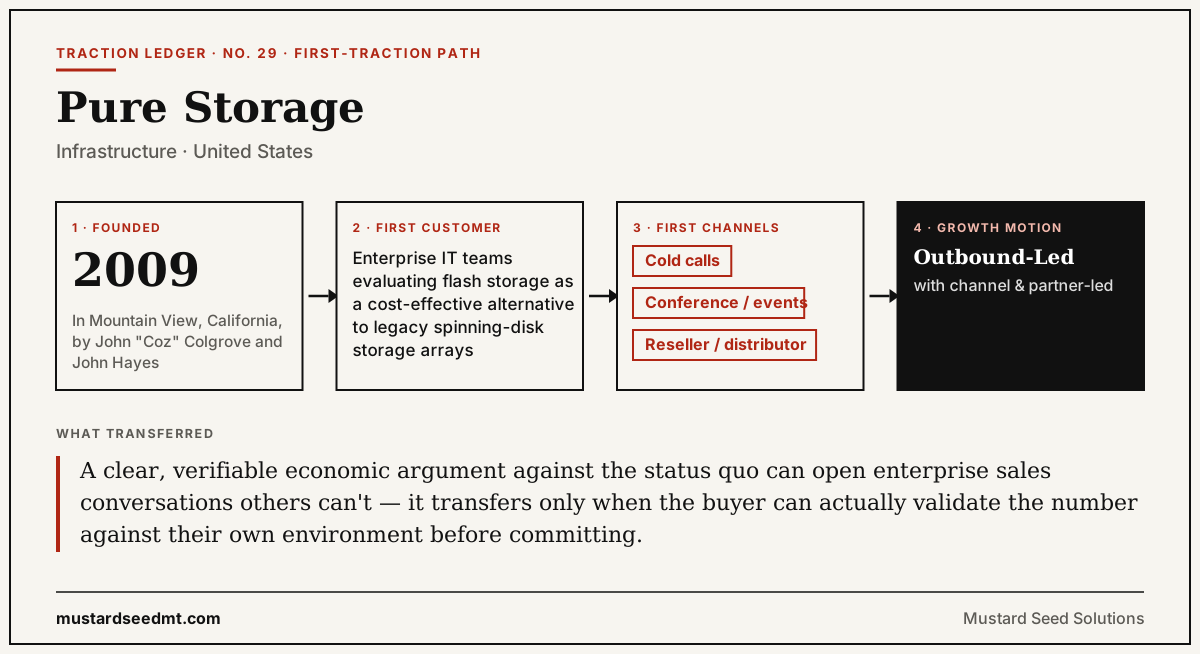
The Wedge: How Pure Storage Got Its First Customers
Pure Storage got its first customers by making an economic argument that flash storage, historically considered too expensive for broad enterprise use, could actually cost less than traditional spinning-disk arrays once data reduction techniques and total operational costs were accounted for.
The first buyers were enterprise IT teams evaluating storage refreshes who were open to an unconventional argument — that flash, not disk, was now the more cost-effective choice — provided the vendor could back that claim with real numbers specific to their environment.
Founded in Mountain View, California, by John "Coz" Colgrove and John Hayes (2009).
Pure Storage's First Channel
The channel was direct enterprise sales, engaging IT infrastructure buyers through outbound outreach and conference presence, with sales conversations built around a specific, quantifiable cost comparison rather than a general performance pitch.
Reseller and distributor relationships extended reach into enterprise accounts already procuring storage infrastructure through established channel relationships, complementing the direct sales motion for larger deals.
The Motion: Outbound-Led
The sales process centered on proving the economic argument directly against a prospect's existing storage costs, often through proof-of-concept deployments that let IT teams verify the data-reduction and performance claims against their own workloads before committing.
Pricing tied to effective capacity (after data reduction) rather than raw capacity reinforced the core economic argument, making the cost comparison against legacy disk arrays concrete rather than abstract.
As flash storage costs continued to decline industry-wide, validating the original economic argument, Pure Storage's addressable market grew without a change in the underlying sales motion or message.
The Turn — the motion held
The motion held. Pure Storage's direct, economics-led enterprise sales approach was consistent from its early proof-of-concept-driven deals through its 2015 IPO, without a significant shift in how new customers were acquired.
Era: 2005-2014
Where It Ended Up: Public (NYSE: PSTG) since 2015
What Transferred
"A clear, verifiable economic argument against the status quo can open enterprise sales conversations others can't — it transfers only when the buyer can actually validate the number against their own environment before committing."
Sources
Related Entries
HashiCorp
Open-source infrastructure tools that developers adopted years before HashiCorp sold anything.
Open-source repoDocker
A container tool that went from conference lightning talk to industry standard in under two years.
Open-source repoElastic
A search library built to solve one developer's recipe-search problem for his wife, open-sourced and adopted everywhere.
Open-source repo