
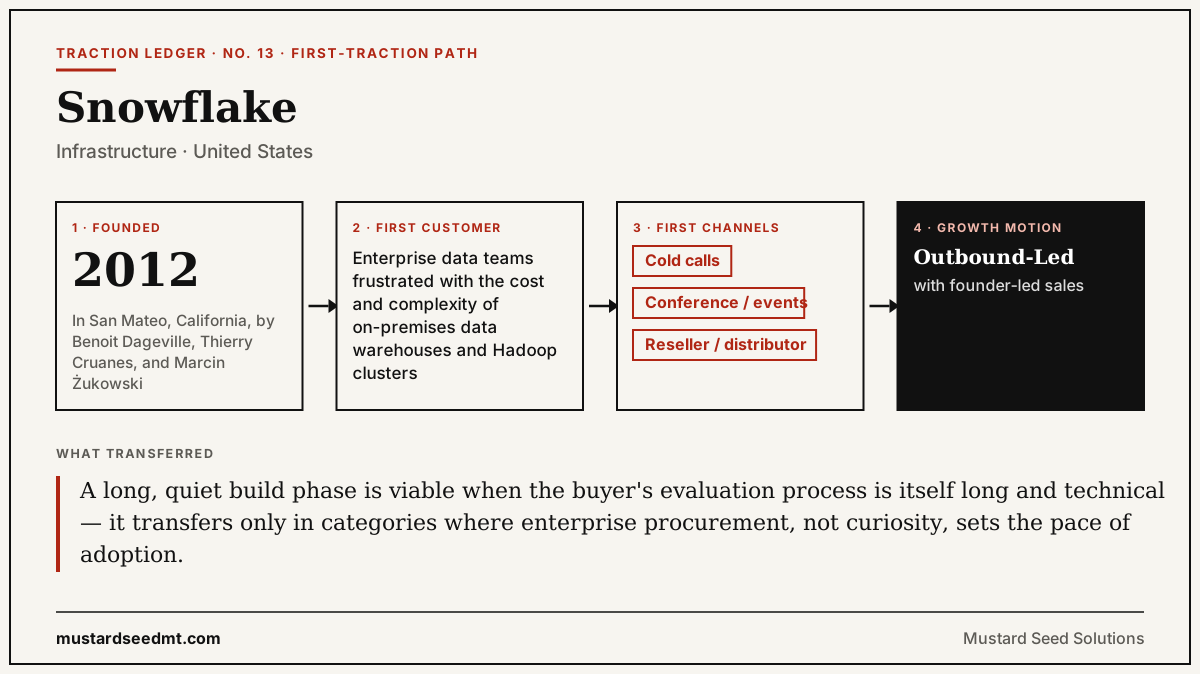
The Wedge: How Snowflake Got Its First Customers
Snowflake got its first customers only after roughly two years of stealth product development — an unusually long, deliberately quiet build phase for a company in this ledger — targeting large enterprises whose existing data warehouses (on-premises systems or early Hadoop deployments) couldn't handle growing data volumes without expensive, disruptive scaling projects.
The first buyers were enterprise data teams with a specific, expensive pain: needing to scale storage and compute independently, rather than being forced to over-provision one to get more of the other, a structural limitation of the systems Snowflake was replacing.
Founded in San Mateo, California, by Benoit Dageville, Thierry Cruanes, and Marcin Żukowski (2012).
Snowflake's First Channel
Unlike most devtools entries in this ledger, Snowflake's first channel was direct enterprise sales — cold outreach and conference presence aimed specifically at data engineering and IT leadership at large organizations, backed by an already-built, technically mature product following the long stealth period.
Listings on cloud marketplaces, particularly AWS, supplemented direct sales by putting the product in front of enterprise buyers already procuring infrastructure through those channels, and by simplifying procurement for buyers who preferred to purchase through an existing cloud vendor relationship.
The Motion: Outbound-Led
The sales motion was built around long enterprise sales cycles from the start — pilots, proofs of concept, and IT procurement processes — reflecting the reality that a company's core data warehouse is a high-stakes, carefully evaluated purchase, not a self-serve trial decision.
Consumption-based pricing (paying separately for compute and storage, scaled independently) was the product's central commercial argument, directly answering the specific cost and flexibility complaint that motivated the first customers to evaluate an alternative at all.
As the customer base grew, Snowflake's go-to-market motion remained direct and sales-led even at scale, unlike most infrastructure entries in this ledger that shifted toward self-serve — reflecting how enterprise data-platform purchases are actually made.
The Turn — the motion held
The motion held. Snowflake's sales-led, enterprise-first approach was consistent from its stealth-mode beginning through its 2020 IPO, the largest software IPO on record at the time, without a significant change in how new customers were acquired.
Era: 2005-2014
Where It Ended Up: Public (NYSE: SNOW) since 2020
What Transferred
"A long, quiet build phase is viable when the buyer's evaluation process is itself long and technical — it transfers only in categories where enterprise procurement, not curiosity, sets the pace of adoption."
Sources
Related Entries
HashiCorp
Open-source infrastructure tools that developers adopted years before HashiCorp sold anything.
Open-source repoDocker
A container tool that went from conference lightning talk to industry standard in under two years.
Open-source repoElastic
A search library built to solve one developer's recipe-search problem for his wife, open-sourced and adopted everywhere.
Open-source repo