
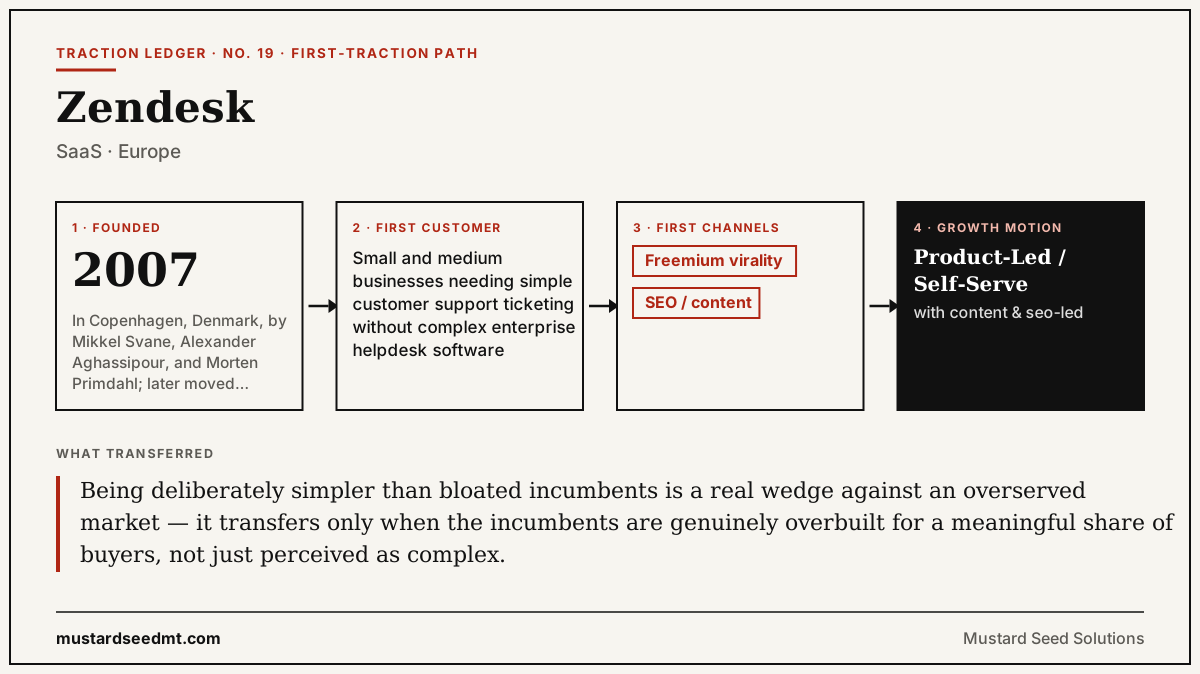
The Wedge: How Zendesk Got Its First Customers
Zendesk got its first customers by being dramatically simpler than the enterprise helpdesk software already on the market, which was typically complex, expensive, and aimed at large call centers rather than small teams handling a manageable volume of customer questions.
The founders, working together in Copenhagen, built a support ticketing tool a small business could set up in an afternoon, targeting teams who found existing options — designed for large enterprise IT departments — entirely disproportionate to their needs.
Founded in Copenhagen, Denmark, by Mikkel Svane, Alexander Aghassipour, and Morten Primdahl; later moved headquarters to San Francisco (2007).
Zendesk's First Channel
The channel combined search-driven content (small businesses searching for simple support-ticketing solutions found Zendesk through comparison content and its own marketing) with a low-friction free trial that let a team test the product immediately.
Because setup required no dedicated IT involvement, a single support lead or small business owner could sign up, configure, and start using it without an internal approval process typical of larger helpdesk software purchases.
The Motion: Product-Led / Self-Serve
The free trial converted to a monthly per-agent subscription, with pricing that scaled naturally as a support team grew — a small team's low bill matched its low agent count, avoiding the large upfront licensing costs of legacy competitors.
Simplicity was maintained as a deliberate product principle relative to competitors, since the target buyer explicitly did not want the configuration complexity of enterprise-grade helpdesk software.
As Zendesk's customer base matured and grew to include larger organizations, the company added more sophisticated features and a sales-assisted motion for bigger accounts, but the self-serve trial remained the primary entry point for the broad base of smaller customers.
The Turn — the motion held
The motion held. Zendesk's move upmarket toward larger enterprise customers over the following decade was a market expansion, not a change in the fundamental self-serve, trial-driven mechanism that won its earliest SMB customers.
Era: 2005-2014
Where It Ended Up: Taken private by an investor group in 2022, after operating as a public company since 2014
What Transferred
"Being deliberately simpler than bloated incumbents is a real wedge against an overserved market — it transfers only when the incumbents are genuinely overbuilt for a meaningful share of buyers, not just perceived as complex."
Sources
Related Entries
Twilio
SMS and voice as an API — pay per call, no sales conversation required.
Hacker NewsGitHub
Git hosting that made open-source collaboration social, starting with the Ruby community.
Open-source repoDatadog
Unified monitoring for DevOps teams juggling too many separate dashboards.
Webinars