
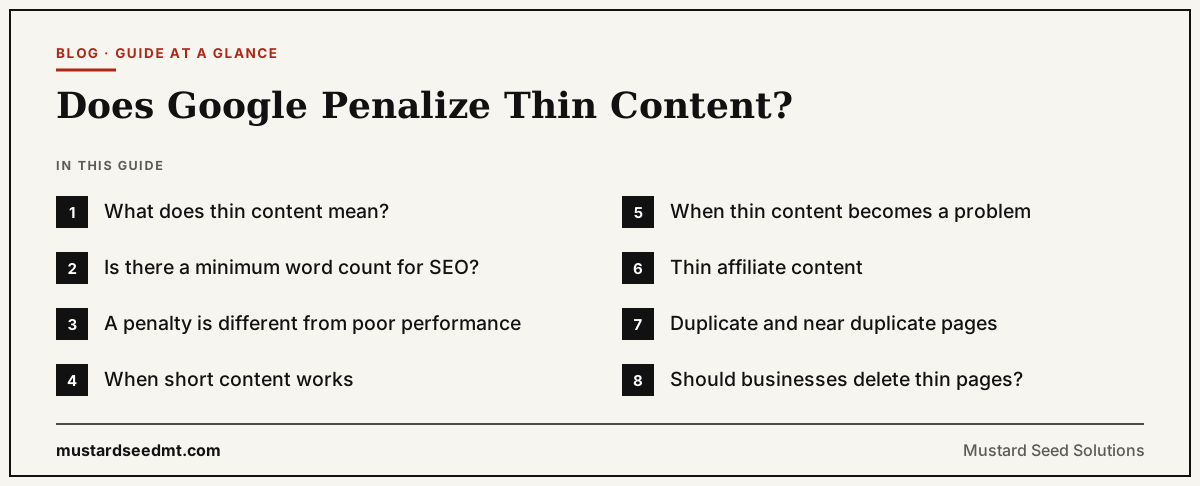
The phrase “thin content” creates unnecessary fear for many website owners.
Businesses are often told that short pages will be penalized, that every article must contain a minimum number of words, or that pages with limited text should be deleted immediately.
This advice oversimplifies how search engines evaluate content.
There is no general rule that a page is penalized simply because it is short. A page with a small amount of text can still be useful, relevant, and appropriate for the search it serves.
The real issue is not always content length. It is whether the page provides enough value for its purpose.
Short content and low quality content are not the same thing.
What does thin content mean?
“Thin content” is an industry term used to describe pages that provide little original or useful information.
However, the definition is often applied too broadly.
A short contact page may contain only an address, telephone number, opening hours, and a form. That page can still serve its purpose perfectly.
A weather page may contain a small amount of text but provide valuable structured information. A product page may rely heavily on images, technical specifications, prices, and availability.
These pages may be light on written copy without being useless.
A page becomes problematic when it exists primarily to capture search traffic but offers little help to the visitor.
Examples may include automatically generated pages with almost identical text, copied descriptions, doorway pages created for numerous locations, or affiliate pages that repeat information available elsewhere without adding meaningful value.
The problem is the lack of usefulness or originality, not a specific word count.
Is there a minimum word count for SEO?
There is no universal minimum word count that guarantees a page will be indexed or ranked.
The correct amount of content depends on the subject and the search intention.
A user searching for the height of a particular building may need only one sentence. A user researching how to establish a limited liability company may need a detailed guide.
Forcing both pages to contain 1,500 words would make no sense.
SEO tools sometimes recommend content length based on the pages currently ranking for a keyword. These estimates can provide context, but they should not be treated as requirements.
Longer ranking pages may perform well because they cover a complex topic, attract more links, or answer several related questions.
Their length may be a result of their usefulness rather than the cause of their rankings.
Businesses should write enough to answer the search properly.
A penalty is different from poor performance
The word “penalty” has a specific and serious meaning.
A penalty suggests that a search engine has taken action against a website because it violated a policy.
Poor rankings do not automatically indicate a penalty.
A page may fail to rank because it targets a highly competitive keyword, lacks authority, does not match search intent, duplicates another page, or provides a weaker answer than competing results.
It may also be crawled without being selected for indexing.
These outcomes can be disappointing, but they are not necessarily punishments.
A search engine does not need to penalize every weak page. It can simply choose not to show that page prominently.
This distinction matters because the solution depends on the problem.
A genuine policy violation may require removing manipulative practices. A weak page may require better targeting, stronger differentiation, improved internal links, or more authority.
When short content works
Short content can perform well when it answers a narrow question efficiently.
A concise glossary definition, calculator, product specification, store location page, image gallery, or support answer may satisfy users without extensive prose.
The page must still provide clear value.
For example, a local store page could include the address, map, telephone number, hours, available services, accessibility information, parking details, and directions.
The total word count may remain low, but the information is useful and specific.
A software support page explaining a single error code may also be brief. Adding a long introduction about the history of the software would make the answer less efficient.
Good content respects the user’s time.
When thin content becomes a problem
Short content becomes risky when it is one part of a larger pattern of weak pages.
A company may create hundreds of location pages that differ only by the city name. The pages may claim to provide local services without containing any location-specific information.
An ecommerce website may publish thousands of manufacturer descriptions copied from other stores.
An affiliate website may summarize products without testing them, comparing them, or adding experience.
A publisher may use automation to create many pages that repeat the same general information.
In each case, the issue is not that the pages are short. The issue is that they contribute little value and may have been created mainly to manipulate search visibility.
Thin affiliate content
Affiliate content deserves particular attention.
An affiliate page earns money when a visitor clicks a link or purchases through a recommendation.
Affiliate marketing itself is legitimate. The problem arises when the page adds no useful information beyond what the seller already provides.
A valuable affiliate page might include original testing, transparent comparisons, photographs, practical limitations, suitability for different users, and clear explanations of how recommendations were selected.
A thin affiliate page may copy product descriptions, add generic praise, and insert purchase links.
The difference is contribution.
Businesses using affiliate content should focus on helping readers make better decisions rather than merely sending traffic to a seller.
Duplicate and near duplicate pages
Websites often create thin content unintentionally through duplication.
A service business may produce separate pages for many locations. An ecommerce platform may create several URLs for product variations. A software website may publish overlapping pages for similar features.
When pages are nearly identical, search engines may choose one version and ignore the others.
This is not necessarily a penalty. It may be a normal indexing decision.
The solution is not always to add random paragraphs to every page.
The business should determine whether each page serves a genuinely different purpose.
A separate location page should contain information relevant to that location. A product variation page should help users understand the difference. Overlapping articles may need to be consolidated.
Should businesses delete thin pages?
Deleting every short page is usually a poor strategy.
Before removing anything, identify the page’s purpose, traffic, backlinks, conversions, and role within the website.
A short page may rank for useful searches. It may support customers, attract links, or contribute to a conversion journey.
Other pages may need improvement rather than deletion.
Possible actions include adding useful information, combining overlapping pages, redirecting outdated URLs, improving internal links, or keeping the page unchanged when it already serves its purpose.
Deletion should be based on evidence, not fear.
How to improve a weak page
Begin by asking what the visitor needs.
Does the page answer the main question clearly? Does it provide specific information? Does it contain something unavailable from competing pages? Is the page easy to find and navigate?
Useful additions might include examples, prices, processes, images, data, comparisons, frequently asked questions, or expert observations.
Do not add text only to increase the word count.
Every addition should improve the page.
A page that needs 300 words should not be expanded to 2,000. A page that requires a detailed explanation should not be reduced simply because short content can rank.
Focus on usefulness, not length
The idea of a universal thin content penalty encourages businesses to measure content by quantity instead of purpose.
That leads to bloated articles, repetitive service pages, and unnecessary writing.
A better question is not, “Is this page long enough?”
The better questions are:
Does the page satisfy the searcher? Is it distinct from other pages? Does it support a real business or customer need? Is there a reason for this page to exist?
Short pages are not automatically bad. Long pages are not automatically good.
The strongest content provides the right amount of information for the task.