
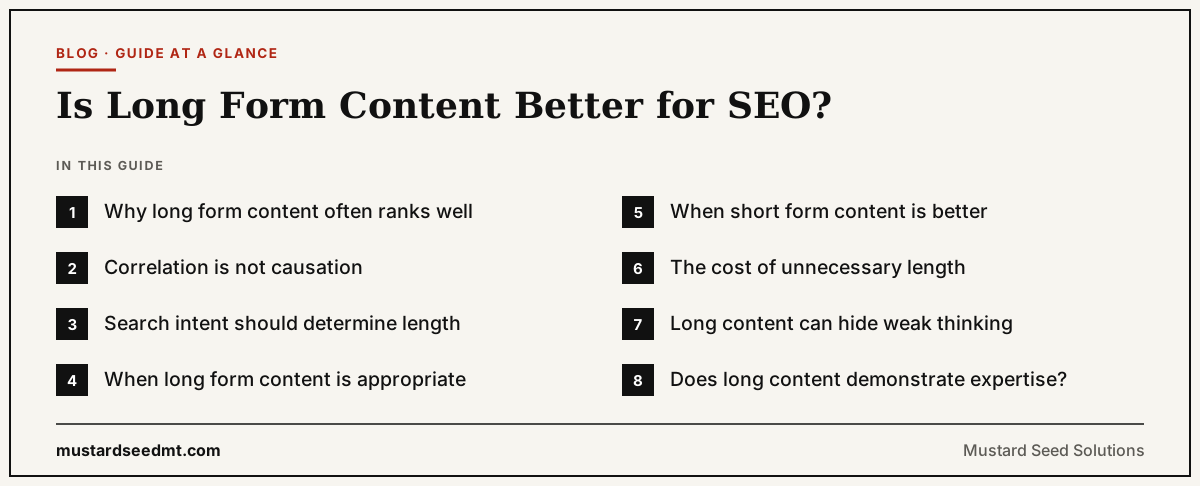
Long form content has become a standard part of many SEO strategies.
Businesses are frequently advised to publish articles containing 1,500, 2,000, or even 3,000 words. The reasoning appears simple: longer articles can include more keywords, cover more questions, and demonstrate greater expertise.
Long form content can perform extremely well.
However, it is not automatically better for SEO.
The right content length depends on the search intention, the complexity of the subject, the competitive environment, and the amount of information needed to help the reader.
An article should be complete, not artificially long.
Why long form content often ranks well
There are legitimate reasons detailed articles frequently appear in search results.
A long article can cover a subject from several angles. It may answer the main question and several related questions in one place.
This can make the page useful for a wider range of searches.
A comprehensive guide may also attract backlinks because other publishers can reference it as a resource. It may keep readers engaged when they want detailed information. It can demonstrate the author’s practical knowledge through examples, explanations, and evidence.
These advantages can support organic visibility.
However, none of them comes from word count alone.
Length provides space to create value. It does not guarantee that the space will be used well.
A 3,000 word article containing repetition, vague statements, and generic advice may be less helpful than a focused 700 word explanation.
Correlation is not causation
SEO studies sometimes show that longer pages rank higher on average.
These findings are often interpreted as proof that businesses should increase their word counts.
The conclusion may confuse correlation with causation.
Longer pages often target broad and complex subjects. They may have existed for years, earned more links, been updated several times, and accumulated authority.
Their rankings may result from relevance, reputation, links, or complete topic coverage.
The visible word count is only one characteristic.
Imagine two guides about starting a business.
The first contains 3,000 words because it explains registration, taxes, accounting, banking, insurance, and employment.
The second contains 3,000 words because it repeats the same general advice in different ways.
Both pages are long, but they do not provide equal value.
Search performance should not be explained by length without considering what the content actually does.
Search intent should determine length
The most important consideration is what the searcher needs.
Someone searching for “what is a meta description” may want a definition, recommended format, and a short example.
A concise article can answer that search effectively.
Someone searching for “how to create an international SEO strategy” may need information about language targeting, website structure, keyword research, local markets, technical implementation, and measurement.
That subject naturally requires greater depth.
The first question should not be expanded unnecessarily. The second should not be reduced to a brief answer.
Content length should follow the task.
When long form content is appropriate
Long form content works particularly well for complex educational topics.
Detailed guides can help users understand a process from beginning to end. Examples include buying guides, legal overviews, technical tutorials, industry reports, strategic frameworks, and comprehensive comparisons.
Long content may also be useful when the searcher needs to evaluate an important decision.
A business choosing accounting software may want to compare features, costs, integrations, limitations, security, and support. A short promotional page is unlikely to provide enough information.
Long form articles can also support content clusters.
A central guide may introduce a broad topic and link to more detailed pages about individual subtopics. This gives the website a clear structure and allows readers to choose the level of detail they need.
When short form content is better
Short form content is often better when the question is narrow.
Definitions, simple instructions, news updates, product specifications, event information, contact details, and troubleshooting answers may not require extensive text.
Users may become frustrated when they must scroll through a long introduction before finding a basic answer.
This is especially common in recipe pages, support documents, and articles created to meet arbitrary SEO word counts.
Efficiency is part of usefulness.
A short page can perform strongly when it provides the answer more clearly than longer competitors.
The cost of unnecessary length
Long content requires more time to research, write, edit, and maintain.
Publishing long articles without a clear reason can waste resources.
The content may also become outdated more quickly because it contains more facts, examples, links, and recommendations that need to be reviewed.
Unnecessary length can reduce conversion performance.
A visitor looking for a service may not want to read a 4,000 word essay before understanding the offer, price, or next step.
Businesses should consider the role of the page.
An educational guide can be detailed. A service page may need enough information to build trust and answer objections, but it should still guide the visitor towards action.
Long content can hide weak thinking
Word count targets can encourage writers to fill space.
They may add generic introductions, repeat definitions, create unnecessary sections, or use several paragraphs where one sentence would be enough.
This creates the appearance of depth without genuine substance.
A strong long form article should remain focused.
Each section should contribute something distinct. Examples should clarify the subject. Supporting details should help the reader understand or act.
If a paragraph can be removed without reducing the article’s usefulness, it may not belong there.
Editing is especially important for long content because weak sections accumulate.
Does long content demonstrate expertise?
Length can provide room to demonstrate expertise, but expertise comes from the quality of the information.
A specialist can show experience through practical examples, clear reasoning, original observations, accurate explanations, and an understanding of tradeoffs.
A long article that repeats common online advice does not automatically establish authority.
Businesses should use long content to share what they genuinely know.
This could include lessons from client work, original data, operational processes, industry patterns, mistakes, and case studies.
Practical detail is more convincing than volume.
How keywords fit into long form content
Long articles naturally contain more language connected to a subject.
They may include synonyms, related questions, entities, and supporting concepts. This can help search engines understand the topic and allow the page to appear for several relevant searches.
However, adding more keywords should not be the main reason for extending a page.
Keyword repetition can make writing unnatural and provide little additional value.
A well structured article usually uses important terms naturally because they are necessary to explain the subject.
The priority is complete topic coverage rather than keyword density.
Should you copy the length of ranking competitors?
Competitor analysis can provide useful context.
If every strong result for a target keyword is a detailed guide, the search probably requires substantial coverage.
If the results are product pages, calculators, videos, or short definitions, publishing a very long article may be the wrong format.
Businesses should examine more than the number of words.
Review the questions the competing pages answer, the format they use, their authority, the search intent they serve, and what they fail to explain.
The goal is not to reproduce the average competitor.
The goal is to create a page that serves the search more effectively.
A practical way to choose content length
Start with an outline rather than a target word count.
List the questions the reader needs answered. Include the information necessary to understand the subject and make a decision.
Write the first draft without trying to reach a specific number.
Then remove repetition, vague language, and sections that do not support the purpose.
Add examples or explanations only where they improve understanding.
The final length should emerge from the subject.
Some articles may finish at 600 words. Others may require 2,500. Both can be appropriate.
Quality of coverage matters more than size
Long form content is a useful format, not a universal ranking tactic.
It performs well when the topic requires depth and the article uses that length to provide genuine value.
Short content performs well when it answers a focused question efficiently.
The decision should be based on search intent, customer needs, and business purpose.
Do not ask how many words Google wants.
Ask how much information the reader needs.
The best content is not necessarily the longest. It is the content that delivers the clearest and most complete answer without wasting the reader’s time.