
“Create great content” is one of the most common pieces of SEO advice.
It sounds logical. Google wants to provide useful results, so businesses should publish useful information. If an article is accurate, clearly written, and valuable to readers, it should perform well.
Unfortunately, the process is not that simple.
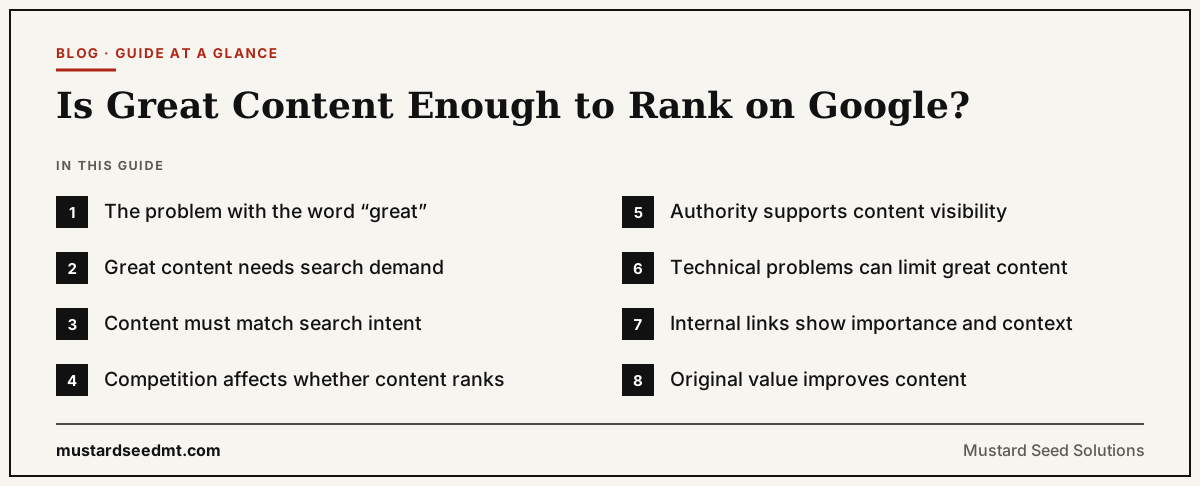
Great content is important, but content quality alone is rarely enough to guarantee strong Google rankings. A page must also match an existing search demand, satisfy the intention behind the query, be accessible to search engines, fit within a clear website structure, and compete against pages that may already have greater authority.
A business can publish an excellent article and still receive almost no organic traffic. Understanding why helps companies build a more realistic SEO content strategy.
The problem with the word “great”
The first difficulty is that greatness is subjective.
A writer may judge an article by its style, originality, grammar, or depth. A business owner may judge it by how well it explains the company’s expertise. A customer may simply want a quick answer.
Search engines cannot evaluate content in exactly the same way a human editor would.
They process signals that help estimate whether a page is relevant and useful for a particular search. These signals may include the words and concepts on the page, links, website structure, source reputation, user context, location, and freshness where appropriate.
This means a well written article is not automatically the best search result.
A detailed essay about the history of accounting may be excellent writing. However, it will not satisfy someone searching for an accountant available today in Warsaw.
The searcher’s intention matters more than the writer’s opinion of the content.
Great content needs search demand
SEO begins with understanding what people search for.
A company may publish a thoughtful article on a subject that interests its internal team but has little demand among potential customers.
The article may be useful, but it may never attract meaningful organic traffic because few people search for the topic.
Search demand does not mean businesses should write only about high volume keywords. Small and specific searches can be valuable when they represent people with a clear commercial need.
For example, a broad keyword such as “marketing” may attract a large audience but provide little information about what the searcher wants.
A more specific search such as “B2B marketing strategy for cybersecurity companies” may have a smaller audience, but those visitors are more likely to match a specialist consultancy.
The objective is not to find the biggest keyword. It is to find the right relationship between demand, relevance, and business value.
Content must match search intent
Search intent describes what the person is trying to accomplish.
Common intentions include learning, comparing, finding a specific website, locating a provider, or purchasing something.
A page can be detailed and accurate while still targeting the wrong intention.
Consider someone searching for “best CRM for a small business.” That person is probably looking for comparisons, advantages, limitations, prices, and recommendations.
A CRM company may try to rank a standard product page for this search. The page may be polished and professionally written, but it may not provide the comparison the searcher expects.
The strongest results for that query may instead be comparison articles, review platforms, or detailed buying guides.
Before creating content, review the type of pages already appearing for the target search. They reveal what the search engine currently interprets as the likely intention.
This should not lead to copying competing articles. It should help the business choose the correct format.
Competition affects whether content ranks
A page does not compete against an abstract standard of quality. It competes against other pages.
For many commercial searches, the existing results may come from established companies, recognized publications, review platforms, or websites that have accumulated authority for years.
A new company may publish an article that is more current and better written. However, the competing pages may have strong backlinks, brand recognition, extensive internal linking, and a history of satisfying similar searches.
This does not mean a newer website cannot compete.
It means the company needs a realistic strategy.
It may begin with narrower searches, underserved questions, specialist expertise, original examples, or topics where large competitors provide weak answers.
Content strategy should consider the competitive environment before publication rather than judging success only after the page fails to rank.
Authority supports content visibility
Search engines need evidence that a source deserves attention.
Any website can describe itself as an expert. Independent recognition provides stronger evidence.
Links from relevant websites, mentions in industry publications, customer reviews, professional partnerships, original research, and participation in a market can all support authority.
This is why content and link building should not be treated as completely separate activities.
Strong content can give people a reason to reference the website. External references can help search engines recognize that the content has earned attention.
A business that publishes generic articles without building relationships may struggle to compete, even when the writing is competent.
Authority is not created only through SEO tactics. It often grows from genuine business activity.
Technical problems can limit great content
Search engines must be able to find and process a page before they can rank it.
A valuable article may underperform when it is blocked from indexing, hidden behind poor navigation, duplicated across several URLs, or isolated from the rest of the website.
Incorrect canonical tags, broken redirects, server errors, or weak internal linking can also reduce visibility.
Technical SEO does not make ordinary content exceptional, but technical problems can prevent good content from receiving a fair opportunity.
The goal is not technical perfection.
The goal is to remove obstacles and make the website easy for users and search engines to navigate.
Internal links show importance and context
Internal links connect pages within the same website.
They help search engines discover content and understand how subjects relate to each other. They also indicate which pages the business considers important.
A blog article about marketing analytics might link to related articles about attribution, conversion measurement, and user behaviour. It may also link to a relevant service page.
Without these connections, the article can become an isolated document.
Publishing content without integrating it into the wider website is a common mistake. The page exists, but it receives little authority or context from other pages.
A clear content cluster can perform better than a collection of unrelated articles because each page supports a broader subject.
Original value improves content
Many SEO articles repeat information already available on hundreds of websites.
They use the same definitions, headings, examples, and conclusions.
The writing may be technically good, but it gives readers little reason to choose that page over an established competitor.
Businesses can improve their content by including genuine experience.
This may include original data, customer questions, project lessons, industry observations, detailed examples, proprietary frameworks, or expert commentary.
Original value does not always require new scientific research. It can come from explaining a familiar problem through practical experience.
A consultancy that has worked with technology companies can discuss the mistakes it repeatedly sees during marketing campaigns. A local business can explain region-specific customer behaviour. A software provider can publish anonymized product usage findings.
These contributions make the content more useful and more difficult to reproduce.
Content needs a business purpose
Traffic is not the final objective.
Content should support a measurable business purpose, such as generating qualified leads, answering sales questions, building trust, attracting relevant backlinks, or helping customers evaluate a service.
An article may receive thousands of visits but produce no meaningful action.
Another article may attract only a few hundred visitors but generate several valuable enquiries.
The second article may be more commercially successful.
Businesses should define the role of each article before writing it. Some content will attract early research traffic. Some will help readers compare options. Some will support a purchase decision.
The calls to action and internal links should match that role.
Great content is a foundation, not a guarantee
Content quality remains essential.
Weak, inaccurate, confusing, or copied content is unlikely to create durable results. However, quality operates within a wider system.
A successful page usually combines several elements:
It answers a real question. It matches search intent. It is accessible to search engines. It is supported by a clear website structure. It offers a reason to choose the page over competing results. It comes from a source with growing credibility.
Great content is therefore not enough by itself.
It is the foundation on which effective SEO can be built.