
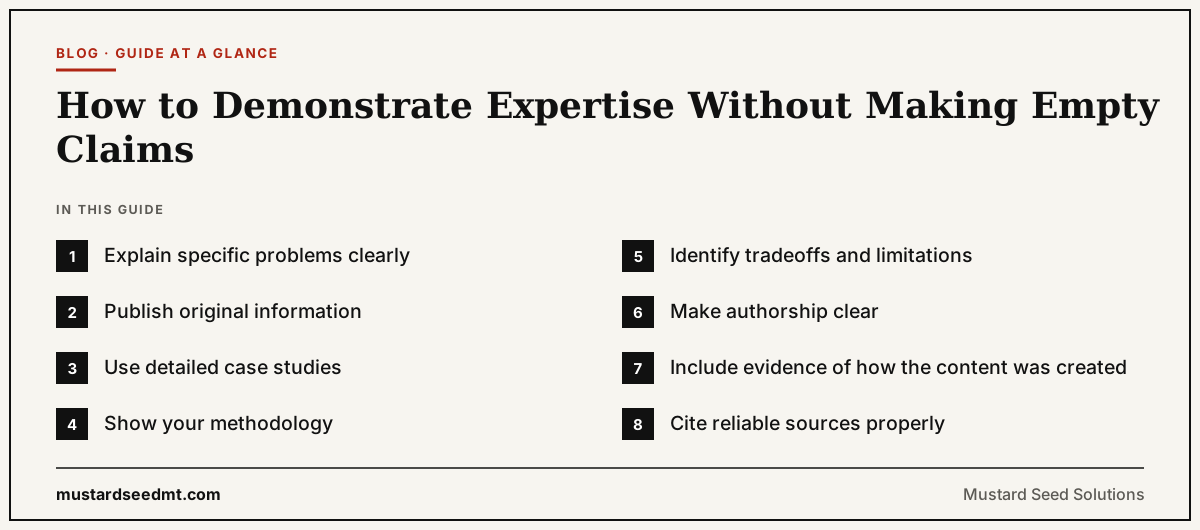
Many business websites describe their companies as experts.
They use phrases such as “industry leading,” “trusted specialists,” “experienced professionals,” and “best in class solutions.”
These statements may be true, but they provide little evidence.
Anyone can publish a claim on their own website. Potential customers, search engines, journalists, and business partners need more than promotional language before they consider a company credible.
Real expertise is demonstrated through the quality of the information a company provides, the problems it has solved, the methods it uses, and the recognition it has earned from others.
The strongest approach is simple: show the work instead of repeatedly claiming authority.
Explain specific problems clearly
Experts can usually explain difficult subjects in clear language.
They understand which details matter, where people become confused, and which mistakes create serious consequences.
A company can demonstrate expertise by answering specific questions that customers regularly ask.
For example, a marketing consultancy could explain how lead quality should be measured, why attribution reports often disagree, or when a company should invest in SEO rather than paid advertising.
A cybersecurity provider could explain how a particular vulnerability works, which organizations face the greatest risk, and what practical controls reduce exposure.
A vague article about “the importance of cybersecurity” demonstrates less expertise than a precise explanation of a real problem.
Specificity creates credibility — it is the difference between marketing that earns trust and marketing that asserts it.
Publish original information
Many business blogs repeat information already available across hundreds of websites.
The writing may be accurate, but it does not prove that the company possesses distinctive knowledge.
Original information provides stronger evidence.
This may include research, survey results, anonymized customer data, industry benchmarks, practical frameworks, testing results, or observations from completed projects.
Google’s current guidance asks whether content provides original information, research, reporting, or analysis and whether it offers value beyond merely rewriting other sources.
A company does not need a large research department to contribute something original.
A consultancy could analyze recurring problems found during twenty website audits. A software provider could publish anonymized data about how customers use a feature. A local service company could document seasonal patterns affecting its market.
The information should be honest about its scope.
Small studies should not be presented as universal conclusions. Explain how the information was collected, what period it covers, and what limitations apply.
Use detailed case studies
Case studies are one of the clearest ways to demonstrate expertise.
A useful case study explains more than the final result.
It describes the initial situation, the problem, the available options, the chosen approach, and the reasoning behind important decisions.
It may also explain what did not work.
For example, instead of writing, “We increased organic traffic by 200 percent,” explain:
What condition was the website in before the project?
Which searches were commercially important?
What technical or strategic problems were discovered?
Which actions were prioritized?
How long did the work take?
What business result followed?
What other factors may have affected the outcome?
This level of detail demonstrates how the company thinks.
It also helps potential customers understand whether the provider has experience with situations similar to their own.
When confidentiality prevents the publication of client names or exact figures, anonymized case studies can still be useful. The company should clearly disclose that identifying details have been removed.
Show your methodology
Experts do not need to reveal every proprietary process, but they should be able to explain how they approach their work.
A methodology shows that results are not based on random activity.
A marketing consultancy might explain how it evaluates market demand, customer intent, competitive authority, technical accessibility, and conversion performance before recommending an SEO strategy.
A design company might explain how it conducts user research, tests prototypes, and evaluates accessibility.
An accounting firm might explain how it collects documents, verifies transactions, manages deadlines, and communicates tax obligations.
The process helps customers evaluate whether the company works systematically.
It also separates meaningful expertise from generic sales promises.
Identify tradeoffs and limitations
Inexperienced content often presents every recommendation as universally correct.
Experts recognize that business decisions involve tradeoffs.
SEO may provide durable visibility, but it can take time to build. Paid advertising may generate faster traffic, but costs can rise. A complex software platform may offer powerful functionality while requiring more implementation support.
Discussing limitations does not weaken authority.
It demonstrates judgment.
A company that admits when its service is not appropriate can appear more credible than one that claims to serve every customer.
Useful content should explain where a method works, where it fails, and what conditions influence the outcome.
This is especially important when readers may make significant financial, medical, legal, or operational decisions.
Make authorship clear
Readers should be able to identify who created important content.
Google recommends making authorship clear where readers would reasonably expect it. Its guidance suggests using accurate bylines and linking them to information about the author’s background and areas of knowledge.
An author profile should include information relevant to the subject.
Useful details may include:
Professional role
Relevant experience
Qualifications
Areas of specialization
Published research
Industry contributions
Projects or responsibilities
A biography should not become a list of unrelated achievements.
The purpose is to help the reader understand why this person is qualified to discuss the topic.
A company should also avoid assigning all articles to a founder or senior executive who did not meaningfully contribute to them.
False attribution damages trust.
Include evidence of how the content was created
Expert content becomes more convincing when readers can see the process behind it.
For a product review, explain which products were tested, how the test was conducted, and what criteria were used.
For a research report, describe the sample, methodology, and analysis.
For a technical tutorial, include screenshots, code examples, measurements, or test conditions.
For a comparison, explain how the options were selected and whether the publisher has commercial relationships with any of the providers.
Google recommends considering the “Who, How, and Why” behind content. It specifically notes that explaining how content was produced can help readers evaluate its trustworthiness.
This transparency is increasingly important when AI tools are used during research, drafting, translation, or editing.
The use of AI does not automatically make content weak. The important question is whether qualified people verified the information and added real value.
Cite reliable sources properly
Expertise includes knowing when outside evidence is required.
A company should cite authoritative sources for statistics, regulations, scientific findings, and other factual claims.
The source should directly support the statement.
Linking to a general homepage or an article that repeats the same unsupported claim provides little value.
Primary sources are usually preferable.
These may include official documentation, legislation, research papers, public datasets, product documentation, or direct statements from responsible organizations.
Citations should support the company’s analysis rather than replace it.
A page that simply summarizes several sources without adding interpretation demonstrates research ability, but not necessarily subject matter expertise.
Publish practical tools and resources
Tools demonstrate that the company understands how customers apply information.
Useful resources might include calculators, checklists, templates, diagnostic tools, decision frameworks, or implementation guides.
A financial consultancy could provide a budgeting template.
A marketing company could publish a campaign measurement framework.
A software provider could create an integration checklist.
A legal practice could offer a document preparation guide, accompanied by appropriate limitations and professional disclaimers.
These resources allow users to experience the company’s expertise before becoming customers.
They can also attract links, mentions, and referrals from other websites.
Participate outside your own website
Authority is stronger when other credible people recognize it.
Businesses can demonstrate expertise by contributing to professional publications, conferences, podcasts, research projects, associations, and industry discussions.
A third party reference carries different weight from a claim on the company’s own website.
This does not mean chasing mentions from every available platform.
Focus on environments relevant to the company’s actual market.
A small specialist publication read by the right audience may be more valuable than a large general website with no connection to the subject.
Use customer results carefully
Customer outcomes can support expertise, but they should be presented responsibly.
Avoid selecting only exceptional results and presenting them as typical.
Explain the starting conditions, the work performed, and any external factors that may have contributed.
Obtain permission before naming customers or sharing confidential information.
Testimonials should be genuine and specific.
A statement such as “The team was excellent” provides limited evidence.
A stronger testimonial explains what problem was solved, how the provider worked, and what changed for the customer.
Correct mistakes publicly
Experts can make mistakes.
Credibility depends partly on how they respond.
When important information is incorrect or outdated, update it. Where appropriate, explain what changed.
Do not quietly rewrite major claims while continuing to present the article as if it had always been correct.
A visible correction policy demonstrates accountability.
This is particularly important for subjects where incorrect information could harm readers.
Avoid manufactured authority
Several common tactics create the appearance of expertise without its substance.
These include fake awards, invented certifications, purchased reviews, fabricated author profiles, stock photographs presented as team members, and exaggerated claims about company size or experience.
Such tactics may create a temporary impression of credibility, but they create serious reputational risk.
Authority should be based on evidence that can withstand inspection.
Expertise should help the reader
The purpose of demonstrating expertise is not simply to impress people.
Expertise should help the reader understand a problem, make a decision, avoid a mistake, or achieve a better result.
Google describes people first content as information created primarily to benefit visitors rather than manipulate search rankings.
That principle is useful beyond SEO.
Companies build authority when their knowledge is consistently useful.
Strong evidence, clear explanations, real experience, original information, transparent methods, and responsible claims create credibility.
Saying “we are experts” is easy.
Publishing work that proves it is harder, but far more persuasive.