
YMYL stands for “Your Money or Your Life.”
Google uses the term for topics that could significantly affect a person’s health, financial stability, safety, or the welfare and wellbeing of society.
Examples can include medical information, financial guidance, legal subjects, major safety issues, and certain forms of public information.
YMYL is not a special tag added to a website. It is not a separate index or a score visible in Google Search Console.
It is a quality concept used to recognize that some information carries greater consequences than other information.
Incorrect advice about choosing a paint color may create inconvenience. Incorrect advice about treating an illness or investing retirement savings can cause serious harm.
The level of evidence, expertise, and trust expected from the content should reflect that difference.
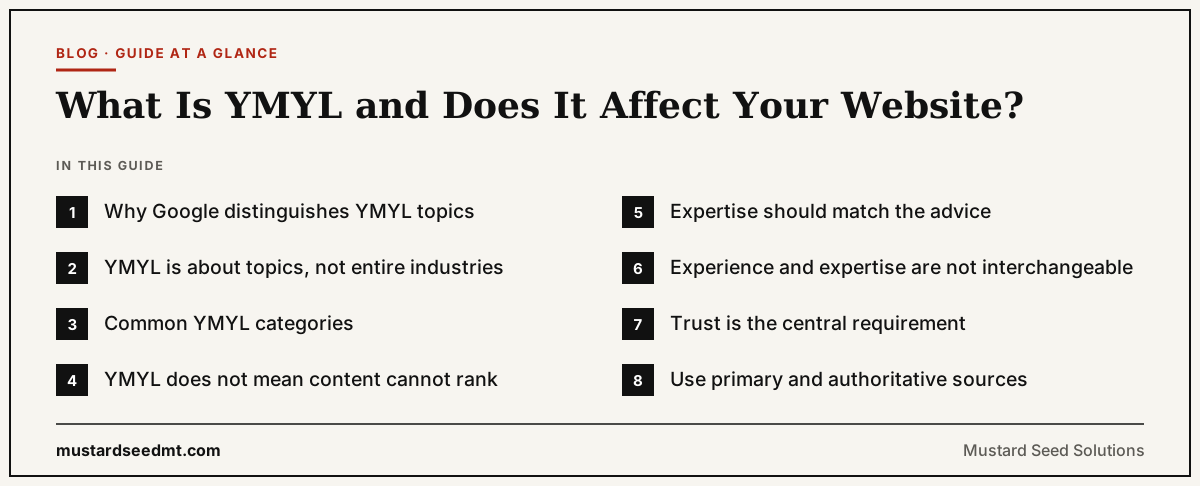
Why Google distinguishes YMYL topics
Search engines provide information to billions of people.
Some searches have very low risk.
A user may want a film summary, a recipe, or ideas for decorating an office.
Other searches can influence decisions with serious consequences.
A person may ask whether a symptom requires medical attention, how to manage debt, whether a financial product is safe, or how a law applies to their situation.
Weak or misleading answers can cause harm.
Google states that its systems give greater weight to signals associated with strong experience, expertise, authoritativeness, and trustworthiness for topics that could significantly affect health, financial stability, safety, or societal wellbeing.
This does not mean that every YMYL page must be written by a doctor, lawyer, or accountant.
The appropriate standard depends on the question.
YMYL is about topics, not entire industries
A common mistake is assuming that every page on a health, finance, or legal website is automatically treated in the same way.
The risk depends partly on the subject and purpose of the page.
A hospital page explaining how to find the parking area has little medical risk.
A bank article describing the history of its headquarters is not financial advice.
A legal firm’s staff event announcement is different from guidance about responding to a criminal charge.
The same website may contain both YMYL and non YMYL content.
Businesses should evaluate individual topics according to the consequences of inaccurate information.
Common YMYL categories
Health content is one of the clearest examples.
Articles about symptoms, diagnoses, treatment, medication, mental health, nutrition, pregnancy, and medical emergencies can affect important decisions.
Financial content can also carry serious risk.
This may include investing, credit, debt, insurance, taxes, pensions, mortgages, banking, and financial planning.
Legal information may influence rights, obligations, court processes, immigration, employment, contracts, or regulatory compliance.
Safety content can include emergency preparation, dangerous products, cybersecurity threats, workplace hazards, and instructions involving physical risk.
Some civic and societal information may also qualify when it can affect public wellbeing, elections, institutions, or vulnerable groups.
The boundaries are not always perfectly clear.
A sensible business should consider the possible harm caused by an inaccurate answer.
YMYL does not mean content cannot rank
Some website owners interpret YMYL as a penalty.
They assume that a new company cannot publish health or financial content, or that only major institutions can appear in search results.
That is not the correct conclusion.
YMYL means that credibility and accuracy are especially important.
A smaller specialist organization can still publish valuable information when it uses appropriate experts, clear evidence, responsible language, and transparent editorial processes.
The objective is not to make the website look large.
The objective is to demonstrate that the content deserves trust.
Expertise should match the advice
Different types of content require different forms of expertise.
A patient can describe their personal experience of living with a condition.
That experience may help other people understand emotional, social, or practical challenges.
However, the patient should not present personal experience as a medical diagnosis or universal treatment recommendation.
A qualified doctor may be appropriate for clinical guidance.
A certified financial adviser may be suitable for explaining investment risk.
A licensed lawyer may be appropriate for interpreting legal obligations.
The author’s expertise should match the claim being made.
A professional writer can still contribute by interviewing specialists, organizing information, verifying sources, and producing accessible explanations.
The final content should receive appropriate expert review.
Experience and expertise are not interchangeable
First hand experience can be highly valuable.
A person who has completed an immigration process can explain what the experience felt like and which practical documents they prepared.
A lawyer can explain the legal requirements and how regulations apply.
Both perspectives may help the reader, but they serve different purposes.
Websites should clearly distinguish personal experience from professional advice.
This protects the reader and strengthens trust.
Google’s E-E-A-T guidance notes that some content is useful because of the experience it demonstrates, while other content is useful because of the expertise it shares.
Trust is the central requirement
Google describes trust as the most important element within E-E-A-T.
For YMYL content, trust depends on several factors.
The information should be accurate.
Sources should be reliable.
Authors and reviewers should be identified.
Commercial incentives should be disclosed.
The website should clearly state who operates it.
Contact information and editorial responsibilities should be visible.
Important content should be updated when laws, medical guidance, prices, or product conditions change.
Trust is damaged by exaggerated claims, guaranteed outcomes, fake testimonials, hidden sponsorships, and misleading urgency.
Use primary and authoritative sources
YMYL claims should be supported with suitable evidence.
Medical articles may rely on peer reviewed research, recognized health authorities, clinical guidelines, and qualified specialists.
Financial articles may use legislation, regulatory guidance, official statistics, tax authority documentation, and reliable financial institutions.
Legal content should reference current legislation, court decisions, official procedures, and qualified legal interpretation.
Avoid building important advice on anonymous blogs or articles that provide no evidence of their own.
A source should directly support the claim.
Citations should not be added only to create the appearance of research.
State limitations clearly
YMYL content should explain what it can and cannot do.
A general article cannot consider every reader’s medical history, financial position, legal jurisdiction, or personal circumstances.
Appropriate disclaimers can help establish boundaries.
However, disclaimers do not excuse inaccurate information.
A page cannot publish reckless medical advice and solve the problem by adding “consult a doctor” at the end.
The content itself must remain responsible.
Use conditional language where certainty is not justified.
Explain when the reader should seek professional or emergency assistance.
Avoid guaranteed outcomes
High risk industries frequently use claims such as:
Guaranteed investment returns
Guaranteed visa approval
Guaranteed legal success
Guaranteed recovery
Risk free financial products
These statements should be treated with extreme caution.
Results often depend on circumstances outside the provider’s control.
Responsible businesses explain risks, variables, requirements, and realistic expectations.
Evidence based confidence is more credible than certainty that cannot be justified.
Create a documented editorial process
Organizations publishing YMYL content should establish clear responsibilities.
Decide who researches the article, who writes it, who reviews it, and who approves publication.
Record the sources used.
Set review dates for time sensitive subjects.
Create a process for correcting errors.
An article about a changing tax rule may require frequent review. A general explanation of a stable concept may need less frequent updating.
The process should reflect the risk and rate of change.
Make author and reviewer details visible
A byline should lead to useful information about the author.
Relevant details may include professional role, qualifications, experience, registration, areas of specialization, and responsibility for the content.
When an article was medically, legally, or financially reviewed, identify the reviewer and the nature of the review.
Do not add a professional’s name to content they did not examine.
False expert review creates a serious trust problem.
Google encourages accurate authorship information where readers would reasonably expect it.
Does YMYL affect ecommerce websites?
Some ecommerce content may involve YMYL concerns.
Products related to health, safety, finance, or major life decisions require careful descriptions.
A retailer selling medical devices should avoid unsupported treatment claims.
A financial platform should clearly explain fees and risks.
All ecommerce websites should provide accurate pricing, payment security, returns information, customer support details, and transparent ownership.
Transactions involve personal and financial information, so trust remains important even when the product itself is not high risk.
Does YMYL affect marketing companies?
A normal article about social media scheduling is unlikely to be strongly YMYL.
However, a marketing company may publish content about regulated industries, financial claims, medical advertising, privacy, or legal compliance.
Those subjects require more care.
Agencies working with YMYL clients should understand the client’s regulatory environment and involve qualified specialists.
Marketing teams should not turn complex professional guidance into stronger promotional claims than the evidence supports.
What to audit on a YMYL website
Review the accuracy of important claims.
Confirm that sources are current and authoritative.
Check whether authors and reviewers are properly identified.
Remove misleading guarantees.
Clarify commercial relationships.
Make company ownership and contact information visible.
Review security, privacy, and transaction processes.
Create an update schedule for changing information.
Examine whether personal experiences are being presented as professional advice.
These steps improve the website for users even when their exact ranking impact cannot be isolated.
YMYL is a responsibility, not an SEO trick
YMYL should not be approached as a checklist for pleasing an algorithm.
It is a reminder that some content can influence serious real world decisions.
Businesses publishing high stakes information should apply stronger standards of expertise, evidence, transparency, and accountability.
That approach supports SEO because it produces more credible information.
More importantly, it protects the people using the website.
When the potential consequences are serious, accuracy and trust should come before traffic.