
A no-show fee works because it turns an abstract inconvenience into a cost the client feels before they skip. One family-run practice lost roughly a quarter of its booked slots to no-shows in a single month — still paying full rent and overhead while working for free one hour in every four. The fix wasn't a harder conversation. It was a deposit the booking system enforced automatically.
That story, shared by someone helping run the business, split a small business forum down the middle. The owner's instinct was that charging a deposit was "too rude" to ask of loyal, small-town customers. The replies — hundreds of them — mostly disagreed, and the disagreement is worth unpacking, because it maps almost exactly onto the argument every solopreneur has with themselves before they change a booking policy.
This is one version of a pattern that shows up constantly in difficult-client situations: the policy that protects the business feels, in the moment, like it might cost the business a relationship. Usually it does the opposite.
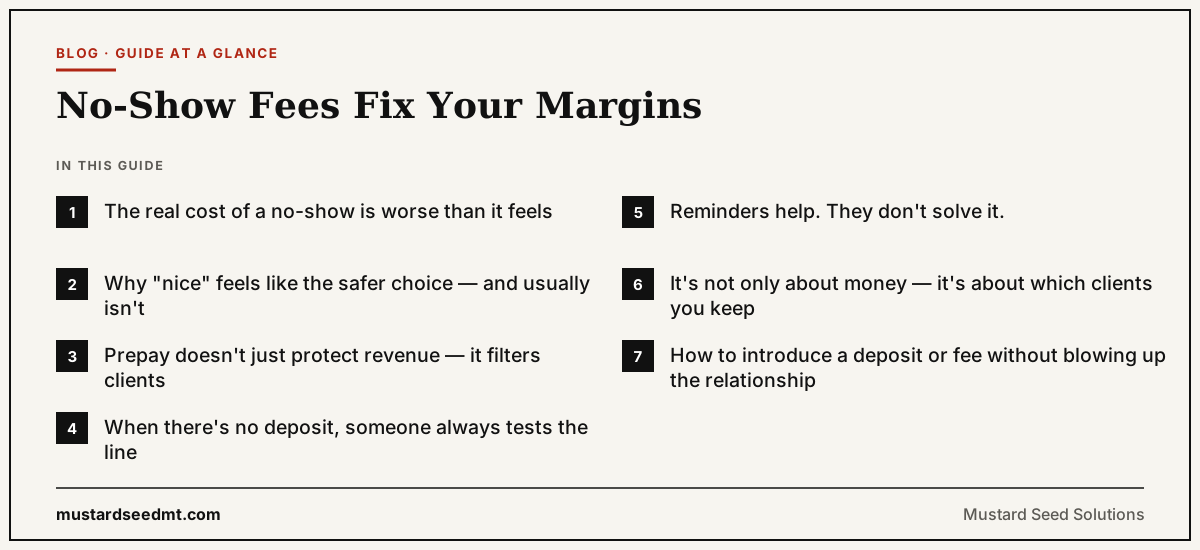
The real cost of a no-show is worse than it feels
Thirteen no-shows in a month, on a schedule where that represented about 25% of all booked appointments. The overhead — rent, utilities, staff time — didn't go away just because the client didn't show up. The business was still paying full price for the hour; it just wasn't getting paid for it.
That math is easy to miss when no-shows arrive one at a time, spread across a month, each one forgettable on its own. Added up, they're not an annoyance. They're a quarter of the business's capacity, gone.
A solopreneur running a single-person calendar feels this even harder than a practice with multiple providers. There's no other client to fill the gap on short notice. The hour is simply lost.
Why "nice" feels like the safer choice — and usually isn't
The owner's objection wasn't unreasonable on its face: a deposit request can feel like accusing a customer of planning to skip out. But the counterargument that carried the most weight in the discussion was practical rather than moral — other healthcare and personal-service providers already charge no-show fees for exactly this reason, and clients treat it as standard, not insulting.
One reply reframed the policy itself: a no-show deposit doesn't have to be strictly enforced every time. It can exist as the default, with room to waive it generously when a client has a genuine reason. That combination — a real policy plus real discretion — came up again and again as the version that worked without making every missed appointment into a confrontation.
Prepay doesn't just protect revenue — it filters clients
A massage therapist who switched to requiring prepayment for phone bookings described watching her book of business quietly reorganize itself. Clients who booked online kept booking. Clients who called in and balked at prepaying mostly stopped calling — and by her own account, that was fine, because those were disproportionately the same clients driving last-minute cancellations and no-shows.
The scale point she raised is worth sitting with: at a large spa doing high volume, one no-show is a rounding error — a fraction of a percent of the day's business. For a solo operator with a handful of appointments, the same no-show can represent somewhere between an eighth and a third of that day's income. The asymmetry isn't in the client's head. It's in the math of running alone.
She also pushed back on the fear that a strict policy destroys referrals. Word of mouth, in her experience, was never as reliable a growth engine as people assume — a small minority of clients refer at all, regardless of how flexible the pricing policy is. Losing a referral-that-was-never-coming is a different risk than losing four hours of unpaid time a month.
When there's no deposit, someone always tests the line
A bakery owner described a $210 custom order — cookies and brownies for a pickup appointment — where the customer arrived roughly ninety minutes late, then cancelled on the spot when asked to wait a little longer for the shop to re-open the display case. A bad review followed, accusing staff of "throwing a tantrum."
The response from other small business owners was close to unanimous: this is exactly what upfront payment exists to prevent. Recommendations ranged from requiring payment for any order over a modest threshold, to a clear cancellation-fee structure — a percentage held back if an order is cancelled after it's already been started. The consistent thread wasn't "charge more." It was "get commitment before you commit the work."
None of these businesses wanted to be strict for its own sake. They wanted the client's incentive and their own to point the same direction before the clock started.
Reminders help. They don't solve it.
It's tempting to treat no-shows as a communication problem — send a text the day before, and the issue goes away. In practice, that only closes part of the gap. Even with a confirmation call the day before, some clients still say yes and then don't show, and there's no reliable way to tell in advance which "yes" is real.
Reminders reduce forgetfulness. They don't touch the no-shows that were never about forgetting — the client who double-booked, decided against it, or simply didn't think a missed small-business appointment carried a real cost. A deposit is the only lever that changes the client's incentive rather than just their memory.
This is exactly the territory the 50 Biggest Solopreneur Challenges research maps out more broadly — the gap between problems that feel like they need a harder conversation and the ones that are actually solved by a better default.
It's not only about money — it's about which clients you keep
A mobile piano teacher's story makes the connection between price, policy, and no-shows explicit. After years of teaching at lower rates, she raised her prices significantly and got her first real pushback — a parent calling the new rate "steep." Her reply explained the increase plainly: she'd previously had trouble with "students that were not very serious," including excessive cancellations, and had since narrowed her roster to a small number of committed students at a rate that reflected her experience and travel time.
That's the same underlying decision as a no-show deposit, arrived at from a different direction. Instead of charging a fee after the fact, she priced and positioned the business so that only clients who took the commitment seriously signed up in the first place. Other business owners reading her story agreed the price wasn't out of line for the service — some pointed out comparable one-on-one lessons in other fields cost more — and the complaint said less about her pricing than about a client who wanted flexibility without paying for the certainty that flexibility requires.
The common thread across every one of these stories, from the family practice to the piano studio, is the same: a solopreneur's calendar is the entire inventory of the business. Policies that seem strict from the outside are usually just an attempt to make sure that inventory gets paid for, whether or not the client behaves the way the schedule assumes they will.
How to introduce a deposit or fee without blowing up the relationship
A few patterns held up consistently across these threads, and they're worth using as a rough sequence rather than a single decision made overnight:
- Frame it as standard practice, not a personal accusation — because in most service industries, it already is.
- Pilot it for a fixed period (three months came up repeatedly) and measure the actual effect on bookings and no-show rate before deciding it's permanent.
- Keep the policy simple: a flat deposit or a clear cancellation-fee percentage, stated at booking, not negotiated after the fact.
- Build in quiet discretion to waive the fee for genuine one-off circumstances, without advertising that discretion as a loophole.
- Route the "enforcement" through the booking system or invoice rather than a personal phone call — a system charging a fee feels procedural; a person asking for one feels confrontational.
None of this requires becoming a different kind of business owner. It requires treating booked time the same way any other business treats inventory — as something that has a cost the moment it's reserved, whether or not it gets used.