
The Wedge: How Ahrefs Got Its First Customers
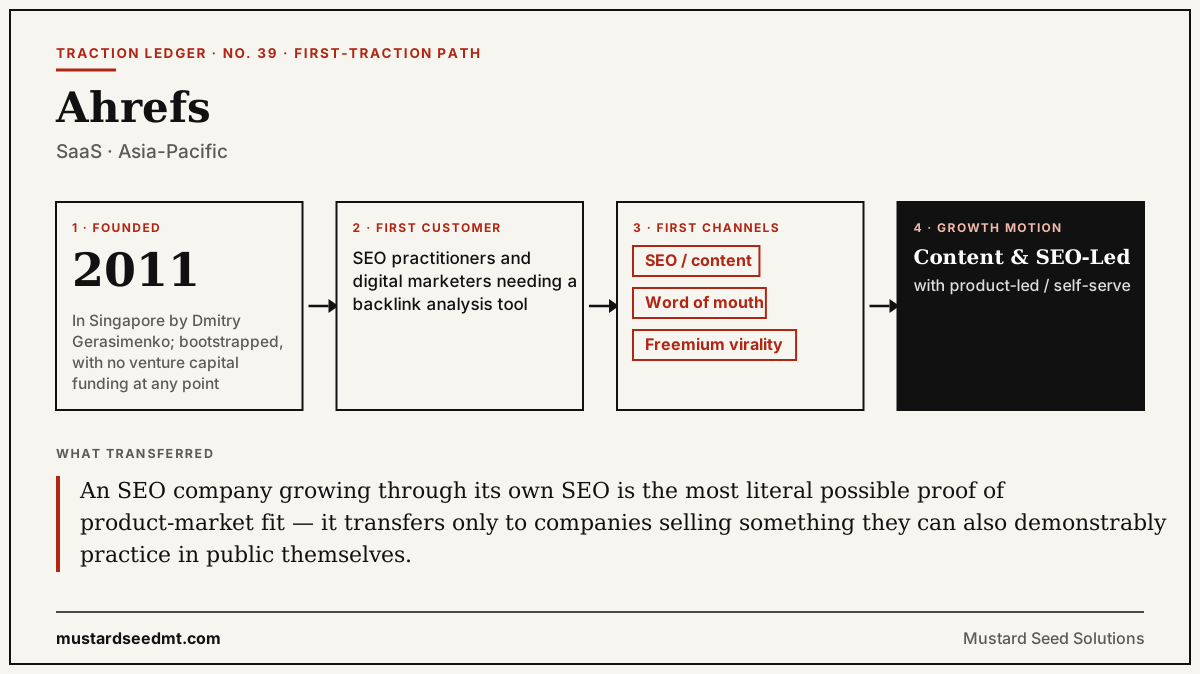
Ahrefs got its first users by building a backlink-analysis tool for the SEO community, a practitioner audience that was, almost by definition, already fluent in exactly the search and content tactics needed to reach them.
Dmitry Gerasimenko built and grew the company entirely without outside venture funding, a deliberate choice that shaped a more patient, profitability-focused growth trajectory than most venture-backed peers in this ledger's software category.
Founded in Singapore by Dmitry Gerasimenko; bootstrapped, with no venture capital funding at any point (2011).
Ahrefs's First Channel
The primary channel was, fittingly, Ahrefs' own SEO and content output — a YouTube channel, a blog, and free tools and calculators — meaning the company demonstrated its own product's category of expertise by ranking well and building an audience using the very discipline it sold software for.
Word of mouth inside the tightly networked SEO practitioner community reinforced this, since SEO professionals actively discuss and compare tools with each other as part of their own professional practice.
The Motion: Content & SEO-Led
The self-referential content strategy is unusually direct proof of product value: an SEO tools company that ranks well and grows an audience through SEO is demonstrating its own product's core promise in the process of marketing it.
Free tools and calculators lowered the barrier to first contact, letting a marketer get some value (a quick backlink check, a basic keyword idea) before committing to a paid subscription tier priced by usage and seats.
As the product broadened from backlink analysis alone into a fuller SEO platform — keyword research, site audits, content gap analysis — each new module was marketed through the same content-led channel that had built the company's audience from the start.
The Turn
The turn was scope, not mechanism: Ahrefs broadened from a single tool into a comprehensive SEO platform while its underlying growth engine — genuinely useful public content and free tools produced by the same team building the product — remained constant, alongside its unusual, sustained commitment to bootstrapped, transparent operation.
Era: 2005-2014
Where It Ended Up: Private; still independent, still bootstrapped
What Transferred
"An SEO company growing through its own SEO is the most literal possible proof of product-market fit — it transfers only to companies selling something they can also demonstrably practice in public themselves."
Sources
Related Entries
Slack
An internal messaging tool built for one gaming studio's own team, released after the game itself failed.
Personal networkZoom
Reliable video calling built by a former WebEx engineer who thought existing video conferencing was too frustrating.
Freemium viralityHubSpot
The company that coined "inbound marketing," then used its own content to prove the concept worked.
SEO / content