
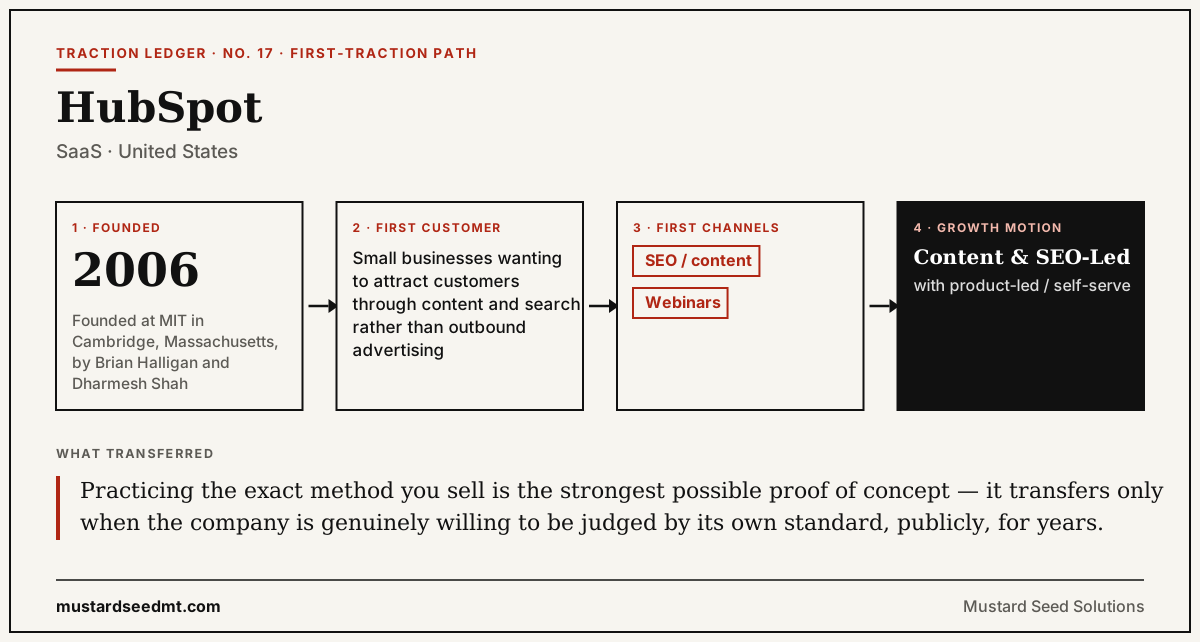
The Wedge: How HubSpot Got Its First Customers
HubSpot got its first customers by literally naming and evangelizing the category it wanted to sell into: Brian Halligan and Dharmesh Shah coined and popularized the term "inbound marketing" to describe attracting customers through useful content and search visibility, rather than interrupting them with outbound advertising.
The first buyers were small businesses without dedicated marketing teams, who had no existing internal expertise in SEO or content marketing and needed both the education and the software in one place — HubSpot supplied the concept, the free tools, and the paid platform together.
Founded at MIT in Cambridge, Massachusetts, by Brian Halligan and Dharmesh Shah (2006).
HubSpot's First Channel
The primary channel was HubSpot's own content, published prolifically on its own blog and distributed through free tools like Website Grader, which generated organic search traffic from exactly the small-business audience HubSpot wanted to sell software to.
This channel was recursive in a way few others in this ledger are: HubSpot practiced inbound marketing to sell inbound marketing software, meaning every piece of content that ranked or converted was simultaneously a product demonstration and a lead-generation asset.
The Motion: Content & SEO-Led
The monetization model was a tiered monthly subscription, priced by contact volume and feature access, structured so a small business could start small and grow into higher tiers as its own marketing list and needs grew.
Free tools and educational content (later formalized as HubSpot Academy) built trust and demonstrated expertise before any purchase conversation, softening the transition from free visitor to paying customer considerably compared to a cold sales pitch.
As the customer base and product matured, HubSpot added inside-sales support for larger accounts and expanded its own content operation significantly, but the underlying logic — earn attention with genuinely useful content, then convert it — remained constant.
The Turn
The turn was scope: HubSpot moved from being purely a marketing tool to a full "growth platform" spanning sales (a CRM) and customer service, betting that the same SMB customer who trusted HubSpot for marketing would consolidate more of their software stack under one vendor.
Era: 2005-2014
Where It Ended Up: Public (NYSE: HUBS) since 2014
What Transferred
"Practicing the exact method you sell is the strongest possible proof of concept — it transfers only when the company is genuinely willing to be judged by its own standard, publicly, for years."
Sources
Related Entries
Slack
An internal messaging tool built for one gaming studio's own team, released after the game itself failed.
Personal networkZoom
Reliable video calling built by a former WebEx engineer who thought existing video conferencing was too frustrating.
Freemium viralityZendesk
Simple customer support ticketing, self-serve from day one, built by three friends in Copenhagen.
Freemium virality