
The Wedge: How Basecamp Got Its First Customers
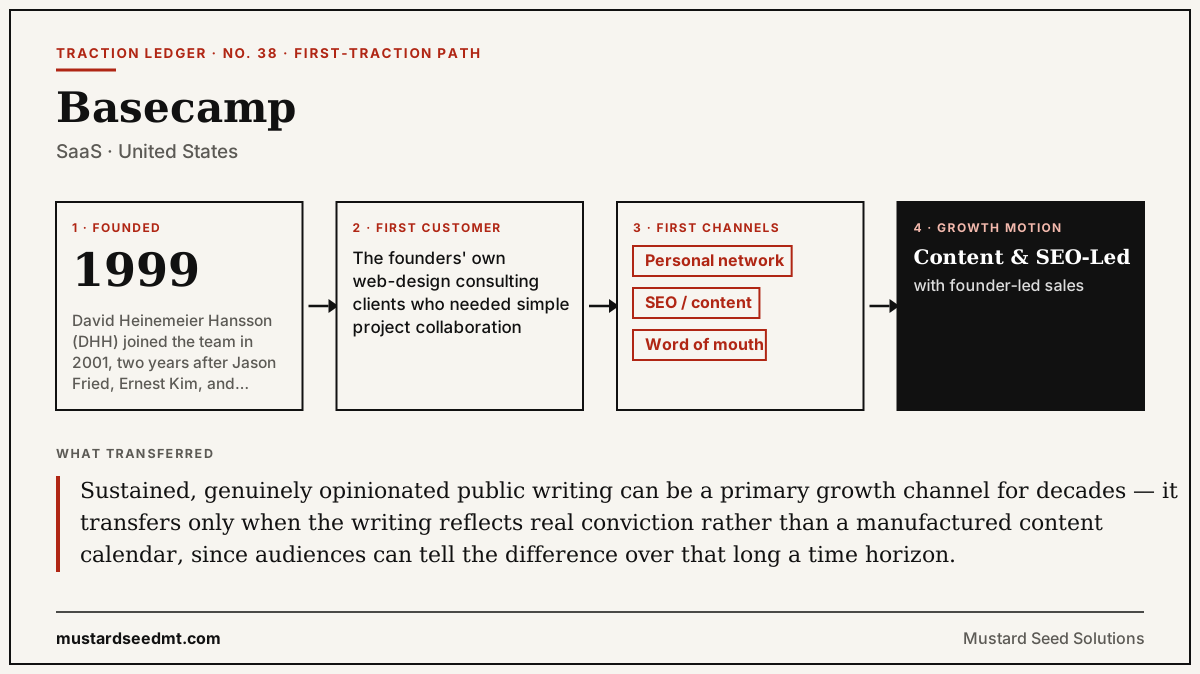
Basecamp shares Mailchimp's origin pattern almost exactly: it began as an internal tool built inside 37signals, a Chicago web-design consultancy, to help the founders manage their own client projects, before existing consulting clients asked to use the same tool themselves.
The first real Basecamp customers were, again, the consultancy's own existing client relationships — a direct, trust-based wedge rather than a cold market entry, matching the same origin mechanism seen elsewhere in this ledger among founders who built tools to solve their own agency's problems first.
David Heinemeier Hansson (DHH) joined the team in 2001, two years after Jason Fried, Ernest Kim, and Carlos Segura founded the company in Chicago, Illinois, as 37signals (1999).
Basecamp's First Channel
Beyond the initial client base, the defining channel was the prolific public writing of Jason Fried and David Heinemeier Hansson — through the Signal v. Noise blog and later books like "Rework" — which built a large, engaged audience of readers who admired the founders' opinions on business and work long before most of them were Basecamp customers.
That audience functioned as a large, ongoing top-of-funnel: readers who agreed with the founders' public thinking about how software companies and work itself should operate were predisposed to trust and eventually try the product those same people built.
The Motion: Content & SEO-Led
Pricing was deliberately simple and flat — a fixed monthly fee regardless of team size — a stance the founders wrote about publicly and repeatedly as a value in itself, distinguishing Basecamp from the per-seat pricing common elsewhere in this ledger.
Content, in Basecamp's case, wasn't SEO-optimized landing pages but genuine, opinionated public writing sustained over two decades, which is a materially different content strategy than most content-led entries in this ledger and one that's difficult to replicate without genuine, sustained conviction behind it.
As the tool's audience grew through this channel, the underlying consultancy business was eventually shut down entirely, since the software business had clearly outgrown the agency that spawned it — freeing the company to focus solely on the product and its own public voice.
The Turn
Two turns compound here: the shift from consultancy-with-a-side-tool to software-only business, and — a genuinely unusual byproduct — DHH's creation of the Ruby on Rails web framework while building Basecamp, which was open-sourced and became an enormously influential distribution channel for the company's engineering reputation, well beyond anything the product itself directly monetized.
Era: pre-2005
Where It Ended Up: Private; still independent, operating as 37signals
What Transferred
"Sustained, genuinely opinionated public writing can be a primary growth channel for decades — it transfers only when the writing reflects real conviction rather than a manufactured content calendar, since audiences can tell the difference over that long a time horizon."
Sources
Related Entries
Slack
An internal messaging tool built for one gaming studio's own team, released after the game itself failed.
Personal networkZoom
Reliable video calling built by a former WebEx engineer who thought existing video conferencing was too frustrating.
Freemium viralityHubSpot
The company that coined "inbound marketing," then used its own content to prove the concept worked.
SEO / content