
The Wedge: How Zapier Got Its First Customers
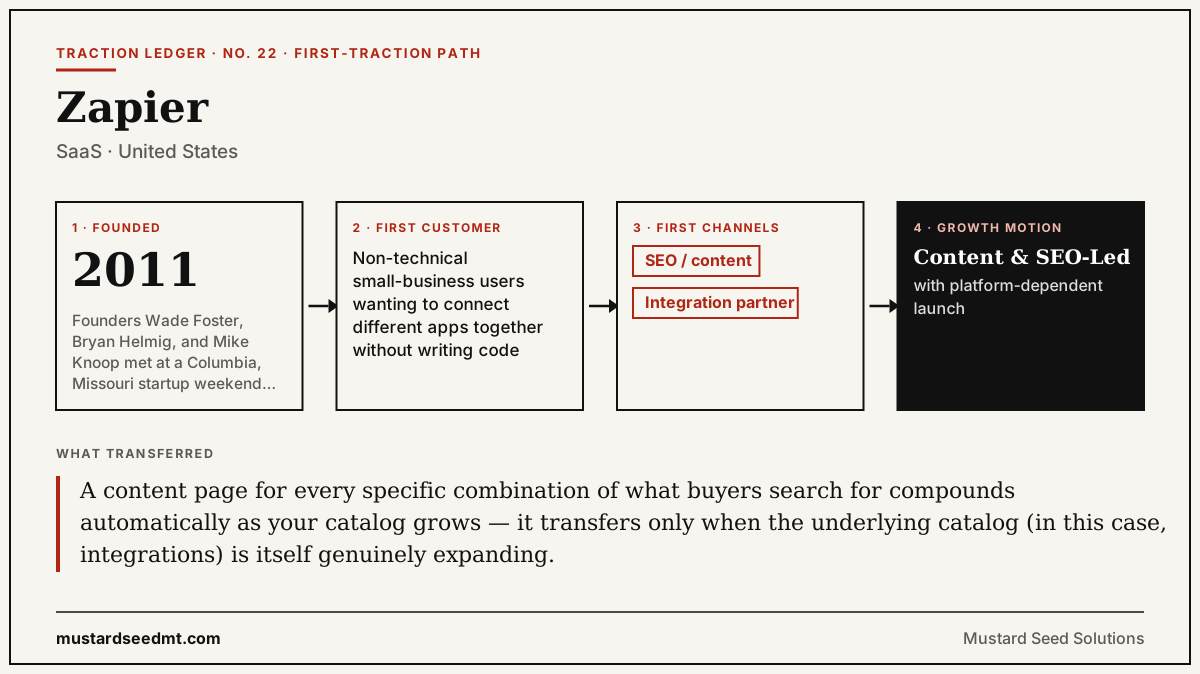
Zapier got its first customers by solving app-to-app automation for people who could not write code themselves — small-business owners and operations staff who wanted, for example, a new form submission to automatically create a row in a spreadsheet, without hiring a developer to build that connection.
The founders met at a startup weekend in Columbia, Missouri, and built the company as fully distributed from day one, a structural choice that shaped a broader, more geographically dispersed early customer base than companies concentrated in a single tech hub.
Founders Wade Foster, Bryan Helmig, and Mike Knoop met at a Columbia, Missouri startup weekend; the company has been distributed/remote since it was founded (2011).
Zapier's First Channel
The defining channel was long-tail search content: Zapier built and continuously expanded a dedicated landing page for every pair of applications it could connect ("connect X to Y"), capturing highly specific search intent from users already looking for exactly that integration.
This was reinforced by integration-partner relationships — being listed inside the app directories of the tools it connected to gave Zapier additional discovery surface directly inside the products its own users already worked in daily.
The Motion: Content & SEO-Led
The freemium model let a user automate a small number of tasks for free, with paid tiers unlocking higher monthly task volumes and more complex multi-step automations — pricing directly tied to the value delivered rather than to seats or features.
Because each supported app-to-app integration generated its own dedicated, indexable page, the total addressable search surface grew automatically as Zapier added support for more applications, compounding the content engine without a proportional increase in manual content production per page.
The non-technical target buyer meant the product itself had to do significant explanatory work — clear naming, straightforward setup flows — since there was no developer intermediary translating the value proposition for them.
The Turn — the motion held
The motion held. Zapier's core growth engine — a search-optimized page for every integration pair — scaled in direct proportion to the number of supported applications for well over a decade, without requiring a fundamentally different channel as the company matured.
Era: 2005-2014
Where It Ended Up: Private; still independent
What Transferred
"A content page for every specific combination of what buyers search for compounds automatically as your catalog grows — it transfers only when the underlying catalog (in this case, integrations) is itself genuinely expanding."
Sources
Related Entries
Slack
An internal messaging tool built for one gaming studio's own team, released after the game itself failed.
Personal networkZoom
Reliable video calling built by a former WebEx engineer who thought existing video conferencing was too frustrating.
Freemium viralityHubSpot
The company that coined "inbound marketing," then used its own content to prove the concept worked.
SEO / content