
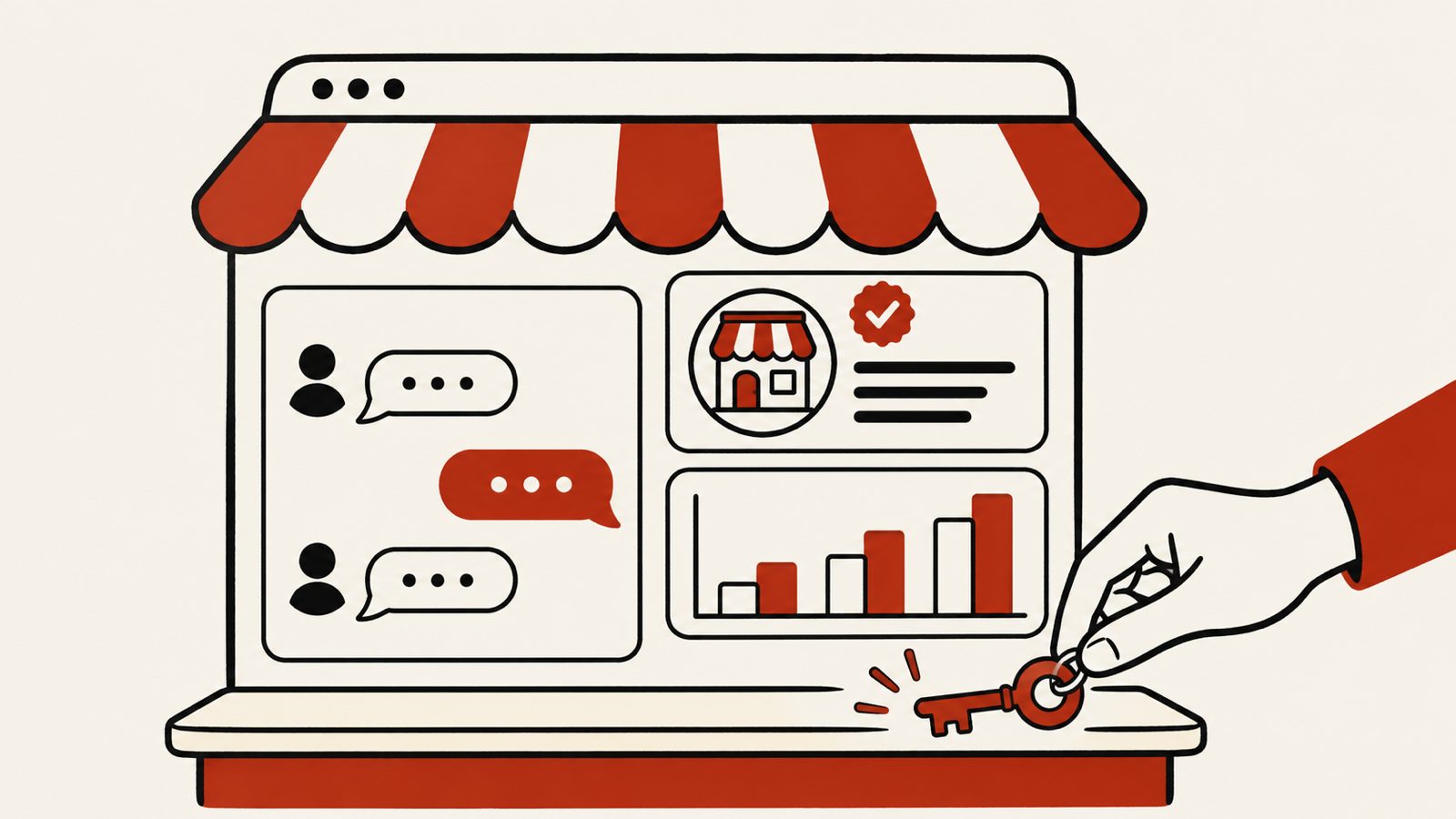
On 10 November 2026, OpenAI launched Businesses in ChatGPT in beta, centered on ChatGPT Business Hub. In our view, B2B technology companies should claim and verify their profile now, check how ChatGPT describes them, and align those details with their website. Business Hub gives useful first-party mentions, clicks, and discovery topics, while Business Agents remain limited to U.S. ecommerce and online services.
What OpenAI launched on 10 November 2026
OpenAI announced Businesses in ChatGPT on 10 November 2026 as a way for companies to reach the 1.2 billion people OpenAI says use ChatGPT each week. The release has two parts: Business Hub for managing company details and reading engagement metrics, and Business Agents for direct customer chats inside ChatGPT.
In TechCrunch's coverage on 10 November 2026, the publication said the profiles closely resemble the ones Google and other search engines already offer, and compared the insights to Google Analytics. TechCrunch also noted that OpenAI previously tried to build a direct checkout cart inside ChatGPT using commission fees, before retiring that effort in March.
Eligibility for ChatGPT Business Hub is wide. OpenAI states that any eligible business located where ChatGPT is available can claim its organization in Business Hub, and Trending Topics notes this includes Europe. Existing OpenAI Enterprise customers and advertisers can work directly with their OpenAI representative to claim their business, while Shopify merchants can connect their store from Business Hub or the Shopify admin.
Claim and verify your business in ChatGPT
For B2B software teams, claiming the profile is the first practical step, even if you do not sell through ecommerce. Once verified in Business Hub, a company can update key details and add self-service product feeds with pricing and availability.
OpenAI has not published a step-by-step public checklist for verification. TechCrunch reported on 10 November 2026 that the formal verification process was not detailed, though OpenAI VP of Monetization Benji Shomair told journalists there are "multiple verification methods that we use for different types of business in different markets."
We think technical software companies should go through the claim and verification flow now rather than waiting for full self-service tooling to mature. Taking ownership of the organization record puts you in control of the core facts ChatGPT holds about your business. If you are an existing OpenAI Enterprise customer or advertiser, reaching out to your OpenAI account representative is the direct route OpenAI recommends.
Check how ChatGPT describes you and match your website
Before editing fields inside ChatGPT Business Hub, run a baseline check on what ChatGPT already says about your company, your product categories, and your ideal buyers. Compare those answers against the positioning on your main website.
Consistency between your Business Hub profile and your website matters for B2B buyers evaluating technical products. When prospects ask follow-up questions or click through to your domain, mismatched descriptions create friction. Keep your company summary, product names, and availability statements aligned across both places.
If ChatGPT misses key pages or cites outdated documentation, the cause can sit in how your site is crawled and structured. Our guides on AI crawlers across ChatGPT, Claude, Gemini, and Perplexity and how ChatGPT and Perplexity rank sources cover how technical B2B sites can make their core pages easier for answer engines to read and cite.
OpenAI describes the 10 November 2026 launch as an early step, noting plans to build tools for organizations with more complex needs over time. Setting a clean, accurate baseline now prepares your team as those enterprise features roll out.
Use mentions, clicks, and discovery topics as a first-party read
Once your profile is claimed, ChatGPT Business Hub provides aggregated insights into how people engage with your business in ChatGPT. OpenAI lists three main areas: the number of mentions, website clicks, and discovery topics, which are common themes across conversations where your website is cited. TechCrunch also noted profile views among the metrics available in the hub.
OpenAI states that these insights are designed to protect user privacy. User conversations and Business Agent chats are not shared with companies, and metrics are aggregated and shown only when interactions pass minimum conversation thresholds. Trending Topics also notes that the metrics in Business Hub relate to organic answers.
Our advice is to treat Business Hub as a useful first-party signal. Mentions show how often your brand appears in ChatGPT answers, website clicks show whether those citations send traffic, and discovery topics show which buyer themes are linked to your domain. Comparing discovery topics against your target use cases helps you spot gaps in your public product content.
What ChatGPT Business Hub leaves out
While Business Hub gives direct usage data from ChatGPT, it has clear boundaries that B2B marketers need to account for. Trending Topics reports that Business Hub covers ChatGPT only, leaving out Gemini, Perplexity, Claude, and Google's AI Overviews.
Business Hub also provides neither the specific prompts that triggered a mention nor competitor comparisons. Trending Topics notes that SEO experts such as Matthäus Michalik have criticized the absence of prompt-level visibility.
Third-party GEO tracking still has a clear job for technical software companies. Business Hub tells you what happens organically inside ChatGPT above OpenAI's privacy thresholds, while third-party tracking remains necessary if you want to monitor other AI answer engines, test specific buyer prompts, or benchmark your visibility against competitors.
Why Business Agents do not apply to most B2B software firms yet
The second half of OpenAI's 10 November 2026 announcement is Business Agents, which allow eligible organizations to build, test, and launch an agent inside ChatGPT. When a business appears in a model response, users can open its profile and start a chat with the agent to ask questions about offerings. OpenAI states that these agent conversations are clearly labeled and kept separate from the user's original ChatGPT conversation and from ChatGPT's independent answers.
Companies can also sponsor their Business Agent as the destination for ChatGPT Ads. Trending Topics notes that OpenAI has been testing ads in the U.S. since February, reached an annualized revenue run rate of $1 billion in September according to OpenAI, and reported more than 100,000 advertisers in 89 countries in October. We have also covered how ChatGPT Ads expanded across 31 European markets for B2B teams tracking paid visibility.
Trending Topics also points out an important distinction: Business Agents are separate from ChatGPT's Workspace Agents, which companies use to automate internal workflows under subscription plans.
For most B2B software companies, Business Agents are off the table for now. OpenAI specifies that Business Agents are currently available only to eligible ecommerce and online service businesses in the United States. Companies outside the U.S., and B2B software vendors with complex enterprise sales motions, cannot launch one yet. Our recommendation: focus on claiming their Business Hub profile and monitoring organic discovery topics while watching for OpenAI's planned expansion to more markets and business categories.